
The Rice and the River
A Year in a Medieval Bengali Village

A Year in a Medieval Bengali Village
Picture a village called Nadiapur, tucked along the banks of the Bhairab River in medieval Bengal, where the days unfold with the sun and the seasons dictate every bite we eat. I’m Ananta, a weaver’s son, barely sixteen, with hands already calloused from gathering reeds and hauling nets. Our lives here aren’t the stuff of ballads—no heroes or battles—but they’re real, shaped by the food we scrape together and the stories we share under the stars. Let me take you through a year in Nadiapur, where every meal tells a tale of survival, community, and the land we call home. This is for you, listening by the fire, as if we’re passing a plate of warm bhaat in the glow of a clay lamp.
Spring: The Awakening Earth
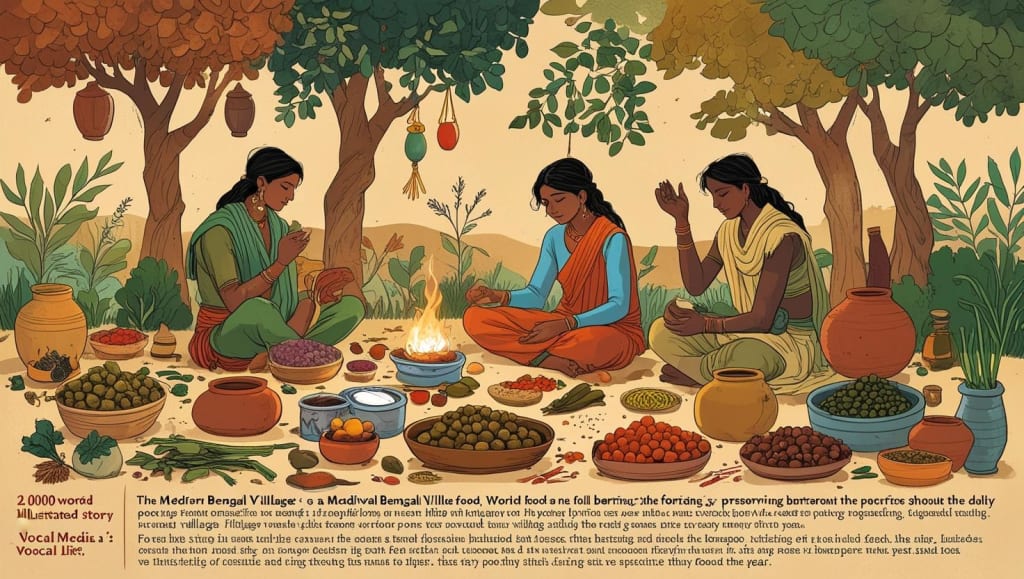
Spring paints Nadiapur green. The river sparkles, and the rice paddies hum with new shoots. My father, Baba, sits at his loom, weaving coarse cloth for the village, while Ma tends our small plot, sowing seeds saved from last year’s harvest. Mornings start early, with a bowl of rice porridge—bhaat thinned with water, flavored with a pinch of salt if we’re lucky. Foraging is our first task. My younger brother, Kesto, and I slip into the forest at dawn, baskets slung over our shoulders. We hunt for shak—wild greens like pui or notey—and sometimes find kathal seeds, chewy and nutty when roasted. Ma taught us which plants are safe, her voice sharp as she points out the poisonous ones: “Touch that, Ananta, and you’ll be sick for days.”
Food is simple but precious. Midday, we might have dal—lentils boiled over a fire of dried twigs, maybe with a single green chili for heat. Fish is a treasure. The river gives us koi or shingi, caught in nets Kesto and I help repair. A good catch means a curry, thick with sour tamarind from the tree behind our hut. But meat is rare; only the zamindar’s men hunt boar or deer, and their feasts don’t reach us. Instead, we barter—Baba’s cloth for a neighbor’s rice, or Ma’s woven baskets for a handful of jujube fruits.
Preservation starts now. We dry fish in the sun, their scales glinting like silver coins, and store them in clay jars. Rice is husked and kept in woven sacks, guarded from rats. The women, led by my aunt Jaya, pickle green mangoes with mustard oil, the jars sealed tight for leaner days. Every meal is a plan, every bite a step toward tomorrow. By evening, we sit on the mud floor, sharing a plate of rice and shak bhaji. Baba tells stories of the river’s spirit, said to dance in the moonlight. The food is plain, but the stories make it rich.
Summer: The Sun’s Heavy Hand
Summer burns Nadiapur. The river shrinks to a trickle, and the paddies turn to dust. Hunger creeps closer. Breakfast is chira—flattened rice—soaked in water with a few wild berries Kesto finds. Foraging becomes a test of endurance. We trek deeper into the forest, dodging thorns and heat, to dig for yam or gather thankuni leaves for a bitter salad. The women lead, their songs keeping us moving. Aunt Jaya knows every root, every leaf, her hands quick as she plucks kolmi shak from marshy patches.
Midday meals are sparse—a handful of rice with a watery dal, or maybe just boiled greens. Fish are scarce; the river’s too low for nets. Sometimes, a neighbor shares a chingri prawn, and we repay them with Baba’s cloth or my help repairing their roof. Barter binds us. Once, we traded a bolt of Baba’s finest weave for a goat kid, named Chhoti, whose milk became our pride. Evenings bring relief, with the village gathering around a shared fire. Ma fries kumro flowers, crisp and golden, or boils keshur—water chestnuts—when we find them. We eat slowly, savoring each bite, while the elders spin tales of floods that drowned whole villages or traders who brought spices from lands we’ll never see.
Summer teaches patience. We ration our rice, mix it with greens to stretch it, and check our stores daily. The dried fish dwindle, but Chhoti’s milk keeps us strong. One night, as we ate under a banyan tree, old man Haru spoke of his father’s time, when drought drove men to eat bark. His words hung heavy, a reminder of why we save every grain.
Monsoon: The River’s Wrath and Gifts
The rains come, and Nadiapur drowns in green. The Bhairab River roars, flooding fields but filling our nets with fish—magur, pabda, even eels that slip through our fingers. Kesto and I wade in, laughing as we set traps, the water cool against our skin. A good catch means a feast: fish curry with green mango, the sourness cutting through the muggy air. We share it with neighbors, crowded in our hut, the rain drumming on the thatch.
But the monsoon betrays as much as it gives. One year, the river swept away half our paddy. We ate soggy rice and boiled kochur loti, the starchy stems a gift from the flooded fields. Foraging stops; the forest is a swamp. Instead, we gather water chestnuts or shapla lilies, their roots chewy and filling. Ma makes a thin soup with whatever greens we have, and we drink it slowly, warming our hands on the bowls. Preservation is urgent. We dry fish when the rain pauses, and Lila, my cousin, helps Ma pickle amra fruits in clay jars. Baba’s cloth is traded for salt—a rare treasure—and we sprinkle it into our curries, tasting the sea we’ve never seen.
Evenings are for stories. We crowd into the headman’s hut, the only one safe from floods, and share a pot of rice and fish. The men talk of Mughal tax collectors who passed last year, their horses kicking up mud. The women whisper of the river goddess, angry when we take too much. Food ties us to these tales, each shared meal a thread in Nadiapur’s fabric.
Winter: The Harvest’s Warmth
Winter is Nadiapur’s reward. The fields dry, and the rice stands tall, golden under the sun. We harvest as one, singing songs of the earth’s bounty. The first meal after is a celebration: rice heaped high, dal thick with ghee from Chhoti’s milk, and a fish curry with fresh dhone pata from Ma’s garden. We eat on banana leaves, the air crisp, our laughter louder than the river’s murmur.
Foraging is lighter now. The forest gives ber fruits and mushrooms, and Kesto and I race to find the best ones. Barter thrives—a bolt of Baba’s cloth for a neighbor’s yams, or a basket of Ma’s pithe for a jar of jaggery. At poush parbon, the harvest festival, we make rice cakes stuffed with coconut, steamed over fires that light up the night. The women sing, their voices weaving with the smoke, while Baba tells me of his grandfather, who saw a Portuguese ship on the river, its sails like clouds.
Winter meals are generous but never wasteful. We store extra rice in clay pots, dry fish for the next lean season, and bury roots in cool earth. Every bite feels like a promise kept, a victory over the year’s hardships.
The Heart of Nadiapur
Life in Nadiapur is no saga of kings, but it’s ours. Our food—rice, greens, fish, roots—is the land’s voice, shaped by our hands. Foraging is our skill, barter our bond, preservation our hope. Each meal is a story, each shared plate a vow to endure. As I tell this by the fire, the warmth of bhaat in my hands, I see Nadiapur’s heart: not in grand deeds, but in the quiet work of feeding each other. That’s our tale, simple and true, carried on the river’s current.
About the Creator
Shohel Rana
As a professional article writer for Vocal Media, I craft engaging, high-quality content tailored to diverse audiences. My expertise ensures well-researched, compelling articles that inform, inspire, and captivate readers effectively.
Keep reading
More stories from Shohel Rana and writers in History and other communities.
The Hearth of Habiganj
A Medieval Bengali Village Story In the heart of medieval Bengal, where the Meghna River curved like a silver thread through endless green, lay the village of Habiganj. It wasn’t a place of kings or conquests, but of muddy paths, straw roofs, and lives woven into the seasons’ rhythm. I’m Shyamal, a potter’s son, and this is my tale of a year in our village—our food, our struggles, our small joys. It’s no epic, but it’s ours, told as if we’re sitting by the fire, passing a clay plate of rice and stories.
By Shohel Rana6 months ago in History
Firoun: The Tyrant Who Defied God
Firoun, known to history as Pharaoh, was not just a king—he was a symbol of absolute power. He ruled over ancient Egypt at a time when the Nile flowed generously, the granaries were full, and massive stone monuments rose toward the sky. To his people, Firoun appeared invincible. To himself, he was more than human.
By The best writer 2 days ago in History


Comments
There are no comments for this story
Be the first to respond and start the conversation.