
The Red Baron: Chronicle of a Destiny Forged at Full Speed
A Destiny Suspended Between Glory and Shadow

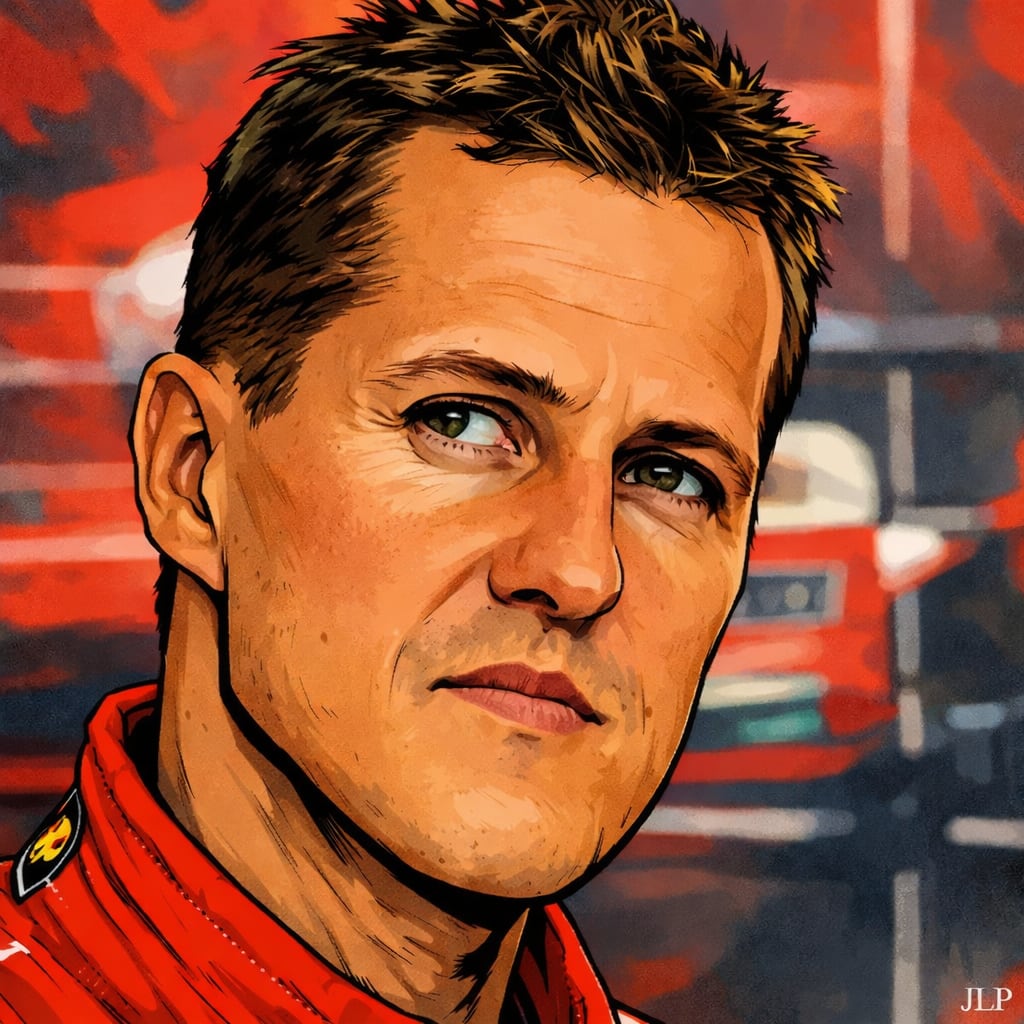
Some destinies flourish under the spotlight, carried by charisma and collective enthusiasm. Others are built in the shadows, through relentless repetition, obsessive detail, and stubborn silence. Michael Schumacher belongs to the latter. He never embodied the romantic hero who captivates crowds with theatrics. He wasn't chasing popular affection. What he pursued was far more demanding: total, absolute mastery.
He was nicknamed the Red Baron, evoking a flamboyant aristocrat draped in Ferrari's legendary red. Yet this nickname says more about others' projections than about the man himself. Schumacher had nothing flamboyant about him. He was precise, calculated. He didn't flirt with risk; he tamed it. Where some drivers turned racing into instinctive poetry, he made it a scientific equation applied to body and machine.
He hated chaos, unpredictability, and above all, depending on factors beyond his control.
From early on, he understood that raw talent is just a starting point. A spark, not a guarantee. The real difference comes from endlessly repeating a gesture until it becomes unassailable. From persevering when others give up. From cold analysis where others rely on intuition. This near-ascetic rigor became his foundation, his deepest identity.
On the track, it revolutionized the role of the driver. Schumacher didn't just pilot a fast car; he demanded that the entire environment align with his vision: engineers, mechanics, strategies, physical preparation. He instilled a culture of the absolute, where chance had no place, where every parameter was optimized. With him, Formula 1 transcended sport to become a perfect system.
But even the most solid systems have a blind spot.
May 1, 1994, shattered everything. Not just Formula 1, but Schumacher himself. At Imola, the myth of invincibility collapsed. Ayrton Senna, the untouchable idol, the divine driver, crashed into the wall at Tamburello. Schumacher was among the first on the scene. He saw the horror. He understood it wasn't an ordinary accident.
That weekend was cursed: Barrichello narrowly escaped death the day before, Ratzenberger met it on Saturday. And now Senna, inert in his car. Safety, technical advances—none of it sufficed to indefinitely repel death.
Schumacher didn't collapse in public. No screams, no dramatic gestures. Many saw it as coldness. They were wrong: the lack of visible emotion doesn't erase trauma. In him, the shock buried itself, turning into silent force.
From then on, his relationship with the world changed. Death was no longer theoretical; it bore the face of his greatest rival. The victories that followed carried a secret bitterness: triumphing without truly facing the king meant reigning over an empty throne.
This survivor's guilt, he never admitted it. He managed it his way: more control, more work, more distance. The inner fortress strengthened. Outwardly, he seemed almost superhuman. Inside, the wound festered.
Years later, when Senna's name brought uncontrollable sobs on camera, the world glimpsed the crack. These weren't nostalgic tears, but delayed ones—the overflow of an event contained too long.
Ferrari then became his refuge, his ground for reconstruction. Not for the fastest car, but to build a predictable universe aligned with his visceral need for order. The years of domination weren't romantic epics, but flawless executions. He won without frills, crushed without seducing. The public divided: admiration, hatred, boredom. All agreed on one thing: he was elsewhere.
This quest for absolute mastery bred a perilous illusion: believing the track's rules applied to the real world. That expertise cancels chance. That experience always minimizes risk. It wasn't arrogance; it was logical extrapolation, a common flaw in great experts.
Skiing wasn't an extreme challenge for him. He knew the mountain, read the terrain, sought fluidity over adrenaline. That day in December 2013 at Méribel, nothing exceptional: a routine off-piste passage, no reckless attack.
The rock, hidden, doesn't negotiate.
The fall was lightning-fast, the impact violent. The head struck at the perfect angle to cause irreversible damage. The helmet cracked, proof of force the body couldn't absorb unscathed. In an instant, decades of construction crumbled against the unpredictable.
The story of the camera mounted on the helmet fueled speculation: an aggravating factor? Investigations proved nothing decisive. With or without it, the outcome could have been the same. The brain remains fragile to brutal decelerations.
Since then, Schumacher exists in suspended time. Sheltered from view, protected by his loved ones. His precise condition remains private, and this silence isn't a tactic: it's the logical continuation of a life built on restraint. He tolerated scrutiny as long as he dominated. Fragility, no.
This muteness unsettles us, depriving us of closure, of a finished story. Yet it may be the most authentic ending for a man who always refused to be reduced to an icon.
The Red Baron didn't fall for going too fast.
He fell because he thought speed, once understood, could be tamed everywhere.
The silence surrounding Michael Schumacher since the winter of 2013 isn't a void. It's charged: with our projections, our speculations, but above all with what our era tolerates least—the absence of a complete narrative. We want to know everything, see everything, as if glory granted eternal access to private life.
But Schumacher was never ours. He merely occupied our attention.
Even before the accident, he was fading gently: fewer interviews, a fortified intimacy. Where others prolong their media aura, he anticipated voluntary oblivion. Out of coherence, not fear.
His family ties illuminate this: discreet in public, but profoundly loyal. Protecting his condition today isn't rejecting fans; it's the ultimate expression of his personal sovereignty.
In an age of forced transparency, this choice borders on rebellion.
What disturbs us most isn't the absence, but the lack of a clear ending. Modern heroes die live or confess endlessly. Schumacher lingers in limbo: neither gone nor fully present. A gray zone we struggle to accept.
We'd almost prefer a neat tragedy, an epilogue. Life drags on, suspends, forces us to accept unfinished stories.
This is perhaps the most troubling lesson of his destiny: it compels us to abandon the heroic myth. To admit that an absolute master of control could slip into silent dependence, without tarnishing either his past greatness or his present dignity.
Formula 1 moved on, incorporating 1994's lessons: enhanced safety, more reliable cars. The sport progresses often after catastrophe. Schumacher, even in shadow, contributed by reminding that zero risk doesn't exist.
Today's drivers evolve in a safer, smoother world. Some miss the Schumacher era without grasping its cost. His domination wasn't just mechanical superiority; it belonged to a time when danger was still accepted.
Today, F1 is cleaner, more controlled. Yet fascination with the Red Baron endures. Because he embodies what fades: the complete champion—driver, tactician, tireless worker, shadow among shadows. Without ready-made discourse, without posture.
The bond with Senna still haunts it all. Their paths remain intertwined beyond rivalry. Senna embodied faith, pure instinct. Schumacher, patient method. One raced as if praying; the other as solving an equation.
Senna's death carved a void Schumacher never symbolically filled. He forged his own path. But the inner cost remained hidden, except in those rare captured breakdowns.
Delayed trauma strikes harder. It seeps in, waits, resurfaces. In Schumacher, it manifested as heightened rigidity, a fiercer rejection of the unforeseen. Irony: it struck outside his mastered domain.
Let's insist: he wasn't reckless, nor drawn to gratuitous thrills. Those who knew him describe a cautious, measured, thoughtful man. But expertise sometimes creates the subtle illusion of full transferability. What is tamed here will be elsewhere.
The mountain reads, but doesn't negotiate. It doesn't adjust, doesn't communicate. It dictates.
Méribel wasn't a moral failure, nor a hidden message. Just a pure accident: without intent, without lesson. And that's what makes it so hard to swallow. We always seek meaning; Schumacher forces us to accept the absurd.
His name still circulates in tributes, comparisons, statistics. The man himself is elsewhere. In slow time, protected, surrounded by those for whom he was never a symbol, but a husband, father, loved one.
We wonder: what is his true state? Conscious? Capable of recognizing, understanding, feeling? These questions are human, but they don't belong to us. They belong to those watching without cameras.
Perhaps Michael Schumacher's final lesson isn't sporting. Perhaps it's ethical: the right to silence. The right not to monetize suffering. The right not to reveal everything.
The Red Baron remains one of the greatest drivers ever. But reducing him to his titles would be mistaken. His true singularity lies elsewhere: in that absolute faith that the world could be understood, structured, dominated through rigor. A faith that took him to the summit, and paradoxically makes his fall all the more poignant.
His destiny teaches no moral. It simply recalls an ancient truth that technological societies forget: human mastery always hits a limit. And that limit never announces its arrival.
The Red Baron lived at full throttle.
He now lives in a silence beyond us.
And perhaps that's, in the end, his ultimate victory.
JLP
About the Creator
Laurenceau Porte
Chroniqueur indépendant. J’écris sur l’actualité, la société, l’environnement et les angles oubliés. Des textes littéraires, engagés, sans dogme, pour comprendre plutôt que consommer l’information.
Keep reading
More stories from Laurenceau Porte and writers in History and other communities.
We Live Longer, But We Live Sicker
We have gained years. Sometimes entire decades. Thanks to scientific advances, more precise treatments, and systematic screenings, life expectancy has steadily risen. The demographic curves show it clearly: we are pushing death further back, generation after generation. This is an undeniable victory for modern medicine.
By Laurenceau Porte29 days ago in Longevity
Power's Sake
When it comes to gaining power, bad people use it to gain more They never gain power to do something with it, they gain power to have it, relish in it, double it down on itself so it grows exponentially and never goes anywhere. Even if you see the people in power commit an atrocity, that is never the true goal. It is a deplorable action for sure but the action itself usually doesn't matter it's the outcome.
By Donny Foley5 days ago in History
How Case Documents Are Maintained in Philadelphia County
Case documentation forms the backbone of judicial accountability in Philadelphia County. Every filing, order, transcript, and judgment plays a defined role in preserving procedural accuracy and historical reference. The methods used to preserve these materials reflect long-standing legal standards combined with structured administrative practice. This article explains how case documents are created, organized, stored, reviewed, and preserved within Philadelphia County, with a clear focus on factual processes rather than commentary or promotion.
By Owen Perryabout an hour ago in History
Miss Persephone's Manual to a Seemingly Ordinary Life
Miss Persephone was found at the dining table, her blue eyes swollen, her tears arriving and retreating like the tides of the ocean. Earlier that day, her family had visited her in the retirement home where she had lived for eight years. It was her eightieth birthday.
By Imola Tóth3 days ago in Fiction



Comments
There are no comments for this story
Be the first to respond and start the conversation.