
The REAL Story of Atlantis and How It CHANGED The World
The Real Story of Atlantis
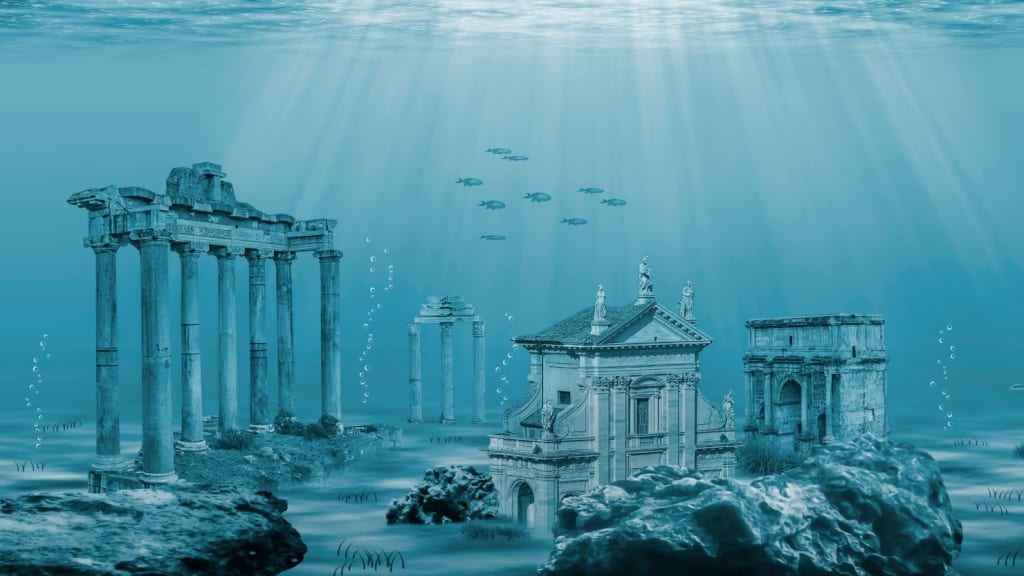
Hey guys,
You know, despite knowing more about our past now than we ever have before, there’s still a rich history of ancient civilizations that remains undiscovered.
From the unexplained knowledge of the Mayans, to the incredible structures built by the Egyptians- there’s still so much more to learn and one of the biggest mysteries that remains is that of Atlantis.
Stories have been told of the sunken city for more than 2000 years, but is the holy grail of archaeology a myth?
Or is there truth to the idea of an advanced civilization that fell victim to the waves?
So in this video, we're going to dive into Atlantis and try to figure out the real story.
The first records that mention Atlantis were the two Socratic dialogues called Timaeus and Critias.
They were written by Plato, the Greek philosopher, at around 360 BC, and were for a speech to be given during festivities in honor of the goddess Athena.
The dialogues told stories that Socrates had supposedly heard from guests about how ancient Athens interacted with other independent states, with one story in particular coming from a man called Critias.
This man shared the tale of the experience of his grandfather who had met the Athenian poet Solon, who himself had visited Egypt and spoken with the local priests.
There the Priests told of a powerful ancient civilization that was based on an island in the Atlantic Ocean, that ruled over several other islands as well as lands across Africa and Europe.
The city was built in concentric rings of land and water, with elaborate baths, a huge harbor, and well equipped barracks.
The Atlantians’ knowledge of engineering was second to none, with a canal network and irrigation system that created lush, fertile lands where they could grow whatever they wanted.
Their society was structured like many others at the time, with Kings, a civil administration, and a formidable military.
Their power led them to seek further fortunes, though, and they waged a war across the rest of Asia and Europe.
At the time, Athens was the only state who had the resources to stand up against this invasion, and was able to repel the attacks.
Soon after this, earthquakes and floods caused Atlantis to be swallowed up by the sea and lost forever.
So now we gotta ask, is this story fact or fiction?
Well, the way that Plato used the story of Atlantis in his speech has led most historians to believe that it was simply a way to prove a point.
The idea of an all-powerful aggressor being fended off by a weaker force is a classic tale of hope in the face of adversity.
It has been suggested that the barbarian-like behavior of the Atlantians is actually a reference to the acts of the Persians or Carthaginians at the time, and the idea of an island violently disappearing could have been inspired by the eruption of Minoan Santorini, which took place at around 1600 BC, and destroyed the island of Thera, and majorly impacted settlements on nearby Crete, with consequences felt as far away as Egypt.
There are, however, those who think Plato’s writings were much more accurate historical records than they may initially seem.
Because he, himself, said that it was a true story- and even gave a precise date as to when Atlantis fell to the waves.
His record of events stated that Solon, who lived 200 years earlier, had directly asked an Egyptian priest in the city of Saïs when it had happened.
He said, according to writings on the walls of the temple, that it was 9,000 years previously, which puts the date at around 9,600 BC.
Now, this is a rather precise date, and actually coincides with a massive geological phenomenon that happened at around that time.
Known as “Meltwater Pulse 1b”, which was a global event that was triggered by the release of water from the ice sheets in the poles, and saw a sea level rise of about 14 meters.
Evidence of this event has been found in the Caribbean, the Mississippi river, the Gulf of Mexico and across the world, and would have been more than enough to destroy low lying island communities.
So now let's talk a little about the Egyptian link of Atlantis....
The Egyptian Atlantis must have lasted long enough in history that it is part of Egyptian culture.
Funerary texts mention it quite often.
Indeed, the Egyptian Atlantis "Aha-Men-Ptah" corresponds to the West.
It also means "The West" in Egyptian, and west is also where you bury the dead.
We see that the idea remains that when you go towards the West, there were many deaths.
Of course there’s still plenty that’s not fully understood about Ancient Egypt, in particular how they built the pyramids, and even the Sphinx.
At the time, the pyramids were covered in white limestone, which has since fallen away, but could there be a clue in some early descriptions of Atlantis?
Because it was referred to by some as the ‘white island’, and described as having numerous pyramids.
And of course, there are a lot of reseaerchers around the world that claim that the pyramids are a lot older than people think.
Also in 1850, the “Inventory stela” was discovered in the ruins of the Temple of Isis by Auguste Mariette.
The writing states: “Long live The King of Upper and Lower Egypt, Khufu, given life He found the house of Isis, Mistress of the Pyramid, by the side of the hollow of Hwran (The Sphinx)” And goes on to say.
“He restored the statue, all covered in painting, of the guardian of the atmosphere, who guides the winds with his gaze.” So, although controversial, this suggests that the Pharaoh Khufu, famous for building structures such as the Great Pyramid and the enigmatic Sphinx, merely discovered it and restored it.
Now, the Egyptians and Greeks aren’t the only to have texts that mention Atlantis.
The Berber tribes from North Africa, for example, describe a powerful ancient city called “Attala”, the Vikings spoke of “Atli”, and the Babylonians mentioned “Arallu” in texts.
There’s even record of the city from India, written in Sanskrit.
They believed that the city was lost during a war between the Gods and the Titans, and gave names to the different stages it went through during the onslaught- “Saka-dvipa” in its early stage, “Sveta-dvipa” which means “White Island”, and then “Ruta” and “Daitya” which refer to the two small islands that remained after the majority of the city was submerged.
So now let's talk about physical evidence.
There are numerous remains found underwater around the world, as countless settlements have been lost to the sea over time.
Mysterious structures have been found off the coast of Japan, in the Mediterranean sea, and there’s another theorized lost island known as “Mu” which is thought to be in the Pacific ocean.
As far as remains found in the Atlantic ocean go, there are a few candidates that could be the true Atlantis.
Large underwater structures that were built by long lost civilizations have been found off the coast of Africa near other island outcrops like the Canary islands.
And some say that this is the final resting spot of Atlantis, or maybe it’s still out there in a completely different location, still waiting to be found.
Atlantis is almost a catch-all term for trying to find the origins of civilization itself.
This probably goes back to the 19th century when the US congressman by the name of Ignatius Donnelly wrote a book that was to become the seminal work on Atlantis.
It was entitled "Atlantis The Antedeluvian World".
And in here, what he proposed was that all of the civilizations of the ancient world and the new world, the Americas, had a mother civilization as it's source.
All of the information that's been left to us on Atlantis by Plato, the Greek philosopher, who wrote around 350 BC, suggests that we should be looking for Atlantis somewhere in the area of the Bahamas and the Caribbean.
But, because of Ignatius Donelly's ideas to do with the mother civilization, Atlantis therefore becomes this concept more than an actual drowned city.
I believe that Atlantis existed, I believe that a high culture probably peopled those massive islands of the Bahamas and the Caribbean, and they may well have been drowned, destroyed, in the Great Cataclysm, the so called Younger Dryas event.
Despite having been part of legend for thousands of years, there’s still no definitive answer that Atlantis never existed.
Was it a highly advanced society that ultimately fell victim to natural forces?
Well, as we talked about, there’s compelling evidence to suggest that there were powerful island states at the time and this city, of course, would have been a powerhouse of the ancient world.
But really the only thing we know for sure- the ocean is insanely vast, and as much as 95% is unexplored, so there are bound to be treasures just waiting to be discovered - so, who’s to say that Atlantis can’t be one of them?
And the likelihood of an ancient advanced civilization existing is something I 100% believe in.
But again, let me know what you think in the comments.
Thank you all so much for watching this video , I'll see you later.
About the Creator
Keep reading
More stories from TBH Agencia Exclusiva Colsanitas and writers in History and other communities.
Are Banks Open on Martin Luther King Jr. Day?
Introduction Martin Luther King Jr. Day, also called MLK Day, is a national holiday in the United States. Many people enjoy a day off from work or school on this day. However, a common question people ask is: Are banks open on MLK Day?
By Farhan Sayedabout 12 hours ago in History
Power's Sake
When it comes to gaining power, bad people use it to gain more They never gain power to do something with it, they gain power to have it, relish in it, double it down on itself so it grows exponentially and never goes anywhere. Even if you see the people in power commit an atrocity, that is never the true goal. It is a deplorable action for sure but the action itself usually doesn't matter it's the outcome.
By Donny Foley6 days ago in History



Comments (2)
This is so interesting
Nicely done it.