
The Radical Life and Stoic Death of W.T. Stead
The man who weaponised the media

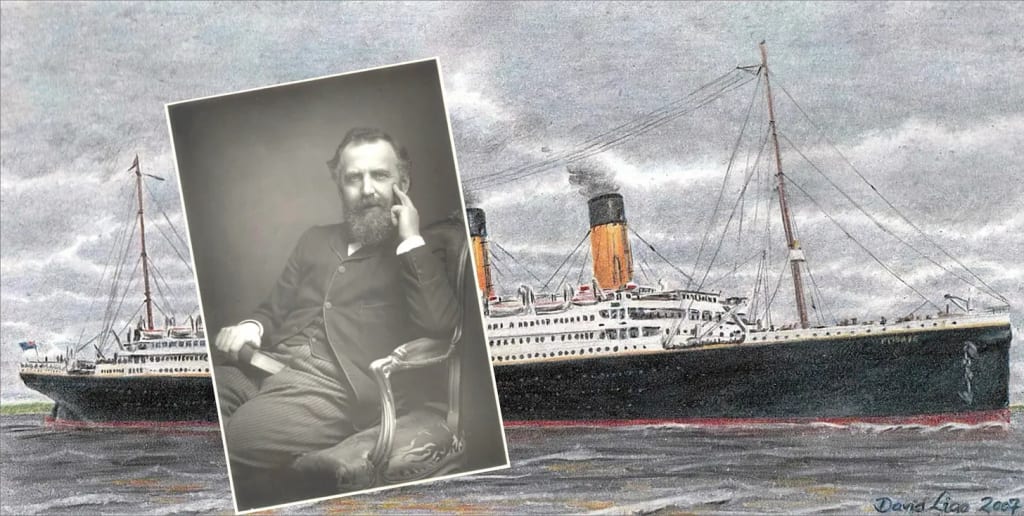
W.T. Stead was the first person to understand that the media could be used as a weapon, a concept that now dominates all aspects of our lives. He frequently used the platform he had built to attack political and social causes to great effect.
He became known as a transformative investigative journalist and was the first writer to successfully embrace the concept of ‘New Journalism,’ which emerged in the 1880s.
However, it was not just in life that he became a sensation, but also in death, when he died in one of the most famous disasters of the time.
Early Life and Education
William Thomas Stead was born in Northumberland. His father was a clergyman and took responsibility for educating his son at home. When he turned twelve, his father relinquished this responsibility and sent him to Silcoates School at Wakefield.
Once he had completed his schooling, he became an apprentice in a merchant’s countinghouse. In 1870, he started to contribute to the Liberal daily newspaper known as the Northern Echo, in Darlington.
One year later, at the age of twenty-two, Stead was invited to become editor of the Northern Echo. During this time, he became a supporter of Prime Minister W.E. Gladstone and used the paper to support his election.
In 1880, he moved to London to the role of assistant editor of the Pall Mall Gazette. He worked under John Morley, who would later become known as Viscount Morley. When Morley entered Parliament, Stead took the position of editor for the paper. He transformed the Pall Mall Gazette into an unconventional yet influential journal.
The Crusade Against Child Prostitution
During his time as a journalist, Stead tackled many subjects considered taboo. This included the subject of poverty and the slums, as well as political and military intervention.
However, it was on the subject of the horrors of child prostitution that he became best known. Stead did not quarrel with the prostitutes themselves; his fight was with the rich men who financed the industry and the young age at which children were being used.
When a Bill to raise the age of consent from 13 to 16 was delegated for the third time in Parliament, Stead knew he had to act. He used his contacts and set up meetings with prostitutes, brothel madams, policemen, and procurers. He then published a series of reports in the Pall Mall Gazette titled “The Maiden Tribute to Modern Babylon.”
The Maiden Tribute to Modern Babylon
His findings shocked the world. He discovered that girls as young as thirteen were being kidnapped, lured away, or sold into prostitution by their parents. Once in the system, they became institutionalised, which made it nearly impossible to leave.
The scale of the enterprise was also shocking; it was a flourishing business which stretched across the country, with girls being trafficked from across Europe. Respectable people and police often ignored what was going on because the age of consent was thirteen. It is the same excuse the police made when investigating Andrew Mountbatten-Windsor in the Epstein files.
To prove how easy it was for a child to be bought, Stead took investigative journalism to a new level and paid £5 for a thirteen-year-old girl named Eliza Armstrong. Her mother was allegedly an alcoholic and ready to sell her daughter. Stead took the girl to Europe and placed her in the care of his friends to stay safe.
Impact and Imprisonment
The revelations caused a massive public outcry, and the pressure ensured that lawmakers passed the Criminal Law Amendment Act of 1885. This act raised the age of consent from 13 to 16 and increased regulation of the sex industry.
Ironically, though, Stead was the first person arrested under the new powers. Eliza Armstrong’s father, a chimney sweep, prosecuted Stead for taking his daughter without consent. Despite the difference in their social standing, the law favoured the father. We can only presume that some powerful people involved in the trade wanted the ultimate revenge. Stead was sentenced to six months in prison.
This did not silence Stead for long. In 1890, Stead left daily journalism to found the monthly journal Review of Reviews. He used its pages to crusade for diverse causes, including British-Russian friendship, international peace, and the reform of criminal codes.
In 1894, he travelled to Chicago for the World’s Fair. Horrified by the conditions he found behind the glamour of the event, he conducted a thorough investigation into the city’s underworld. Readers of Erik Larson’s The Devil in the White City will recognise this as an environment that serial killer HH Holmes was operating in.
Spiritualism and ‘The Blue Island’
In later life, Stead took a deep interest in spiritualism—something that Sir Arthur Conan Doyle had also become interested in. Stead focused on communicating with the dead through mediums and séances.
In 1893, he founded the periodical Borderland with the medium Ada Goodrich Freer (known as “Miss X”), aiming to bridge the gap between scientific experts and the public. He also established “Julia’s Bureau” for spirit communication.
The Titanic and Beyond
His life ended when, in 1912, he boarded the RMS Titanic to travel to a ceremony in New York. Perhaps the most chilling aspect of his death was that Stead had spent years warning the public about such a disaster through fiction.
In 1886, he wrote “How the Mail Steamer Went Down in Mid-Atlantic by a Survivor,” a story about a liner sinking with a massive loss of life due to a shortage of lifeboats. He later wrote another story in 1892, From the Old World to the New, in which a ship rescues survivors of an Atlantic collision with an iceberg.
When the real disaster struck, Stead remained true to the stoic warnings he had penned. When the ship sank, Stead perished; he was sixty-three. Survivors would later testify that he remained stoic and contemplative until the end, facing his death with dignity.
Beyond the Veil
However, this was not the last time Stead was heard from. It is reported that he continued his work in the spiritual world. His daughter, Estelle, claimed she had spoken to him. She published The Blue Island: Experiences of a New Arrival.
The book, which included an endorsement from Arthur Conan Doyle, featured Stead’s supposed descriptions of his journey into the spirit world, from floating above the sinking Titanic to his observations of the afterlife.
Stead was a formidable figure whose actions rescued many girls from horrendous torture. We can only wish that there is a journalist of his quality prepared to risk it all for the Epstein victims.
Learn about more famous Titanic victims
About the Creator
Sam H Arnold
Fiction and parenting writer exploring the dynamics of family life, supporting children with additional needs. I also delve into the darker narratives that shape our world, specialising in history and crime.
Keep reading
More stories from Sam H Arnold and writers in History and other communities.
The Enigma of the Second Mrs Crippen
Kunigunde Mackamotzki was a woman of many names, but history remembers her by a name she never truly owned: Cora Crippen. The daughter of a Russian-Polish father and a German mother, she would eventually become the victim in one of the most sensational cases of the Edwardian era.
By Sam H Arnold7 days ago in History



Comments
There are no comments for this story
Be the first to respond and start the conversation.