
The Pyramids
The Untold Story of the Hands That Built Eternity

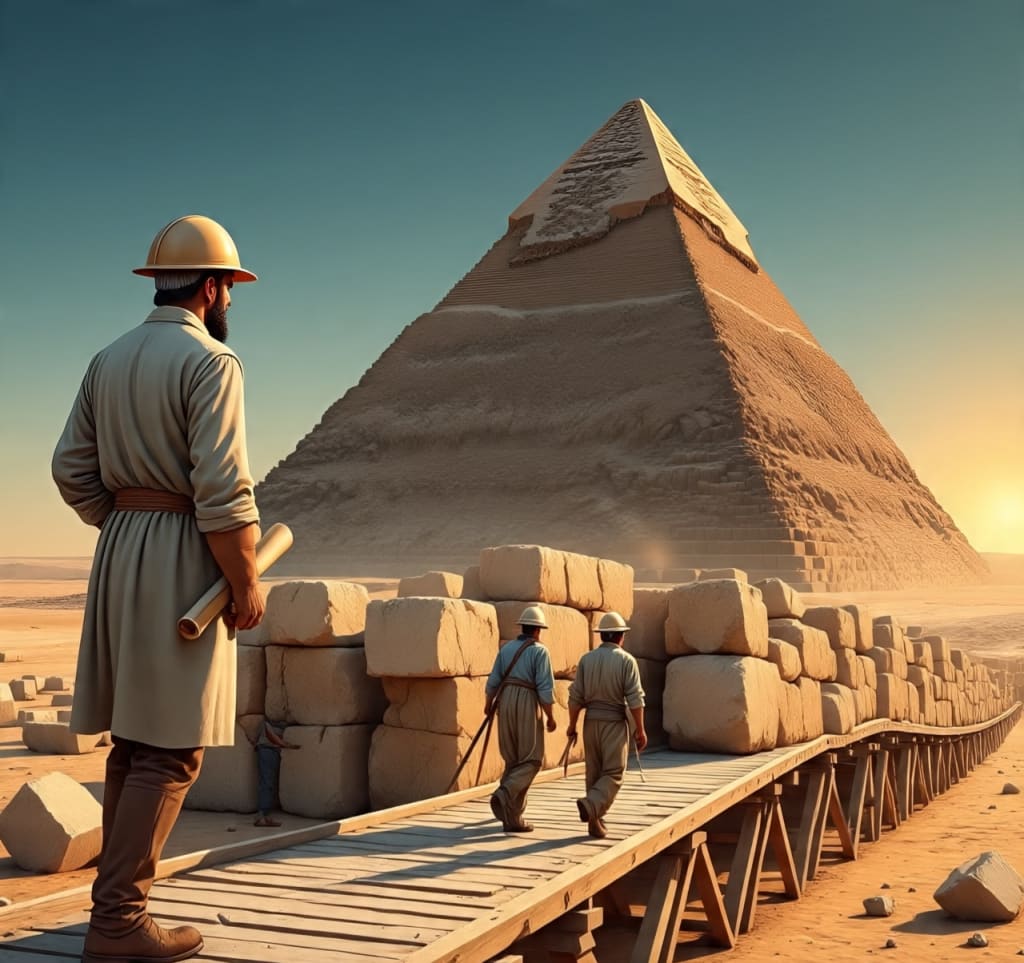
The desert sun burned mercilessly on the horizon, casting long shadows over the Nile’s banks where boats creaked under the weight of limestone blocks. Each slab was hauled from the quarries across the river, destined to become part of a monument that, according to Pharaoh Khufu, would outlast time itself. To the world, it was to be a tomb fit for a god. To those who built it, it was both burden and legacy.
Among the thousands of laborers was Khepri, a farmer’s son from a small village near Memphis. He had come to Giza to escape hunger, lured by the promise of food, clothing, and steady work. Each dawn, he tied a strip of cloth around his brow, pressed his hands to the rough rope, and pulled with hundreds of others to drag the stones up massive ramps. His body grew lean, his shoulders hard, but his thoughts often drifted to his family, who waited for him with faith that his sacrifices would keep them alive.
At the construction’s heart stood Imhotep, the Pharaoh’s chief architect. Though he wore fine linen and carried papyrus plans, his brow was furrowed with the same weight Khepri carried in his arms. For Imhotep bore responsibility not for one stone, but for all—every angle, every ramp, every life. Pharaoh demanded a pyramid that pierced the heavens, its sides flawless, its capstone gleaming with gold. Yet sandstorms battered the desert, workers fell ill, ropes snapped, and blocks cracked under strain. Each problem was his to solve, or his to answer for.
Despite the hardships, the site was alive with determination. Workers sang rhythmic chants to keep time while hauling blocks, their voices rising above the desert winds. Artisans chipped away at limestone, shaping it smooth so the sun would glint off its face. Cooks stirred great pots of lentils and bread to feed the masses, while doctors tended to cuts, fevers, and broken bones. Though history would speak of kings, the pyramid was being raised by thousands of nameless hands.
For Khepri, the work was grueling yet strangely meaningful. At night, he would sit with his companions around a small fire, sharing bread and dates. They spoke of their homes, of the Pharaoh’s glory, and of the whispers that perhaps building such a monument was a way of ensuring their own immortality. One older worker told him, “When this stone outlives us all, the world will know we once stood here. Our sweat will shine in its walls.”
Imhotep, too, wrestled with deeper thoughts. Though loyal to Khufu, he wondered if the pyramid was truly for the Pharaoh—or for Egypt itself. It was a symbol of power, of unity, of human will against the desert. Yet it came at a cost measured in aching backs, calloused hands, and lives quietly lost along the ramps. He often walked among the workers, watching them strain and bleed, and he knew the monument was theirs as much as his.
Years passed. The pyramid rose layer by layer, its steps climbing toward the sky. The ramps grew higher, curling around the structure like a serpent. Khepri had grown from a boy into a man, his arms corded with muscle, his eyes weathered by sand and sun. He had seen friends carried away on stretchers, never to return. He had seen men cheer when a stone finally slid into place after days of struggle. He had felt both despair and pride in equal measure.
One evening, as the setting sun bathed the half-built pyramid in crimson light, Khepri stood beside Imhotep. It was rare for a laborer to stand beside the great architect, yet Imhotep often sought the perspective of those who bore the burden of his designs.
“Does it feel worth it to you?” Imhotep asked quietly, his gaze fixed on the towering structure.
Khepri hesitated. “It is hard, and many have fallen. But when I look at what we’ve built… I feel something greater than myself. My children will know I helped raise this mountain of stone. That is enough.”
Imhotep nodded, a faint smile crossing his lips. “Then it is not just a tomb. It is a story carved in stone—a story of us all.”
Finally, after decades of toil, the pyramid stood complete. Its smooth sides rose from the desert like a stairway to the gods, its capstone gleaming as the morning sun touched it. Trumpets blared, priests chanted, and the Pharaoh gazed upon his eternal house with satisfaction.
Yet for Khepri, the greatest moment came when he stood among his fellow workers, sweat and dust still clinging to his skin, and looked at the monument in silence. It was not Pharaoh’s glory he saw, but the legacy of countless hands. He saw the songs, the laughter, the tears, and the dreams etched into every block.
The pyramid would be remembered as Khufu’s, but Khepri knew the truth—that it was theirs too. Theirs, as much as the Pharaoh’s. The monument did not belong to one man, but to a nation, to the nameless souls who built it with strength, endurance, and faith.
As the desert winds swept across the plateau, Khepri closed his eyes. For the first time, he felt not like a worker, but like a part of history.
And the pyramid, standing tall against the sands of eternity, bore witness to his truth.
About the Creator
LUNA EDITH
Writer, storyteller, and lifelong learner. I share thoughts on life, creativity, and everything in between. Here to connect, inspire, and grow — one story at a time.
Keep reading
More stories from LUNA EDITH and writers in History and other communities.
Cleopatra
The desert sun blazed over the golden city of Alexandria, where the great library stood as a beacon of knowledge and the harbor bustled with ships from every corner of the Mediterranean. In the palace overlooking the sea, a young girl watched the waves and dreamed of power. Her name was Cleopatra, and one day she would become the last pharaoh of Egypt.
By LUNA EDITH6 months ago in History
Rising Tensions in the Middle East: Is the World Heading Toward World War 3? Part 1
With growing tensions in the Middle East and after Iran’s attack on Israel, many people are seeing this issue moving toward a full-fledged war. A large section of people also believes that if this war starts, it could quickly escalate into World War 3. But is that really going to happen?
By Imran Ali Shahabout 18 hours ago in History



Comments (1)
So amazing about pyramids. Also i need your support don,t forget me ok dear.