
The Punishment That Shamed the Soul Before the Body
An ancient Chinese form of justice where public humiliation weighed heavier than physical pain — and how its echoes still haunt us today in the digital age.

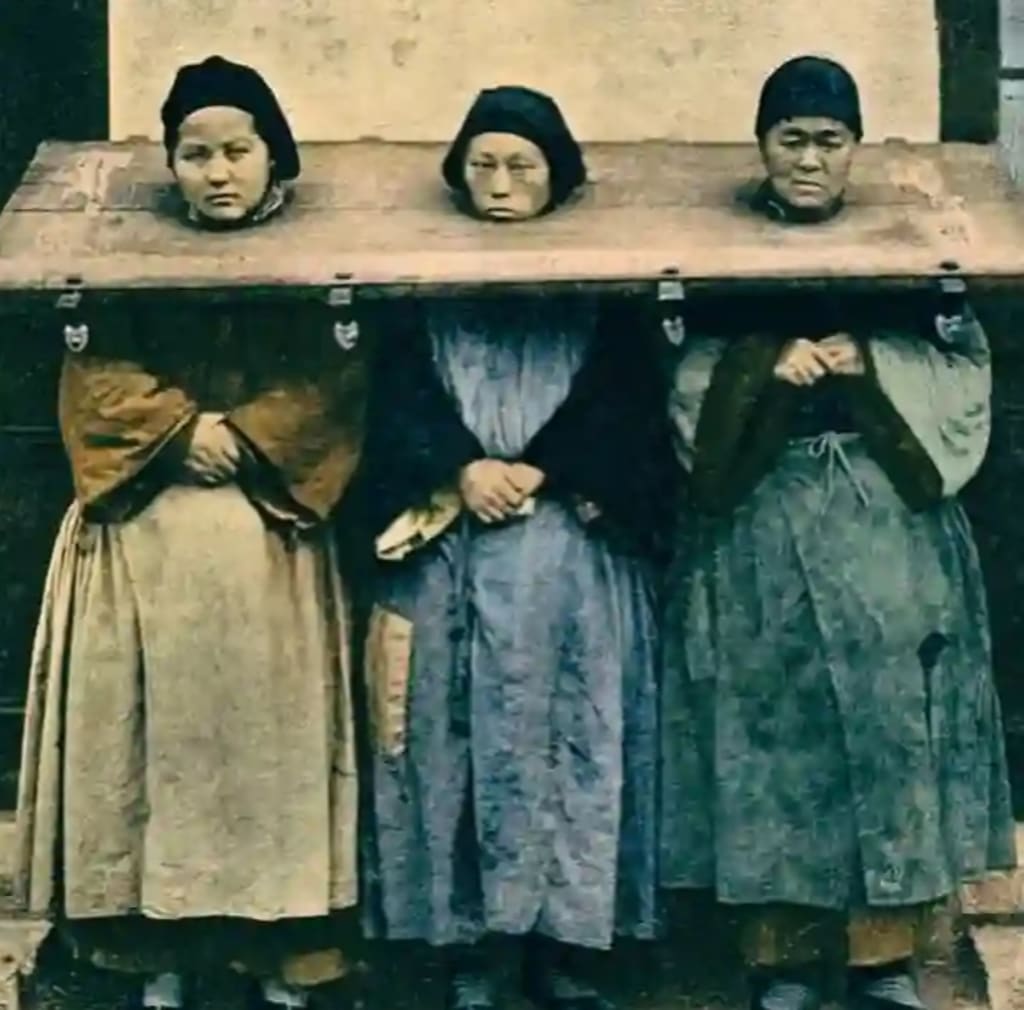
An ancient Chinese form of justice where public humiliation weighed heavier than physical pain — and how its echoes still haunt us today in the digital age.
Have you ever imagined a punishment not just meant to inflict physical pain, but to pierce through the soul with shame and humiliation?
Human societies have always developed different ways to punish criminals — some methods focus on pain, others on isolation. But ancient China introduced a unique form of punishment called the “Cangue”, which combined physical suffering with deep psychological and social humiliation.
The Cangue was a large, heavy wooden or metal board with a hole in the center for the neck. This board was placed around the neck and rested on the shoulders of the convict, rendering them nearly immobile due to its weight — which ranged anywhere from 10 to 100 pounds. In some versions, additional holes were made to fix the hands in place, making even basic movement nearly impossible.
At first glance, it may look like just a physical burden, but the real weight of this punishment came from its public nature — a spectacle of shame meant to break the spirit of the criminal.
The Cangue was mostly used for minor to medium-level crimes, such as:
- Theft
- Adultery
- Debt default
- Disobedience to parents
- Lying or cheating
These were not just legal offenses — in Chinese society, they were seen as moral failures. The punishment, therefore, wasn’t just about law enforcement, but also about public morality.
The Cangue was not meant to be served in private. The convicted person would be forced to stand in public places for hours, days, or even weeks — at street corners, busy markets, or temple entrances.
During this period:
- There was no proper arrangement for food
- No access to toilet facilities
- The person had to beg for food or rely on passersby — a source of deep shame in traditional society
Every passerby could stop, stare, spit, laugh, mock — or simply ignore them as an object of disgrace. It was less about punishing the body and more about breaking the soul through public degradation.
The Cangue wasn't just a punishment — it was a message. In Chinese culture, it served as a moral example. It sent a clear signal to society: crime is not just breaking the law, it's a fall from virtue — and that fall demands not just legal correction but social condemnation.
This was a time when honor and shame were stronger tools of control than prisons or police.
With the fall of the Chinese monarchy in 1912 and the rise of modern legal systems, the Cangue was officially abolished. However, its symbolic presence still lingers in historical novels, Chinese dramas, museums, and cultural conversations.
Today, it is remembered as a reflection of a time when justice walked hand-in-hand with pain, public disgrace, and ethical discipline.
A question arises: has the punishment of shame truly disappeared in our modern world?
The answer might be unsettling. Social media, public shaming, viral videos, and online mob mentality — these have become the new-age Cangue. Today, a person accused of a crime (or sometimes even innocent) can be publicly humiliated in seconds and judged by millions without due process.
What was once done in village squares is now done on digital screens:
- Character assassination
- Emotional collapse
- Isolation and fear
- Deep psychological trauma
All of it, in front of a crowd that doesn’t just watch — it comments, shares, mocks, and destroys.
The story of the Cangue teaches us a powerful truth: the punishment of shame is one of the harshest known to humankind. It lingers longer than physical pain, and its wounds go deeper than bruises.
Whether we live in ancient China or the digital age, the tools may change — but the human impulse to shame remains dangerously alive.
We must ask ourselves:
- Do we seek justice, or do we seek spectacle?
- Do we correct people, or crucify them publicly?
- Are we part of the solution, or part of the crowd that throws stones?
In a time when every person carries a digital stage in their pocket, perhaps we should remember the lessons of the Cangue — and be careful not to become a modern version of it ourselves.


Comments
There are no comments for this story
Be the first to respond and start the conversation.