
The Olive Tree of Jerusalem
One night in the life of Salahuddin Ayyubi that changed the course of compassion in war.

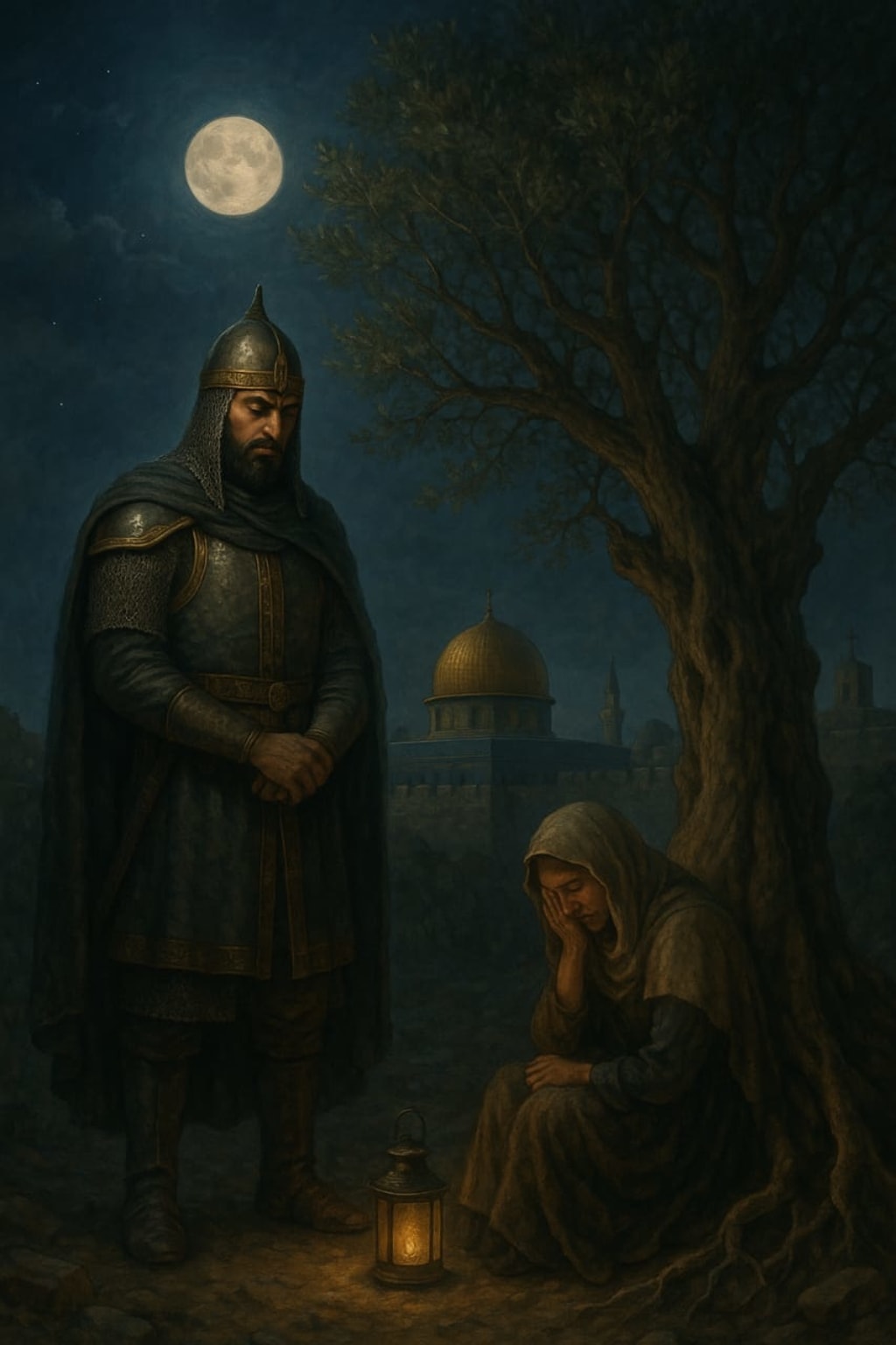
The night air hung heavy over Jerusalem. The moon hovered above the ancient city like a silent witness to centuries of bloodshed and prayers. After months of siege, the city had fallen—not with the brutality that had marked its past, but with mercy. The people whispered in disbelief: “Salahuddin Ayyubi is not like the others.”
Wrapped in a simple cloak, Salahuddin walked the narrow stone alleys of the city—not as a sultan, but as a man. He had won back Jerusalem for Islam, yet his heart carried the weight of both victory and humanity.
He passed crumbled arches and shuttered windows, feeling the heartbeat of the city—tired, scared, but slowly returning to life. A faint weeping reached his ears, soft but steady. He turned and followed the sound, his steps echoing under the stars.
In a small courtyard, beside an old olive tree twisted with age, a woman sat hunched. Her clothes were worn and her face veiled in shadow, but her pain was clear. A lantern flickered by her feet, casting long shadows of her shaking frame.
Salahuddin approached gently. “Peace be upon you,” he said.
The woman startled, then bowed her head. “I have no peace,” she whispered, “and I am no one.”
He stepped closer. “No one who grieves is forgotten by God. Why do you cry here, mother?”
She looked up. Her face was worn, eyes swollen from tears. “This tree,” she said, touching its gnarled trunk, “is where my son would sit. He was a scribe in the church. When the Crusaders took the city, he became a soldier to defend it. He died... somewhere. I never found his body. I return here each night to remember him.”
Salahuddin was silent. In this moment, she was not a Christian, and he was not a conqueror. They were simply two people broken by war.
“Would you recognize him?” Salahuddin asked.
She nodded, barely.
He looked to one of his guards who had followed at a respectful distance. “Bring the records,” he ordered softly. “All fallen men, buried or found.”
The next morning, the woman was summoned to the gates. Wrapped carefully in a shroud lay her son’s body, found in the records and gently recovered. Salahuddin had ordered a Christian priest to offer prayers beside her.
Tears streamed down her face as she touched her son’s forehead one last time. “Why?” she asked, turning to Salahuddin. “Why would you do this for me? I am the mother of your enemy.”
He looked at her not with pride, but with deep sorrow. “Because the true enemy is hatred. And mercy is more powerful than swords.”
He reached into his robe and pulled out a small flask of oil. “This olive oil,” he said, “is from the tree under which your son sat. Plant it where he now rests, and let peace grow where war once stood.”
She bowed deeply, not as a subject, but as a soul finally given closure.
Years passed. The city changed hands again and again in history’s cruel tide, but that olive tree—its offspring planted by a mother’s love and a sultan’s compassion—remained.
Some say it still stands today, not far from the city walls, a quiet witness to a night when war paused for humanity.
And people still whisper, “Salahuddin Ayyubi was not like the others.”
Themes:
Mercy in leadership
Humanity over conflict
Faith crossing boundaries
The power of symbolic acts
About the Creator
Keep reading
More stories from Sana Ullah and writers in History and other communities.
The Wolf of the Storm: An Oath in the Dark
The wind howled across the snow-covered plains of Anatolia, slicing through tents like knives. The Kayi tribe, warriors of proud Turkic blood, huddled around faint fires, cloaks drawn tight, eyes searching the sky for hope. But there was none—not in the sky, nor in the mountains, nor in the starving bellies of children who had not eaten for days.
By Sana Ullah7 months ago in History
The Seven Wonders of the World: Amazing Human Creations
People have always been fascinated by things that are grand and unusual. From the very beginning of civilization, humans wanted to build structures that were not just useful, but also showed their skill, creativity, and ambition. The Seven Wonders of the World are the most famous examples of this desire. They are impressive not only because of their size or beauty, but also because of the stories they tell about our past, different cultures, and human innovation. The idea of the Seven Wonders comes from ancient travelers and historians who listed the most remarkable human creations. Even though some of these wonders no longer exist, their legacy continues to inspire people around the world. Let’s explore each one, looking at their history, significance, and why they remain unforgettable. 1. The Great Pyramid of Giza (Egypt) The Great Pyramid of Giza is the only surviving wonder of the original Seven Wonders. Built around 2560 BCE as the tomb of Pharaoh Khufu, it is an extraordinary engineering achievement. Made from more than two million limestone blocks, some weighing over 15 tons, the precision of its construction is still astonishing today. The pyramid shows the power and beliefs of ancient Egypt and continues to attract visitors from all over the world. It is a true symbol of human skill and vision. 2. The Hanging Gardens of Babylon (Iraq) The Hanging Gardens of Babylon are famous for their beauty and clever design, though historians still debate whether they really existed. Ancient stories say King Nebuchadnezzar II built these stepped gardens for his wife, Amytis, who missed the green hills of her homeland. The gardens, described as terraces full of trees, flowers, and shrubs, appeared to float above the city. Whether real or partly mythical, they show how ancient people combined nature and architecture in extraordinary ways. 3. The Statue of Zeus at Olympia (Greece) Around 435 BCE, the sculptor Phidias created the Statue of Zeus at Olympia. This huge statue of the Greek god Zeus, seated on a throne, was over 12 meters tall and made of ivory and gold-plated bronze. It represented both artistic skill and religious devotion. Even though it was destroyed long ago, records and artistic depictions keep its memory alive, showing the Greeks’ dedication to beauty, religion, and craftsmanship. 4. The Temple of Artemis at Ephesus (Turkey) The Temple of Artemis, built around 550 BCE, was dedicated to the Greek goddess of the hunt and wilderness. Known for its enormous size, detailed sculptures, and beautiful design, it was rebuilt several times after destruction, reflecting its cultural importance. People traveled from across the Mediterranean to see it, making the temple a center of religion, art, and commerce. Today, its ruins still tell the story of a civilization that valued beauty and spiritual devotion. 5. The Mausoleum at Halicarnassus (Turkey) Built between 353 and 350 BCE, the Mausoleum at Halicarnassus was the tomb of Mausolus and his wife Artemisia. Combining Greek, Egyptian, and Lycian styles, it stood around 45 meters tall and was decorated with intricate sculptures. Its design influenced monumental tombs for centuries. Even after earthquakes destroyed it, the Mausoleum remains a symbol of human creativity and architectural achievement. 6. The Colossus of Rhodes (Greece) The Colossus of Rhodes, built between 292 and 280 BCE, was a massive bronze statue of the sun god Helios, celebrating Rhodes’ victory over an invading army. Over 30 meters tall, it was one of the tallest statues of the ancient world. Although it only stood for 54 years before an earthquake toppled it, the Colossus became a symbol of triumph, resilience, and artistic achievement, inspiring large statues throughout history. 7. The Lighthouse of Alexandria (Egypt) The Lighthouse of Alexandria, or Pharos, was built around 280 BCE on the small island of Pharos. Standing over 100 meters tall, it served as both a landmark and a guide for sailors entering Alexandria’s busy harbor. Its elegant design combined functionality and beauty. Though earthquakes destroyed it long ago, it remains a symbol of human ingenuity and innovation in maritime engineering. The Legacy of the Seven Wonders The Seven Wonders are more than just buildings; they are symbols of human creativity, ambition, and achievement. Each wonder tells a story about the people who built it, the culture it came from, and the new ideas of its time. Even though some no longer exist, their stories continue to live through historical records, art, and the fascination of people worldwide. These wonders still inspire architects, artists, engineers, and travelers today. From the pyramids of Egypt to the Hanging Gardens of Babylon, they remind us that imagination and effort can create something that lasts for thousands of years. They are examples of determination, vision, and the pursuit of excellence. Conclusion The Seven Wonders of the World are timeless creations that celebrate human creativity and determination. They are more than stones, metals, or ruins—they represent entire civilizations and the marks they left on history. Even after centuries, their stories continue to inspire people to dream, create, and achieve greatness. These wonders remind us that with vision, passion, and effort, humans can build creations that
By Binan Mooon2 days ago in History
3 Everyday Rules That Exist Because Someone Once Did Something Very Stupid
Everywhere you go, you are surrounded by rules that feel oddly specific. Do not touch. No running. Contents hot. Do not insert body parts. These warnings aren’t theoretical. They weren’t written by pessimists or lawyers with too much free time. They exist because at some point in history, a real human being looked at a situation and thought, “This will probably be fine.”
By Enoch Sagini5 days ago in History


Comments
There are no comments for this story
Be the first to respond and start the conversation.