
The Mind That Split the World: J. Robert Oppenheimer's Atomic Legacy
From Genius to Guilt — The Dark Reality Behind the Father of the Atomic Bomb

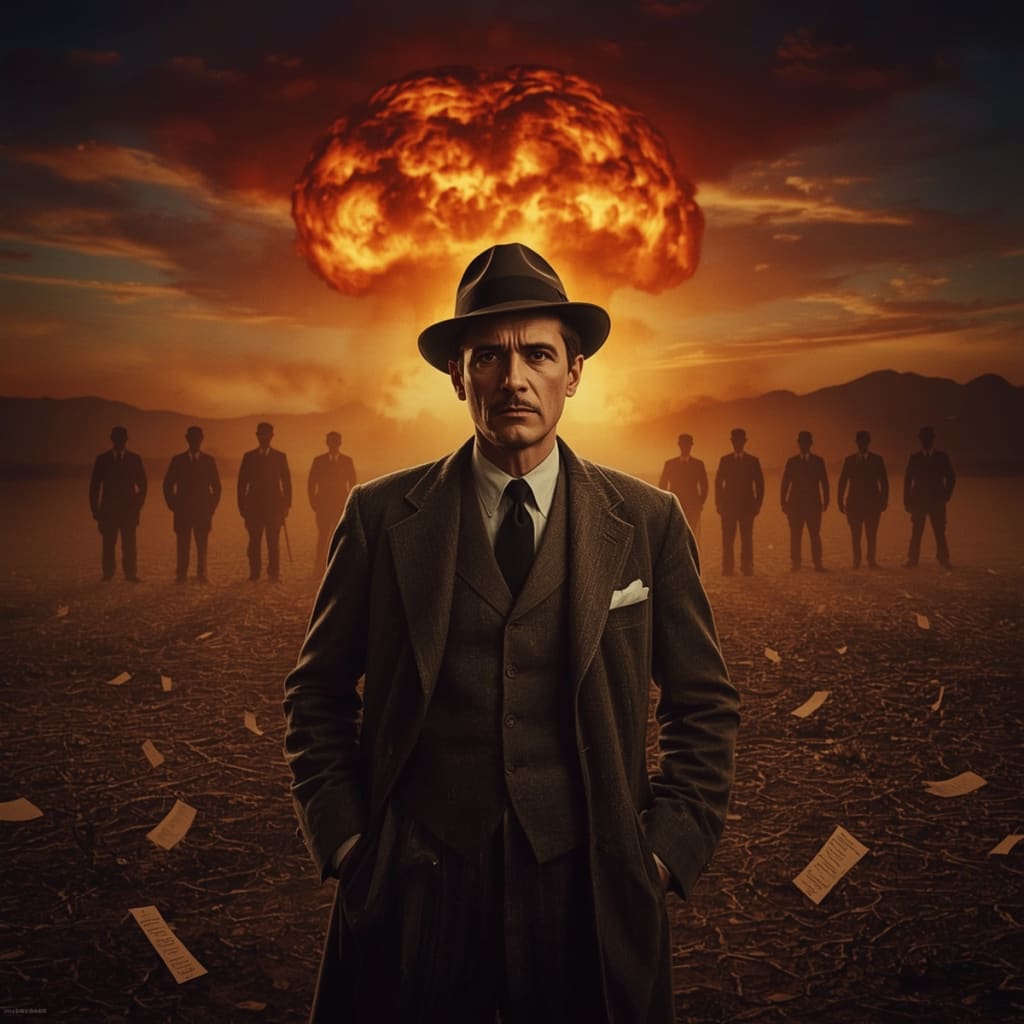
In the vast landscape of 20th-century history, few individuals left as deep and morally complex a legacy as J. Robert Oppenheimer. Known to many as the “Father of the Atomic Bomb,” his story stretches far beyond that of a scientist creating a powerful weapon—it is the journey of a man wrestling with brilliance, ambition, responsibility, and ultimately, regret.
A Brilliant Beginning
Born in New York City on April 22, 1904, Oppenheimer grew up in a cultured, intellectual environment. His father was a successful textile importer, and his mother an artist. From a young age, Robert showed remarkable academic promise. He was reading classics by the time he was five and developed an intense interest in science and languages. He graduated from Harvard in just three years, studying physics, chemistry, literature, and philosophy. His thirst for knowledge knew no bounds.
After Harvard, he traveled to Europe to study theoretical physics, eventually earning his doctorate under Max Born at the University of Göttingen in Germany. There, he mingled with the most brilliant minds of his era, including Werner Heisenberg and Niels Bohr. Oppenheimer was seen as a genius, but one prone to emotional volatility and existential doubt.
A World on the Edge
As the 1930s advanced, the rise of fascism and the looming threat of global war pushed scientific concerns into geopolitical relevance. When German physicists discovered nuclear fission in 1938, scientists around the world realized that a bomb of unimaginable power could now be created. In 1939, Albert Einstein and physicist Leo Szilard warned President Franklin D. Roosevelt of the Nazi atomic threat in a letter that helped initiate U.S. efforts to develop such a weapon.
Oppenheimer, by then a professor at UC Berkeley, was recruited for the top-secret Manhattan Project. Despite limited experience managing large teams, he was appointed scientific director of the Los Alamos Laboratory in New Mexico. General Leslie Groves, head of the military side of the project, saw in Oppenheimer not only intellect but the rare ability to unify diverse scientific minds.
The Manhattan Project: Science Turns to War
The Manhattan Project grew rapidly. Over 130,000 people worked across multiple sites in the U.S. as they raced to beat the Germans to the bomb. Oppenheimer assembled a team of top physicists—including Richard Feynman, Edward Teller, Enrico Fermi, and Niels Bohr. The Los Alamos lab became a nerve center of both creativity and secrecy.
Under immense pressure, the team developed two types of atomic bombs: a uranium-based bomb (“Little Boy”) and a plutonium-based bomb (“Fat Man”). The first successful detonation came on July 16, 1945, in the New Mexico desert. Codenamed “Trinity,” the blast lit the sky and sent shockwaves across the sand dunes.
Oppenheimer’s reaction? He later quoted the Bhagavad Gita: “Now I am become Death, the destroyer of worlds.” Though poetic, the quote masked a deep moral unease that would grow with time.
Hiroshima, Nagasaki, and the Fallout of Conscience
On August 6 and 9, 1945, the bombs were dropped on Hiroshima and Nagasaki. The death toll exceeded 200,000, including long-term radiation victims. The world changed overnight.
Initially hailed as a hero, Oppenheimer met with President Truman to discuss the bomb's aftermath. When he confessed, “Mr. President, I feel I have blood on my hands,” Truman was reportedly furious and later dismissed him as a “crybaby scientist.”
This moment marked a turning point. Oppenheimer began advocating against nuclear proliferation and opposed the development of the far more powerful hydrogen bomb. He called for international cooperation and moral responsibility in the atomic age.
From Fame to Fallout: The Security Hearings
During the 1950s, America entered the era of McCarthyism. Oppenheimer’s past political affiliations—including friendships with known Communists—came under scrutiny. Despite his loyalty and service, he became the target of suspicion.
In 1954, the Atomic Energy Commission held controversial hearings to revoke his security clearance. The proceedings were highly publicized and deeply humiliating. Former colleagues like Edward Teller testified against him, while others tried in vain to defend his integrity.
The hearings ended with Oppenheimer being stripped of his clearance. Though he was not accused of treason, the verdict effectively ended his influence in government science. He returned to academic life, lecturing and writing, but never regained his former stature.
The Weight of Genius
Haunted by the consequences of his work, Oppenheimer’s later years were marked by introspection. He accepted the Enrico Fermi Award in 1963 as a symbolic gesture of rehabilitation, but it did little to erase the stain of his public downfall.
He often spoke on the ethical responsibility of scientists. In one of his speeches, he said, “In some sort of crude sense… the physicists have known sin.” That line encapsulated his lifelong burden—the knowledge that his creation ended hundreds of thousands of lives and began an era of existential risk.
The End and the Echo
Diagnosed with throat cancer in 1965, Oppenheimer died on February 18, 1967. He was 62. His death was quiet, unlike the explosion that had defined his life.
Today, Oppenheimer remains a symbol of the dual-edged sword of knowledge. His story challenges us to think deeply about the intersection of science, ethics, and humanity. Was he a genius who saved the world from tyranny—or a man who opened Pandora’s box? The truth, like Oppenheimer himself, is complicated.
In the final analysis, he was both creator and destroyer—hailed and shunned, honored and betrayed. But perhaps most enduringly, he was human.
About the Creator
Sadaa-e-Lamakan
I don’t write from memory, but from silence.
Each word is a zikr, each pause a prayer.
These stories don’t speak — they descend.
This is Sadaa-e-Lamakan: a doorway where ink is light and meaning is surrender.
Keep reading
More stories from Sadaa-e-Lamakan and writers in History and other communities.
The Year 1986 in Review: Fun Facts, Trivia, and Historic Highlights
This quick read is a collection of fun facts, trivia, and historical events from the year 1986. Discover the year’s top news stories, most influential people, sports trivia, grocery prices, and much more.
By Gregory DeVictorabout 2 hours ago in History



Comments
There are no comments for this story
Be the first to respond and start the conversation.