
The Love Letters of Julius Caesar
A Story of Passion, Power, and Longing
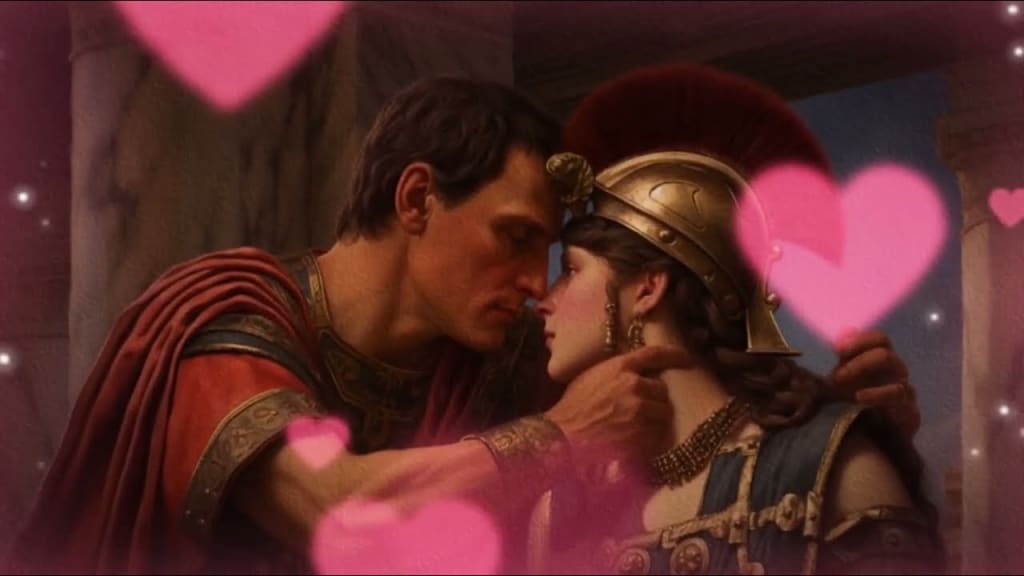
The year was 44 BCE, and Rome was a city alive with whispers. The name Julius Caesar echoed through its streets, spoken with reverence, fear, and awe. He was a man who had conquered nations, rewritten the laws of the Republic, and stood at the pinnacle of power. But behind the marble statues and the laurel wreaths, there was another side to Caesar—one that few knew. It was a side that poured its heart onto parchment, weaving words of love and longing for the women who held his heart captive.
This is the story of Caesar’s love letters—a tale of passion, secrecy, and the fragile humanity of a man who seemed larger than life.
The Garden of Servilia
Servilia Caepionis was a woman of extraordinary beauty and intellect, a Roman noblewoman who moved through the halls of power with grace and cunning. She was married to Marcus Junius Brutus, a man of little consequence compared to the rising star of Julius Caesar. Servilia and Caesar’s affair was the worst-kept secret in Rome, but their love was as real as the risks they took to nurture it.
Caesar’s letters to Servilia were filled with a tenderness that belied his reputation as a ruthless general. One such letter, written during his campaign in Gaul, survived in fragments:
“My dearest Servilia,
The nights here are long and cold, but your memory warms me like the sun over the Capitoline Hill. I dream of the garden where we last met, where the scent of jasmine clung to the air and your laughter was sweeter than any victory. Rome feels a world away, but you are always with me. Wait for me, as I wait for the day I can hold you again.
Yours, always, Caesar.”
Servilia kept these letters hidden in a wooden chest, tied with a crimson ribbon—a symbol of their forbidden love. She would read them by candlelight, her fingers tracing the words as if they were his lips. But their love was not without consequence. Servilia’s son, Brutus, would grow up to become one of Caesar’s most infamous betrayers. Some say it was jealousy, others say it was fate. But Servilia’s heart never fully recovered.
The Queen of the Nile
Years later, Caesar found himself in Egypt, drawn not only by the political turmoil of the Ptolemaic dynasty but also by the allure of its queen. Cleopatra was unlike any woman he had ever known—brilliant, ambitious, and utterly captivating. Their affair was as much a political alliance as it was a romance, but their letters revealed a deeper connection.
One letter, written on fine Egyptian papyrus, was delivered to Cleopatra by a trusted servant:
“To Cleopatra, Queen of the Nile and ruler of my heart,
Your eyes are like the stars that guide my ships, and your laughter is the melody that soothes my weary soul. Egypt is a land of wonders, but you are its greatest treasure. Though the Senate calls me back to Rome, know that my thoughts will linger in your chambers, where the scent of lotus flowers reminds me of your embrace. Until we meet again, I remain your devoted Caesar.”
Cleopatra kept these letters in a gilded box, a treasure more valuable than any jewel. She would read them aloud to her handmaidens, her voice trembling with emotion, as if Caesar himself were whispering in her ear. Their love was a flame that burned brightly, but it was destined to be extinguished by the tides of history.
The Keeper of Secrets
Caesar’s scribe, a loyal man named Lucius, was the keeper of these letters. He alone knew the depth of Caesar’s affections and the risks of such correspondence falling into the wrong hands. Lucius often wondered if the letters would one day be discovered, revealing the humanity behind the legend.
But fate had other plans. On the Ides of March, as Caesar fell to the daggers of the Senate, his letters remained hidden, scattered across Rome and Egypt. Servilia burned hers in a fit of grief, the ashes carried away by the wind. Cleopatra, ever the survivor, kept hers until her own tragic end, when they were lost to the sands of time.
The Legacy of Love
Centuries later, fragments of these letters were discovered in the ruins of ancient villas and the depths of Egyptian tombs. Historians marveled at the vulnerability they revealed in a man known for his invincibility. The love letters of Julius Caesar became a testament to the power of love, even in the hearts of those who shaped empires.
They remind us that even the greatest of men are, at their core, human. For in the quiet moments between battles and betrayals, it was love that moved the heart of Rome’s most famous conqueror.
“In love, as in war, I am but a man.”
—Julius Caesar
Author’s Note:
The love letters of Julius Caesar may be lost to history, but their essence lives on in the stories we tell. They remind us that even the most powerful figures are shaped by the same emotions that touch us all—love, longing, and the desire to be understood.
If you enjoyed this story, let me know in the comments below. And don’t forget to share it with someone who loves history, romance, or the timeless allure of ancient Rome.
About the Creator
Reader insights
Nice work
Very well written. Keep up the good work!
Top insight
Heartfelt and relatable
The story invoked strong personal emotions
Keep reading
More stories from Ammad Raza Naqvi and writers in History and other communities.
MS Excel as a Life-Changing Tool
How Microsoft Excel Can Ease and Transform Your Life In a world driven by data, efficiency, and organization, Microsoft Excel stands as one of the most powerful tools ever created. Whether you’re a student, a professional, a small business owner, or simply someone trying to manage personal finances, Excel has the potential to simplify your life and unlock new levels of productivity. From crunching numbers to organizing complex information, Excel is more than just a spreadsheet program—it’s a life-changing tool that can revolutionize the way you work, plan, and think.
By Ammad Raza Naqvi12 months ago in Education
3 True Stories People Refused to Believe Until the Evidence Appeared
Human beings have a remarkable ability to hear something true and immediately file it under “absolutely not.” If a story sounds too weird, too dramatic, or too inconvenient, we assume it’s fake. We say it’s a conspiracy theory, urban legend, or drunk uncle material. Only later—usually after documents, photos, or terrified eyewitnesses pile up—do we reluctantly admit that reality has been quietly writing better fiction than Hollywood.
By Enoch Sagini3 days ago in History
🅼🅸🅳🅽🅸🅶🅷🆃 🆂🅽🅰🅲🅺🆂
"It's 10 in Tuscon! We all know what that means... It's Time for Midnight Snacks with your man, Gerald Gee! Ready to spend the night together? Me too! I'm full of snacks and can't wait to regurgitate them all back into your hungry ears. Crack a brew! Pop some corn! Anything to get ready for one hell of a show where the talk maybe cheap but the words cut deep...
By Lamar Wiggins3 days ago in Fiction



Comments
There are no comments for this story
Be the first to respond and start the conversation.