
Genghis Khan: A Great and Terrifying Figure in History 😱⚔
😱 Dark & Mysterious "The Emperor of Fear: How Genghis Khan Conquered the World — and Crushed Its Soul"

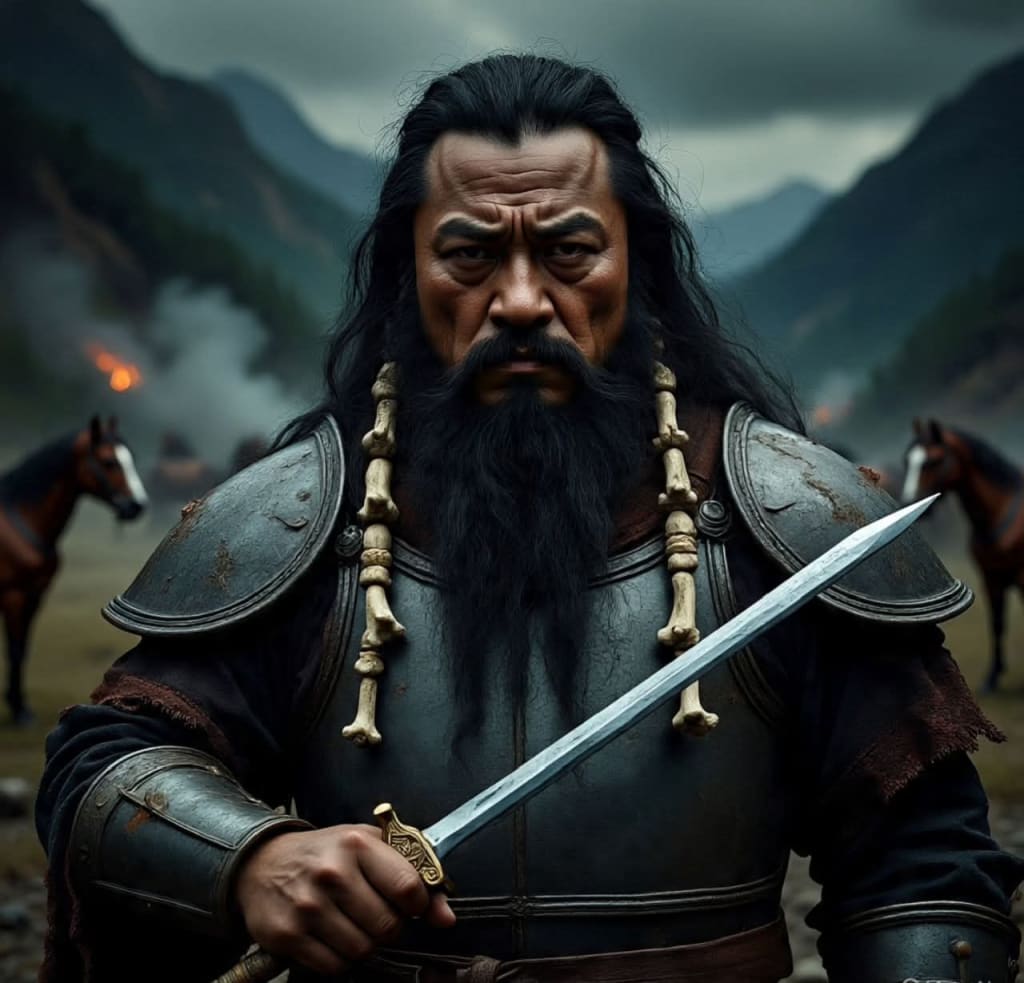
Genghis Khan: A Great and Terrifying Figure in History 😱⚔
Genghis Khan, born as Temujin, was one of the most influential and fearsome figures of the 13th century 🐎. He rose from humble beginnings to become the founder of the Mongol Empire — the largest contiguous land empire in world history 🌍. Known for his unmatched military prowess, ruthless tactics 😈, and sharp strategic thinking 🧠, Genghis Khan’s name became a symbol of conquest, fear, and unstoppable ambition. While his achievements were extraordinary, the legacy of destruction, loss, and cruelty that accompanied his rise cannot be ignored 🏰🔥🩸.
Early Life of Genghis Khan 🍼
Temujin was born around 1162 in the rugged steppes of present-day Mongolia 🏞. He was the son of a tribal leader, but his childhood was marked by intense hardship 😢. After his father was poisoned by rival clans ☠, Temujin’s family was abandoned by their tribe and left to survive in poverty and isolation. These early years were full of hunger, danger, and betrayal 😞.
Despite these difficulties, Temujin displayed extraordinary leadership qualities 💪. He gradually began to unite Mongol tribes that had long been locked in bitter feuds. Through alliances, loyalty, and sheer determination, he rose through the ranks. In 1206, after years of battles and negotiations, the Mongol tribes unanimously declared him “Genghis Khan”, meaning "Universal Ruler" 👑. This marked the beginning of a new era for Mongolia — and for much of the world 🎉.
Conquests and Military Strategy ⚔🏹
Genghis Khan was not just a warrior — he was a revolutionary military thinker 🛡. His army was highly disciplined and mobile, able to cover vast distances at lightning speed on horseback 🐎💨. He employed psychological warfare, deception, and intelligence networks to weaken enemies before even engaging them in battle.
He led devastating campaigns against powerful kingdoms and empires. He crushed the Khwarazmian Empire after its ruler killed Mongol envoys — a decision that led to total annihilation 🔥. He subdued the Jin Dynasty in northern China and launched successful invasions into Central Asia, Persia, and even eastern Europe 🏆. His armies swept across Eurasia like a storm, creating an empire that stretched from the Pacific Ocean to the Caspian Sea 🌏.
The Ruthlessness of Genghis Khan 😈💀
Though he was a skilled leader and unifier, Genghis Khan was also infamous for his ruthless cruelty 🪓🔥. His conquests left cities flattened, economies shattered, and millions dead ☠. He is known for using terror as a weapon — instilling fear to force surrender without battle.
Some historical accounts describe horrifying acts: cities where no one was spared, children thrown into rivers, and entire populations massacred 😨. It's said he built towers and walls using the bones of his enemies 🦴🏰 and drank from their skulls 🍷💀 as signs of dominance. Whether myth or fact, such stories reveal the intensity of fear his name inspired across continents.
Personal Life of Genghis Khan 💍👰
In his personal life, Genghis Khan was equally controversial 😳. He had multiple wives and countless concubines 💒. Through conquest, he often took women from defeated tribes and kingdoms by force 😠. This abuse of power left a genetic footprint that still exists today — according to genetic studies, around 16 million men alive today may carry a Y-chromosome linked to Genghis Khan 🧬.
His sons and daughters were raised to be rulers and commanders, but his brutal methods of family expansion also highlight the dark side of his rule 💪👑.
The End of Genghis Khan ⚰
Despite being seen as nearly invincible 😎, Genghis Khan met his end in 1227, reportedly due to either a fall from a horse, a battlefield wound, or illness — accounts vary 🪦. The location of his grave remains unknown to this day, adding mystery to his legend 🌌.
After his death, his vast empire was divided among his sons and later ruled by his grandsons, including Kublai Khan, who would go on to found the Yuan Dynasty in China 👨👦. Although he died at the height of his power, his death was a powerful reminder that no man, no matter how mighty, can escape fate 🙏.
Legacy of Genghis Khan 🏛
Even today, Genghis Khan’s legacy remains deeply debated 🤔. Some praise him as a visionary leader, who promoted meritocracy, religious tolerance, and the growth of international trade via the Silk Road 🛤💰. His empire helped connect East and West in unprecedented ways.
But for many others, especially in regions he invaded, he remains a symbol of destruction. Entire civilizations were erased, cultures lost, and generations wiped out 😢. For them, he is not a hero, but a terrifying villain 🏚.
A Lesson of Warning 📜
The story of Genghis Khan offers a timeless lesson: Power, no matter how great, is temporary ⏳. He saw himself as the supreme ruler of the world 😤, but history shows that tyranny eventually collapses. God's justice is silent but certain ⚡.
When the Almighty decides to act, even the mightiest emperors vanish without a trace 🪐🙏. Genghis Khan’s rise and fall remind us that true greatness lies not in conquest, but in compassion 🌱. Power should be used to uplift humanity — not to burn it down 🔥.
About the Creator
Furqan Elahi
Writer of quiet thoughts in a loud world.
I believe stories can heal, words can build bridges, and silence is sometimes the loudest truth. On Vocal, I write to make sense of the unseen and give voice to the unsaid.
Keep reading
More stories from Furqan Elahi and writers in History and other communities.
Be Like Jesus... No - Don't!
My kids and I are Seventh Day Adventists. It is the closest organized religion that I resonate with... for the most part. A key thing is that Saturdays are our Sabbaths. So, today, Sabbath school lessons were not published on the website I use. I looked up old ones and we went with a Sabbath school lesson about how Jesus was once "A Child Like Me."
By The Schizophrenic Mom6 days ago in History
Antarctica Map
Antarctica is the coldest, driest, and windiest continent on Earth. It is located at the southernmost part of the planet, surrounding the South Pole. Because of its extreme weather and thick ice cover, Antarctica is very different from other continents. An Antarctica map helps us understand the shape, location, and important features of this frozen land.
By Farhan Sayedabout 2 hours ago in History



Comments
There are no comments for this story
Be the first to respond and start the conversation.