
"The Kachori Seller’s Comeback"
"Where Simplicity Served More Than Snacks"

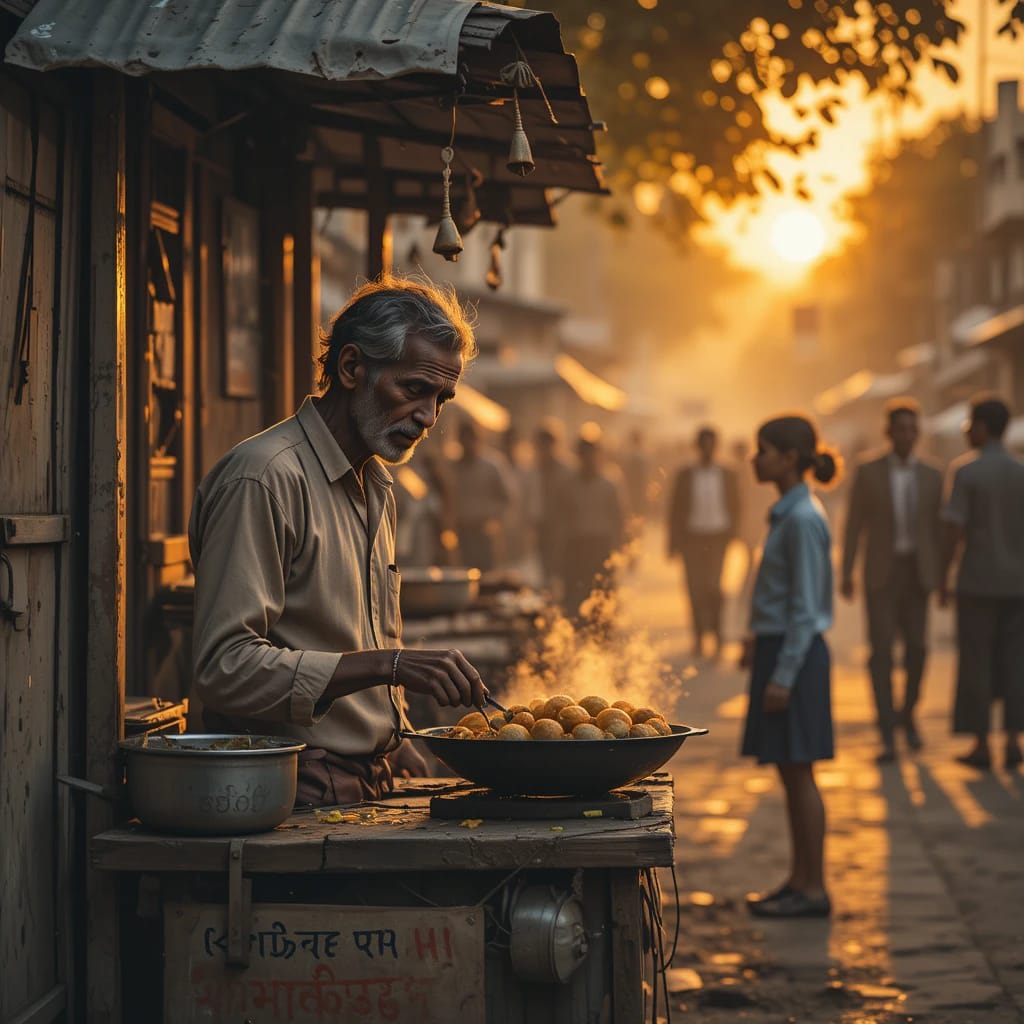
In the heart of a bustling Indian town, among the noisy rickshaws, chatter of tea vendors, and calls of train announcements, lived an old man named Ramlal. Every morning, before the first rays of sunlight touched the station platform, Ramlal would arrive at his spot near the railway station with his wooden cart. The cart was nothing fancy—a rusty stove fueled by kerosene, a tin roof patched with old posters, and stacks of newspaper for wrapping kachoris.
Ramlal had been selling his kachoris there for almost thirty years. He wasn’t rich, nor did he ever dream of being so. He just wanted to live with dignity. His fingers bore the marks of time—burn scars from hot oil, cracked skin from years of work—but his heart was warm and his spirit unshaken.
His customers loved his kachoris. They were hot, crisp, and filled with spicy, flavorful stuffing—made with recipes passed down from his mother and wife. Each bite had a story. Regulars came not just for the food, but for Ramlal’s cheerful greetings, kind words, and his occasional advice on life.
Life was hard, but it was enough. His wife had passed away several years ago, and his only son had gone to Delhi in search of a better future, never to return. Ramlal didn’t have much, but he had a sense of pride in his honest work. He shared his leftover food with stray dogs and sometimes with poor kids passing by. Even in poverty, his heart remained generous.
One morning, as Ramlal was setting up his cart, he noticed a commotion across the street. Workers were decorating a new building. Bright blue boards were going up, and a clean glass door shined in the morning sun. Within two days, a new shop had opened: “The English Food Store.”
The sign was stylish, written in English cursive, with slogans like "Fresh. Fast. Fancy." The store had a bright interior, shelves full of imported snacks, cookies, packaged juices, and sandwiches with names Ramlal couldn’t pronounce. Cool air blew from the store whenever the automatic doors opened. Soft English music played from speakers.
People began to flock to the store. Youngsters took selfies in front of it. College students were drawn by the newness, the packaging, and the English labels. Little by little, the footfall at Ramlal’s humble cart began to fade.
He watched silently as old customers now passed him by, paper cups in hand, eating puffed pastries from the English store. The laughter of children who once fought over his kachoris was now heard across the street, around colorful cupcakes and plastic-wrapped croissants.
Days turned into weeks. His income dropped. Some days he sold just three or four kachoris. One evening, as the sun set and the street lights flickered on, Ramlal sat alone behind his cart, rubbing his aching knees. His stove had gone cold early that day. He hadn’t made enough to even buy milk for tea.
He looked at the glowing store across the road, full of customers, and whispered to himself, “Maybe I don’t belong here anymore.”
But even as tears welled up in his tired eyes, something deep inside him refused to give up.
That night, Ramlal didn’t sleep. He sat on the floor of his small hut, thinking. He knew he couldn’t compete with the store’s air conditioning, shiny packaging, or English-speaking staff. But he remembered something his wife once told him: “People may forget what you say, but they never forget how you make them feel.”
The next morning, Ramlal did something different.
He woke up early and scrubbed his cart clean. He used a piece of cloth to polish the metal. He painted the old wooden frame and bought a cheap plastic banner. With the help of a kind student, he wrote on it in English and Hindi:
“Real Taste. Desi Kachori. Made With Love.”
He made fewer kachoris that day, but with more care. He added a bit more stuffing, made the dough crisper, and packed a little extra chutney. He offered free samples to anyone who stopped. He greeted each customer with a smile, asked about their family, and told them stories from his youth.
He didn't try to be like the English store. He decided to be more of who he already was.
Something surprising began to happen.
An elderly lady, tired of tasteless sandwiches, crossed the road to buy from Ramlal. She took a bite, closed her eyes, and smiled. “This tastes like home,” she said softly.
A group of college students walked over one day, giggling. “We missed your kachoris, uncle!” they said. They clicked a photo with him and posted it online.
A food blogger traveling through the town stopped by. He tried one kachori and said, “Better than anything in that shiny store.” He took pictures, wrote a post titled “The Soul of the Street: Ramlal’s Kachoris”, and within hours it went viral.
The next week, a queue started forming at Ramlal’s cart again. New faces came, drawn by word of mouth. Some came out of curiosity. Some came for nostalgia. Some came just for Ramlal’s warmth.
Ramlal didn’t change his ingredients. He didn’t start using English words. But he added something more important—care, stories, and love in every serving.
One day, a little boy asked, “Uncle, what’s your secret masala?”
Ramlal laughed and said, “My wife taught me this. She said if a kachori doesn’t make you smile and sweat a little, it’s not real!”
People laughed. People remembered.
Across the road, the English store still stood, but the shine had faded. The music kept playing, but it sounded hollow. Customers came and went—but there was no warmth, no personal touch.
As the sun set behind the buildings and Ramlal packed up his cart, he felt no jealousy, no bitterness. He looked around at his little crowd and smiled. He had no air conditioning, no glass walls, and no foreign labels. But he had something better—heart.
Ramlal had proved that real flavor is not in fancy packaging. It is in memories, tradition, and kindness.
In a world rushing to be modern, Ramlal’s cart reminded everyone what it meant to feel at home.
About the Creator
bilal
وَتُعِزُّ مَنْ تَشَاءُ وَتُذِلُّ مَنْ تَشَاءُ
3 True Stories People Refused to Believe Until the Evidence Appeared
Human beings have a remarkable ability to hear something true and immediately file it under “absolutely not.” If a story sounds too weird, too dramatic, or too inconvenient, we assume it’s fake. We say it’s a conspiracy theory, urban legend, or drunk uncle material. Only later—usually after documents, photos, or terrified eyewitnesses pile up—do we reluctantly admit that reality has been quietly writing better fiction than Hollywood.
By Enoch Sagini4 days ago in History



Comments
There are no comments for this story
Be the first to respond and start the conversation.