
The Harrowing Tale of the Medusa: A Maritime Tragedy Unraveled
Surviving the Abyss: The Gruesome Saga of the Medusa Raft

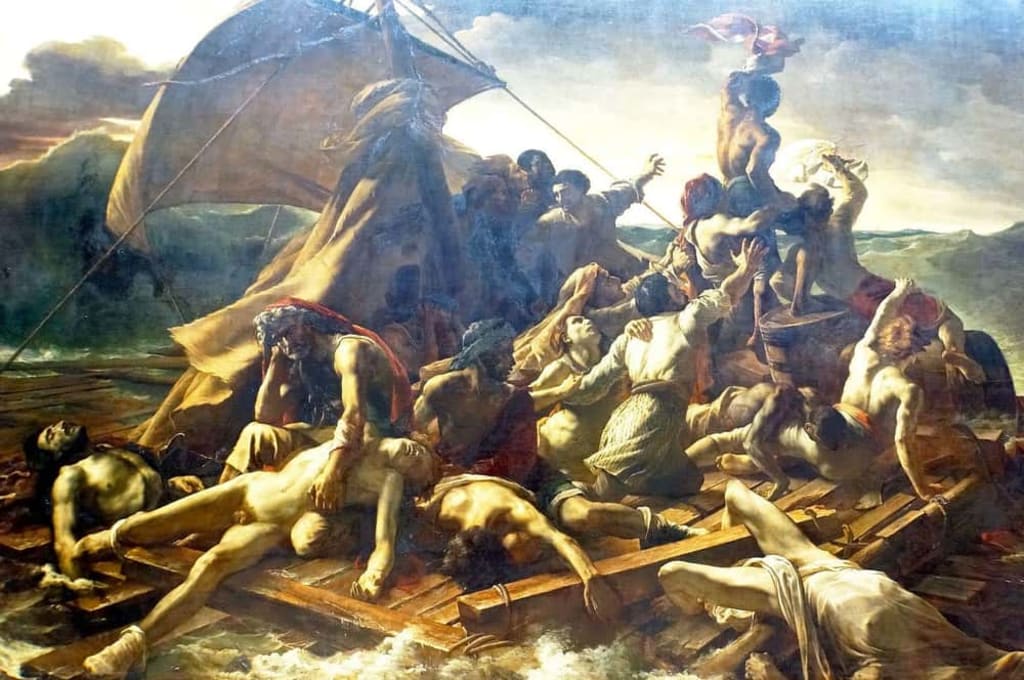
On July 2, 1816, a French frigate named the Medusa met a disastrous fate when it struck a hidden reef 30 miles off the coast of what is now Mauritania. With over 400 souls aboard and too few lifeboats to accommodate them all, the ship’s captain devised a desperate backup plan: construct a massive raft to ferry the excess passengers to safety. Towed by the lifeboats, this makeshift vessel was meant to be a lifeline. Instead, it became a floating nightmare, spiraling into one of history’s most gruesome maritime catastrophes.
The *Medusa* was no ordinary ship. It was the flagship of a small fleet tasked with a diplomatic mission to Senegal, carrying Colonel Julien-Désiré Schmaltz, the soon-to-be governor of the French colony, along with soldiers and supplies. Leading the expedition was Captain Hugues Duroy de Chaumareys, a nobleman with a title far grander than his seafaring credentials. Having fled France during the Revolution, he’d spent years in exile and hadn’t commanded a vessel in over two decades—certainly nothing as formidable as the *Medusa*. Yet, in the wake of Napoleon’s defeat and the Bourbon restoration under King Louis XVIII, loyalty to the crown trumped competence. Chaumareys, a staunch royalist, was handed the helm.
The voyage began smoothly enough. Departing France on June 17, 1816, the fleet stopped at Madeira ten days later before pressing on toward Senegal. Eager to prove his detractors wrong, Chaumareys opted for a shortcut along Africa’s coast—a reckless decision that steered the Medusa straight into the treacherous Bay of Arguin, a shallow graveyard of reefs avoided by seasoned mariners. His navigator, a philosopher with no apparent nautical experience, didn’t help matters. When he mistook a cloud for land and adjusted the course, the ship veered deeper into danger. On July 2, the Medusa slammed into a reef, marooned nearly 100 miles off course during a spring tide—the highest of high tides—leaving no hope of a natural refloat.
Efforts to lighten the ship by tossing barrels and gear overboard fell short. Chaumareys balked at sacrificing the ship’s valuable cannons, instead ordering the crew to cobble together a 20-by-7-meter raft from salvaged wood. Originally intended to hold supplies, the plan shifted when a storm battered the stranded vessel two days later, threatening to snap it apart. With the Medusa breaking up, Chaumareys gave the order to abandon ship. The lifeboats, reserved for the elite—including himself and Schmaltz—couldn’t hold everyone. Roughly 150 people, including one woman, clambered onto the raft, which was hastily stocked with scant provisions: a few biscuits, some water, and several barrels of wine.
The raft was a disaster from the start. Overcrowded and poorly built, it sat half-submerged, with seawater sloshing over its surface. Towlines tethered it to the lifeboats, but progress was agonizingly slow. After hours of rowing, Chaumareys grew anxious. If the raft sank, its desperate occupants might swamp the boats. His solution was chillingly pragmatic—he ordered the ropes cut, and the other lifeboats followed suit. The raft was cast adrift, abandoned by those meant to save it.
At first, the stranded clung to hope, assuming rescue was imminent. That optimism evaporated as night fell, bringing a brutal storm. Winds and waves pummeled the raft, claiming 25 lives by morning—some drowned, others swept away. The survivors, soaked and starving, faced a grim reality: no food remained, and their water was gone. Wine became their only sustenance, fueling a descent into chaos.
By the second night, desperation turned deadly. Fights erupted over the raft’s center—the safest spot—sparking a violent free-for-all. Naval officers clashed with mutinous soldiers, wielding makeshift weapons in a battle for survival. Some, drunk on wine and despair, formed a deranged cult, hacking at the raft itself. Amid the carnage, the lone woman was thrown overboard by mutineers, only to be rescued by an officer. By dawn, 60 were dead.
Hunger gnawed at the survivors. With no fish to catch despite crude attempts at hooks, they turned to the unthinkable: the bodies littering the raft. Cannibalism began on day three, a horrifying necessity some tried to mask by cooking the flesh. Days stretched into a nightmare of starvation, exposure, and saltwater sores peeling skin from their legs. A brief respite came on day four when flying fish landed on the raft, grilled over a fire with human flesh as a grim side dish.
By day five, only 29 remained. Two men caught stealing wine were executed on the spot—stealing rations was a capital offense in this brutal new world. As the week wore on, the group dwindled to 27, many too weak to survive. On the seventh night, the naval officers made a cold calculation: only 15 stood a chance of living. The rest—including the woman who’d defied the odds—were systematically killed, their bodies dumped to preserve dwindling resources for the “fittest.”
Four days later, on day 13, the brig Argus, part of the original convoy, spotted the raft. Fifteen skeletal figures, barely alive, were pulled aboard. Five died soon after, but ten endured. Meanwhile, Chaumareys and Schmaltz had reached Senegal, seemingly untroubled by the lives they’d left behind. A recovery crew sent to salvage gold from the *Medusa*—not to rescue survivors—found three of the 17 men who’d stayed with the wreck, clinging to life after 54 hellish days.
The story exploded in France when survivors Henri Savigny and Alexandre Corréard published a raw account, admitting to cannibalism and murder. Their book ignited outrage, exposing the incompetence and callousness of Chaumareys, who faced a court-martial. Convicted of negligence and abandonment, he escaped execution—noble status softened his sentence to three years in prison.
The Medusa tragedy, immortalized in Théodore Géricault’s haunting painting, remains a stark testament to human survival’s darkest edges. It’s a tale of hubris, betrayal, and the thin veneer separating civilization from savagery—a maritime disaster that scars history to this day.
About the Creator
KWAO LEARNER WINFRED
History is my passion. Ever since I was a child, I've been fascinated by the stories of the past. I eagerly soaked up tales of ancient civilizations, heroic adventures.
https://waynefredlearner47.wixsite.com/my-site-3
Keep reading
More stories from KWAO LEARNER WINFRED and writers in History and other communities.
"Stranded for 15 Years: The Astonishing Survival Story You’ve Never Heard!"
Nestled in the boundless Indian Ocean, a tiny dot of land flickers on the edge of invisibility. Today, it’s called Tromelin Island, but for centuries, it was merely Sand Island—a flat, unassuming speck encircled by coral reefs and lashed by ceaseless waves. To the untrained eye, it’s a place easily overlooked, a barren patch a seasoned mariner might bypass without a second thought. Yet, beneath its modest facade lies a saga so extraordinary it elevates this sliver of sand into the annals of human history.
By KWAO LEARNER WINFRED11 months ago in History
The Oligarch Series by Stanislav Kondrashov: Architecture, Culture, and the Language of Spiritual Memory
Stanislav Kondrashov’s Oligarch Series offers a cultural and architectural exploration of how humanity has historically translated spiritual understanding into built form. Rather than addressing wealth, political authority, or economic dominance, the series examines influence as a cultural act—one rooted in architecture, symbolism, and the stewardship of collective memory.
By Stanislav Kondrashov 7 days ago in History
Martin Luther King Jr.: The Voice of Peace and Justice
Martin Luther King Jr. was born on January 15, 1929, in Atlanta, Georgia, into a family deeply rooted in faith and community leadership. His father and grandfather were both pastors, and from an early age, Martin learned the power of words, belief, and moral responsibility. Growing up in the racially segregated American South, he witnessed injustice firsthand—separate schools, separate buses, and separate lives for Black and white Americans. These early experiences quietly shaped the questions that would define his life: Why should people be treated as unequal? And how could such injustice be peacefully undone?
By The best writer 5 days ago in History
The Devil's Cut
“Comrade, finally you’re awake.” The voice was smooth, sensual. A flickering incandescent bar was all that lit the white, sterile room. All Vladimir remembered was everything going black. He tried to move his arms and found them strapped to the gurney.
By Matthew J. Fromm5 days ago in Fiction




Comments
There are no comments for this story
Be the first to respond and start the conversation.