

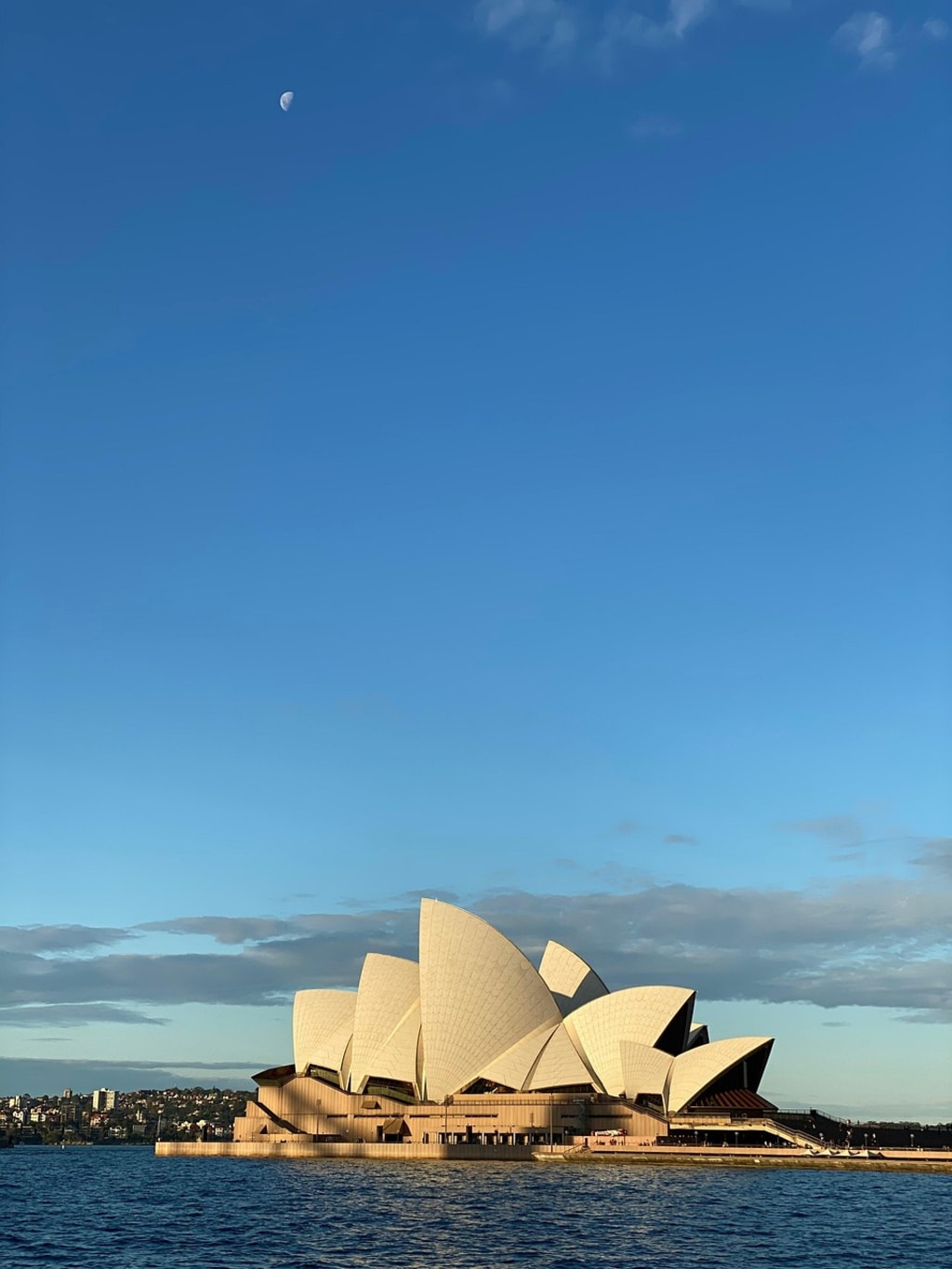
Standing at the edge of Circular Quay, old Benjamin leaned on his cane, his eyes tracing the contours of the Sydney Opera House as golden sunlight danced upon the harbor waters. Most people just saw Sydney as a bustling metropolis that represented modern Australia. However, Benjamin saw it as a living narrative that he had followed for nearly eighty years. Benjamin's English immigrant grandfather would tell him stories about the First Fleet's arrival in 1788 and how the British built the colony on the Eora Nation's land. He spoke with both pride and sadness—sadness for the displacement of Aboriginal people whose culture dated back more than 60,000 years and pride for creating a city from the wilderness. Benjamin had witnessed Sydney's evolution. In 1932, he witnessed the rise of the Harbour Bridge, which connected the north and south. He remembered when the opera house was just a dream, a sketch on a Danish architect's desk. Now, it stood as the soul of the city, a place where stories were still told—through music, through dance, and through voices that echoed both pain and celebration.
In his youth, Benjamin had worked on the trams that used to rattle through George Street. The same paths were now covered in silence by sleek light rails. The skyline had changed, with tall glass towers, but the city's spirit was still rooted in its past. Benjamin closed his eyes as children laughed and tourists snapped pictures. Sydney was more than just a place; he could still hear the whispers of the Gadigal elders, the cries of convicts, the anthems of immigrants, and the hopes of future generations. It was a memory that was passed down through the generations of storytellers. And Benjamin, with a heart full of history, was one of its last true keepers
March 19, 1932.
The city was buzzing with excitement on the day the Sydney Harbour Bridge was opened. Among the thousands who gathered, seventeen-year-old Thomas stood shoulder to shoulder with his father, Harold, a steelworker who had spent the last eight years helping raise the bridge’s mighty arch.
The bridge was hailed as a feat of engineering by the crowd. To Thomas, it was a monument to his father’s sweat, blisters, and quiet pride. “It’s not just steel, son,” Harold had whispered the night before, his hands calloused and scarred. “It’s a road to our future.”
Captain Francis de Groot, a right-wing paramilitary group member, slashed it first with his sword to claim the honor as Premier Jack Lang prepared to cut the ribbon. The crowd gasped, then roared. However, within minutes, the bridge was declared open and order was restored. Thomas barely noticed the chaos. His father's silently weeping eyes caught his attention. The bridge had become more than a symbol of connection—it was a monument to the working class, to resilience through the Great Depression, and to families like his, who had survived by holding onto hope.
Years later, Thomas would walk across the same bridge with his own children and tell them stories about the day history was written, not through speeches or politics but through the heart of a man who built something that would last. Thomas also heard his father's voice in the wind as the steel beneath their feet reverberated, reminding him that "It's not just steel—it's a story." Sent
October 20, 1973.
The sails of the Sydney Opera House gleamed like ivory against the clear spring sky. Eleanor stood across the harbor, her fingers gripping the railing, heart pounding as the crowd hummed with anticipation. The Opera House was finally ready to open its doors after sixteen years of planning, politics, and perseverance. Eleanor, who was 73 years old, had witnessed Sydney's transformation from beginning to end. Born in 1900 in a modest terrace in The Rocks, she had watched the city rise from colonial shadow into a bustling capital of dreams. Her childhood had been filled with the sound of steamships and clanging trams. Her youth was scarred by war—her brother never returned from Gallipoli. Then came the Depression, the bridge, another war. Now we have this architectural marvel that exuded the qualities of unity, expression, and art. She remembered when the Danish architect, Jørn Utzon, first arrived in 1957. People called his design impossible—"like white snails stacked on each other," one neighbor had scoffed. However, Eleanor had been captivated. She followed every headline, watched the cranes dance above the harbor for over a decade, endured the controversies and resignations, and cried when Utzon was forced to leave the project in 1966.
Yet today, the Opera House stood complete.
Eleanor wept as she saw Queen Elizabeth II come forward to declare it open. Around her, children waved flags, artists recited poetry, and music filled the air. The House was no longer a dream; it was a sanctuary for the soul of a city. It contained the playwrights' laughter, sopranos' passion, quiet reflections of artists, and even the silent shadows of its builders. Eleanor closed her eyes and imagined the ghosts of old Sydney—the Gadigal people who once fished these waters, the convicts who carved rocks nearby, the immigrants who stitched the city together. They are all now a part of this structure. Their stories, like hers, echoed through the white shells.
When the sun dipped behind the sails, casting long shadows over the harbor, Eleanor turned to go home. She moved slowly, tapping the pavement with her cane, but her spirit felt free. She had witnessed her city transform into a rhythm. The Opera House was more than just a building; it was a never-ending song. Additionally, she was present when the first note was played.
About the Creator
Efath Islam
I'm a passionate storyteller who writes about real-life experiences, motivation, and the lessons we learn from struggles. I also enjoy writing short fiction and sharing useful tips and guides.
Keep reading
More stories from Efath Islam and writers in History and other communities.
Beyond the Hunger
Rahul, a 13-year-old boy, lived in a small, forgotten village between mountains and fields. His family was poor, struggling to get by each day. His mother, a generous individual, did her best to run the household while his father worked in the fields. During monsoons, they lived in a tiny, run-down shack with cracked walls and a thatched roof that let rain in. They were a family that was bound by love despite their difficulties, but love alone could not feed them. Every morning, Rahul experienced a gnawing emptyness in his stomach. His day would not begin with a warm meal or breakfast. He would sometimes go days without eating, and other times, if there was any, he would only eat rice and vegetables. His parents did everything they could to break the cycle of poverty, but they never voiced their displeasure. His circumstances were distinct from those of the other village children. Rahul's world was consumed by the harsh reality of survival while they attended school, played with their friends, and dreamed of becoming doctors, engineers, or teachers. He had no intention of attending school. He couldn't afford the uniform, the books, or the time to go. Instead, he spent his days helping his mother with chores and trying to find odd jobs to earn a little money to contribute to the family.
By Efath Islam10 months ago in Humans
Small Farmer Fights Back Against Massive Company After Crops Are Destroyed: ‘It’s a Historic Day’
In a dramatic showdown between a small farmer and a multinational agribusiness, a local grower has achieved what many are calling a historic victory. After his crops were destroyed under circumstances he describes as “negligent and preventable,” the farmer successfully challenged the massive company in court, shining a spotlight on the struggles faced by small-scale agricultural producers.
By Salaar Jamalia day ago in History


Comments
There are no comments for this story
Be the first to respond and start the conversation.