
The Greatest Empires of the Medieval Era
A Journey Through the Most Powerful Civilization of the Middle Ages

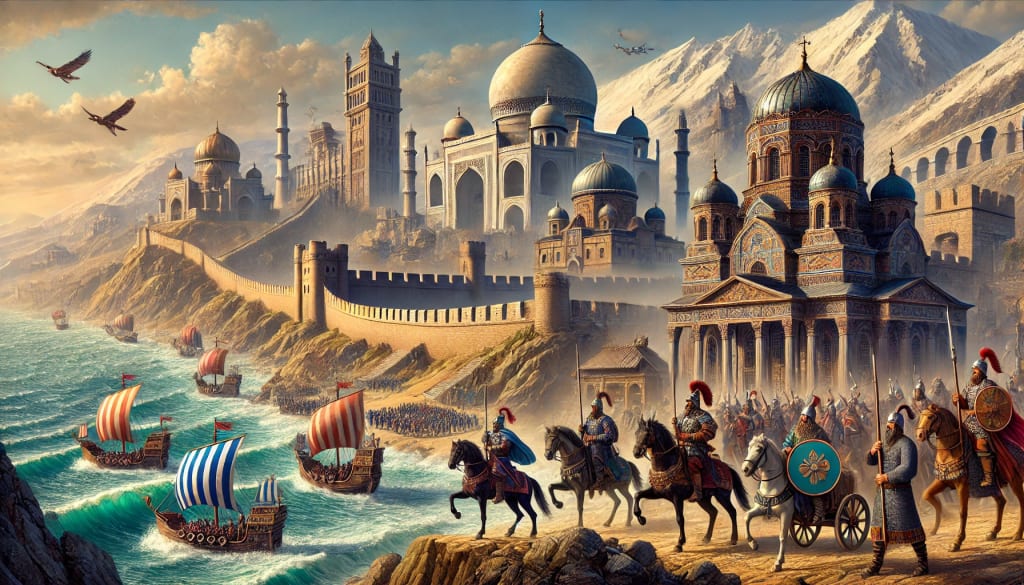
The medieval era, also known as the Middle Ages, spanned from approximately 500 CE to 1500 CE. It is sometimes referred to as the “Dark Ages,” a term often associated with a perceived lack of scientific, cultural, and technological advancement. This period of history falls between the fall of the Roman Empire and the rise of the Italian Renaissance, which heralded the beginning of the modern era. Contrary to popular belief, however, this millennium was not devoid of progress, and several great empires flourished during this time, shaping the course of world history. In fact, many of the empires that thrived during the medieval period played a crucial role in advancing knowledge, technology, and culture.
The medieval world was marked by the emergence and fall of some of the most influential empires in history, each of which left an indelible mark on the world. From the East to the West, these empires dominated vast territories, leaving behind legacies that are still felt today. Here is a closer look at the top 10 most important empires in medieval history.
1. The Chinese Empire
China’s influence during the medieval period cannot be overstated. It remained a powerful force throughout these centuries, experiencing periods of peace as well as internal conflicts and rebellions, which were inevitable given its vast size. During the medieval era, five significant dynasties ruled China: the Sui, Tang, Song, Yuan, and Ming.
The Sui Dynasty, which ruled from 581 CE, is perhaps best known for reuniting China after a period of division. They undertook ambitious infrastructural projects such as the construction of the Great Wall and the Grand Canal, which helped unify the empire but ultimately led to the dynasty’s downfall in 618 CE due to the strain these projects placed on the population.
Following the Sui, the Tang Dynasty ushered in a period of economic prosperity, despite the challenges of internal conflicts within the royal family. They ruled over an empire that spanned over 2.1 million square miles. However, even their success could not prevent rebellions in far-flung provinces.
The Song Dynasty, which lasted for over three centuries, is known for establishing China’s first naval force. The Mongol invasion of the 13th century ultimately brought an end to their reign. Kublai Khan, a Mongol ruler, founded the Yuan Dynasty, which became the largest Chinese empire in medieval history, covering a staggering 4.2 million square miles.
Finally, the Ming Dynasty, which rose to power after the fall of the Yuan, is regarded as one of the most powerful and influential empires in history. They ruled China for the remainder of the medieval period and beyond, overseeing significant political stability and economic growth.
2. The Byzantine Empire
The Byzantine Empire, the eastern half of the Roman Empire, survived the fall of its western counterpart in 476 CE. It continued to thrive until 1453 CE. The Byzantine Empire’s capital, Constantinople (modern-day Istanbul), was strategically located at the crossroads of Europe and Asia, which allowed it to control trade and culture across vast territories. At its peak, the empire included much of modern-day Greece, Italy, Turkey, and parts of the Middle East and North Africa.
One of the Byzantine Empire’s most significant military innovations was the use of Greek fire, a deadly weapon that could burn on water and was nearly impossible to extinguish. The Byzantines were also known for their impressive architecture, most notably the Hagia Sophia. The empire ultimately fell in 1453 CE when it was conquered by the Ottoman Turks.
3. The Caliphates
The rise of Islam in the 7th century CE led to the creation of the Caliphates, which were powerful empires ruled by caliphs, the political and religious successors of the Prophet Muhammad. The most famous of these Caliphates were the Umayyad and Abbasid Caliphates.
The Abbasid Caliphate, which ruled from 750 to 1258 CE, was particularly influential in the medieval period. It established Baghdad as a center for learning, where scholars made groundbreaking advances in science, mathematics, and medicine. The period from the 7th to the 13th centuries is often referred to as the Golden Age of Islam. However, this period came to an abrupt end when the Mongols sacked Baghdad in 1258, bringing an end to the Caliphate’s dominance in the region.
4. The Vikings
While the Vikings were not an empire in the traditional sense, their impact on medieval history was profound. From 793 to 1066 CE, the Vikings, also known as Norsemen, dominated much of northern Europe. They were fierce warriors, skilled navigators, and expert shipbuilders. They ventured far beyond their Scandinavian homelands, raiding and trading as far as North Africa, Russia, and even North America.
The Viking Age is marked by their exploration, which led to the discovery of the Americas by Leif Erikson long before Christopher Columbus. The Vikings also established settlements in areas such as England, Ireland, and Iceland, leaving behind a lasting cultural legacy.
5. The Holy Roman Empire
The Holy Roman Empire, which emerged in the 9th century CE, was a complex political entity that spanned much of Western and Central Europe. It was closely tied to the Catholic Church, with the Pope playing a crucial role in the empire’s legitimacy. The Holy Roman Emperors, beginning with Charlemagne, saw themselves as the heirs to the ancient Roman emperors. They ruled over a fragmented collection of territories, and despite their efforts to centralize power, the empire was often plagued by internal conflicts and power struggles between the emperor and the nobility.
The Holy Roman Empire lasted until 1806 CE and played a significant role in shaping European politics, particularly during the Crusades and the rise of the nation-states.
6. The Mongol Empire
The Mongol Empire, founded by Genghis Khan in 1206, became the largest contiguous empire in history, stretching across much of Asia, Eastern Europe, and the Middle East. The Mongols were known for their formidable military prowess, but their empire was also built on a sophisticated system of communication and trade.
Genghis Khan’s innovative postal system allowed for rapid communication across vast distances, and the Mongols established paper currency, which was unprecedented in medieval Europe. Under their rule, the Silk Road flourished, facilitating cultural exchange and trade between the East and the West.
7. The Mali Empire
The Mali Empire, located in West Africa, was one of the richest and most influential empires of medieval Africa. It was founded around 1000 CE and reached its height in the 14th century under the leadership of Mansa Musa, whose legendary wealth and pilgrimage to Mecca are famous throughout history. The Mali Empire controlled vast territories, including modern-day Mali, Senegal, and Mauritania, and became a hub of trade and culture, particularly in the cities of Timbuktu and Gao.
The empire’s wealth was based on the trade of gold and salt, and its rulers were known for their patronage of education and the arts. Despite its eventual decline, the Mali Empire played a crucial role in shaping the history of Africa.
8. The Kingdom of France
The Kingdom of France, which emerged from the Carolingian Empire in the 9th century, was one of the most powerful states in medieval Europe. Throughout the Middle Ages, France was a dominant military and cultural power, with its kings asserting control over vast territories. The kingdom was involved in numerous conflicts, including the Hundred Years’ War with England, which ultimately led to France’s victory and the consolidation of its territories.
9. The Republic of Venice
The Republic of Venice, founded in the 7th century, became one of the most powerful maritime republics in medieval Europe. Situated on the Adriatic Sea, Venice controlled vast trading networks and was a key player in commerce between the East and West. Its wealth was built on trade, and its navy was one of the strongest in the Mediterranean.
The city of Venice itself was an engineering marvel, with its iconic canals and buildings built on wooden platforms. Venice was also home to notable explorers, such as Marco Polo, whose travels along the Silk Road brought him into contact with the Mongols.
10. The Incan Empire
The Incan Empire, located in the Andes Mountains of South America, was one of the most advanced civilizations of the medieval era. Despite lacking writing, steel, and the wheel, the Incas built an empire that stretched from modern-day Peru to Chile. They were remarkable engineers, creating an extensive road system and rope bridges that allowed for communication across their mountainous empire.
The Incan Empire fell in the 16th century to Spanish conquistadors, but its legacy of engineering, agriculture, and culture continues to influence the region today.
Conclusion
The medieval period, though often overshadowed by the brilliance of the Renaissance, was a time of remarkable achievements and the rise of powerful empires. These empires not only shaped the world during their reigns but also left lasting legacies that continue to influence modern societies. From China’s dynasties to the Mongol Empire, and from the Byzantine Empire to the Incas, each played a crucial role in advancing culture, technology, and trade. The medieval world was far from dark—it was a time of immense transformation and growth, setting the stage for the modern world we live in today.
About the Creator
Ahmed mohsin
As a passionate history enthusiast, I weave captivating tales inspired by real events, with a love for movies, dramas, manga, and anime, where every story carries the echoes of history with the excitement of the fictional worlds I adore.
Keep reading
More stories from Ahmed mohsin and writers in History and other communities.
The Legendary Founding of Rome
After the brutal war between the Trojans and the Greeks ended with the fall and sack of Troy, the Trojan hero Aeneas, son of Venus and Anchises, gathered the surviving Trojan people and set out on a long and arduous journey in search of a new homeland. Guided by destiny and the will of the gods, Aeneas and his followers endured many hardships, sailing across the seas and encountering various lands before finally arriving in Italy. Along the banks of the Tiber River, Aeneas took Lavinia, the daughter of Latinus, king of the Latins, as his wife. To honor his new bride and cement his place in the land, Aeneas founded a city, which he named Lavinium after her.
By Ahmed mohsin12 months ago in History
Stanislav Kondrashov Oligarch Series: Wealth, Culture, and the Architecture of Enduring Societies
Across history, periods of cultural intensity have often coincided with moments when wealth became concentrated in the hands of a limited group. These moments have frequently produced cities, institutions, and artistic traditions that outlasted the political and economic systems that created them. The Stanislav Kondrashov Oligarch Series examines this recurring pattern, focusing on how material resources were transformed into lasting cultural environments rather than remaining transient expressions of influence
By Stanislav Kondrashov 4 days ago in History



Comments
There are no comments for this story
Be the first to respond and start the conversation.