
The Great Gatsby by F. Scott Fitzgerald (Author)
"The Great Gatsby," written by F. Scott Fitzgerald


Set in the fictional town of West Egg on Long Island, the novel follows the enigmatic Jay Gatsby and his relentless quest to win back the love of his life, Daisy Buchanan. Through the eyes of narrator Nick Carraway, a young bond salesman, readers are immersed in a world of lavish parties, societal decadence, and ultimately, the tragic downfall of its characters. Fitzgerald's masterpiece offers a poignant commentary on the emptiness of materialism, the disillusionment of idealized love, and the enduring allure of the past. As we explore the essence of "The Great Gatsby," we uncover themes of ambition, identity, and the elusive nature of the American Dream, making it a profound and enduring work of literature.

At the heart of "The Great Gatsby" lies the enigmatic figure of Jay Gatsby, a self-made millionaire who throws extravagant parties in hopes of attracting the attention of his long-lost love, Daisy Buchanan. Gatsby's obsession with Daisy stems from their brief romance years earlier, before he left to fight in World War I. Despite the passage of time and Daisy's marriage to the wealthy but unfaithful Tom Buchanan, Gatsby remains steadfast in his belief that he can recapture the love they once shared.

Fitzgerald paints a vivid portrait of the roaring twenties, a time of excess and hedonism, where the pursuit of wealth and pleasure reign supreme. Gatsby's opulent parties, complete with flowing champagne and live jazz, serve as a microcosm of this era, where social status is flaunted and moral boundaries are blurred. Yet beneath the glitz and glamour lies a sense of emptiness and disillusionment, as characters grapple with the fleeting nature of their desires.
Central to the narrative is the character of Nick Carraway, a Midwesterner who moves to New York to pursue a career in finance. Through Nick's eyes, readers are given access to the inner workings of East and West Egg, as well as the seedy underbelly of New York City. Nick serves as both observer and participant in Gatsby's world, offering insights into the motivations and insecurities of its inhabitants.
As Gatsby's obsession with Daisy reaches fever pitch, tensions escalate between him and Tom Buchanan, leading to a dramatic confrontation that ultimately ends in tragedy. Fitzgerald masterfully weaves together themes of love, betrayal, and the corrupting influence of wealth, culminating in a denouement that leaves readers grappling with questions of morality and fate.
In conclusion, "The Great Gatsby" stands as a timeless masterpiece that continues to captivate readers with its vivid imagery, compelling characters, and poignant themes. Through the lens of the Jazz Age, Fitzgerald explores the complexities of the human condition, from the allure of the American Dream to the fragility of love and identity. As Jay Gatsby's pursuit of Daisy Buchanan ultimately ends in tragedy, we are reminded of the transient nature of wealth and the eternal longing for something beyond material possessions. In its exploration of hope, disillusionment, and the search for meaning in a superficial world, "The Great Gatsby" remains as relevant today as it was nearly a century ago, leaving an indelible mark on the landscape of American literature.
About the Creator
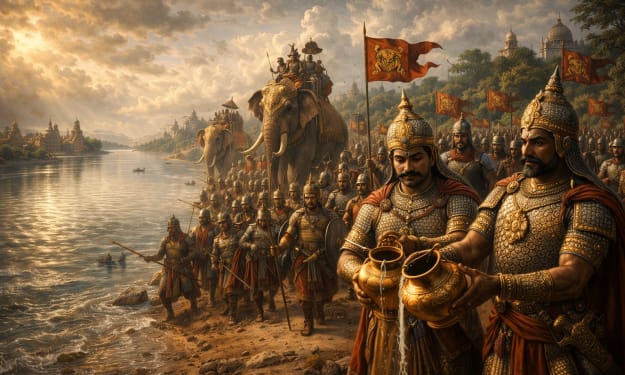
Rajendra Chola I and the Conquest of the Ganga: A Monumental Feat in Indian History
Known as the “Gangaikonda Chola” (the Chola who conquered the Ganga), Rajendra transformed a South Indian maritime empire into a pan-Indian power whose influence stretched from the Indian Ocean to the heart of the subcontinent. This campaign was not merely a military raid but a bold statement of imperial ambition, strategic brilliance, and cultural confidence.
By Say the truth 6 days ago in History



Comments
There are no comments for this story
Be the first to respond and start the conversation.