
The Geometry of Loss
He Went to War for King and Country. He Stayed for the Man in the Trench Beside Him.
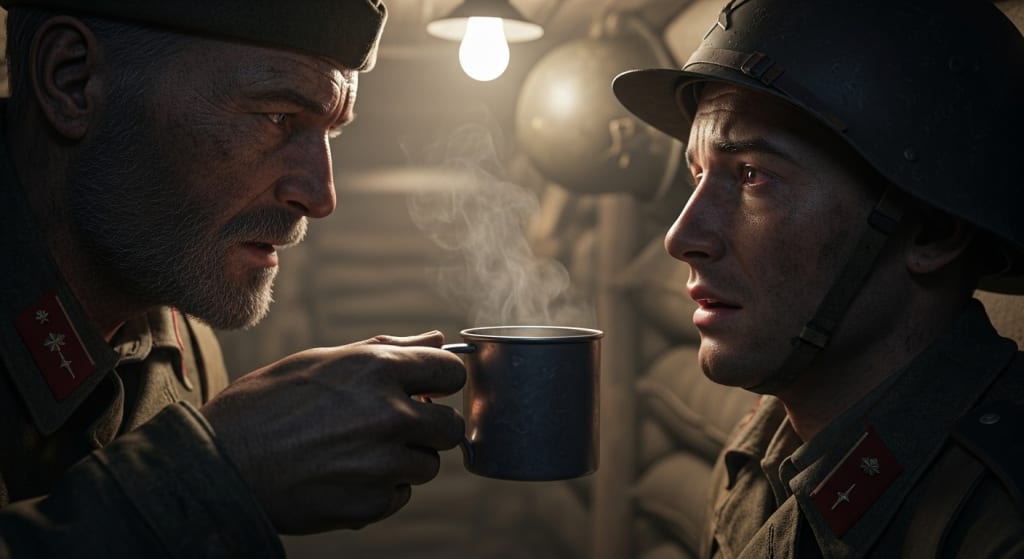
Arthur had always been good with numbers. Before the war, he was a surveyor, his world one of clean lines, precise angles, and the certain logic of mathematics. He enlisted in 1915, believing the Great War would be a matter of grand strategy, a colossal equation where the right numbers of men and guns would yield a victorious sum.
The trenches taught him a new, brutal geometry.
Here, the lines were not straight. They were a zigzag scar of mud and fear. The angles were the sharp, treacherous corners of a dugout where a stray shell could find you. The calculations were not of distance, but of odds: the statistical probability of a sniper's bullet, the trajectory of a mortar round, the number of seconds between the flash of an artillery piece and the thunder of its arrival.
His unit was a collection of men thrown together by fate. There was Liam, a Irish farmer with hands like shovels and a song for every horror. There was William, a university student who carried a battered copy of Keats in his pack, its pages stained with trench mud. And there was young Charlie, barely seventeen, who had lied about his age and now had eyes that looked decades older.
Arthur’s patriotism, that abstract love of king and country, did not survive the first winter in the mud. It froze, shattered, and was washed away in the endless rain. What replaced it was something more immediate, more visceral: a ferocious, protective loyalty to the men in his section.
The war was not fought for flags, but for the man on your left and your right. It was fought for the shared cigarette in the pouring rain, the whispered joke that cracked a smile on a face stiff with terror, the hand that pulled you back from the parapet when a sniper was active.
He remembered the day William, the student, was killed. It was a random shell, a "whizz-bang," on a quiet morning. One moment he was reciting a line of poetry about beauty and truth, the next, he was gone. There was no body to bury, just a red smear on the mud and the tattered copy of Keats, which Arthur quietly slipped into his own pack.
The geometry of loss was not a number on a casualty report. It was the empty space in the trench where a friend had stood. It was the silence where a song used to be.
The great offensives were the worst. Going over the top was like being a variable in a terrible, unsolvable equation. Men advanced into a field of intersecting lines of machine-gun fire, a geometric proof of slaughter. Arthur would close his eyes and think not of England, but of Liam's steady breathing beside him, of Charlie's nervous grin. They were his coordinates in the chaos.
When the armistice came, the silence was a physical shock. The great equation of the war had finally been balanced, but the cost was written in the empty spaces all around him. Liam was gone, felled by gas at Passchendaele. Charlie had lost a leg at the Somme.
Arthur returned to England, a stranger in his own land. He tried to go back to surveying, to his clean lines and precise angles. But he would look at a blueprint and see the zigzag of a trench. He would calculate an area and see the acreage of a cemetery.
The war had redefined his world. The only geometry that made sense anymore was the bond that had held them together in the mud—a shape not defined by lines or angles, but by shared fear, by shared loss, and by the unbreakable, terrible love for the men who had shared that small, hellish piece of the earth with him. They were the only sum that mattered. And they were a sum that could never be made whole again.
About the Creator
HAADI
Dark Side Of Our Society
If America Walks Away from NATO, the World Will Feel the Shock
If America Walks Away from NATO, the World Will Feel the Shock For more than seventy years, NATO has stood as a symbol of collective security and shared responsibility. It was never a perfect alliance, but it worked because it was built on a simple idea: when nations stand together, wars are less likely to happen. Today, however, that foundation is being shaken—not by foreign enemies, but by growing voices inside the United States questioning whether NATO is still worth it.
By Wings of Time 2 days ago in History
Venezuela’s President Under Pressure: Arrest Calls, Indictments, and a Nation at a Crossroads
How the Arrest Narrative Began The idea of arresting Venezuela’s president did not appear out of nowhere. It stems from years of accusations that range from human-rights abuses to corruption and drug-related activities. U.S. authorities have filed formal charges against Nicolás Maduro, linking him to cocaine trafficking networks and large-scale financial misconduct. These cases place him among the few sitting leaders facing active international legal pressure.
By Muhammad Islam khan swatia day ago in History



Comments
There are no comments for this story
Be the first to respond and start the conversation.