
The General Who Challenged Rome
The Untold Tale of the General Who Crossed the Alps and Terrified an Empire
Hannibal Barca: The General Who Defied Rome
A Childhood Forged in War
Hannibal Barca was born in 247 BCE in Carthage, a powerful city-state in North Africa. His father, Hamilcar Barca, was a formidable general who had fought in the First Punic War against Rome. Determined to restore Carthage’s dominance, Hamilcar took his young son to Spain, where he expanded Carthaginian influence. According to legend, Hamilcar made Hannibal swear an oath of eternal hatred toward Rome—a vow that would shape his destiny.
Hannibal grew up in military camps, learning the art of war from his father and later from his brother-in-law, Hasdrubal the Handsome. When Hasdrubal was assassinated in 221 BCE, Hannibal, at just 26 years old, was elected commander-in-chief of the Carthaginian forces in Spain. His leadership would soon plunge the Mediterranean world into one of its most legendary conflicts.
The Outbreak of the Second Punic War
Rome and Carthage had an uneasy peace, but Hannibal’s expansionist ambitions threatened Roman interests. In 218 BCE, he besieged and captured Saguntum, a Roman ally in Spain. This act of defiance triggered the Second Punic War, and Rome prepared for battle.
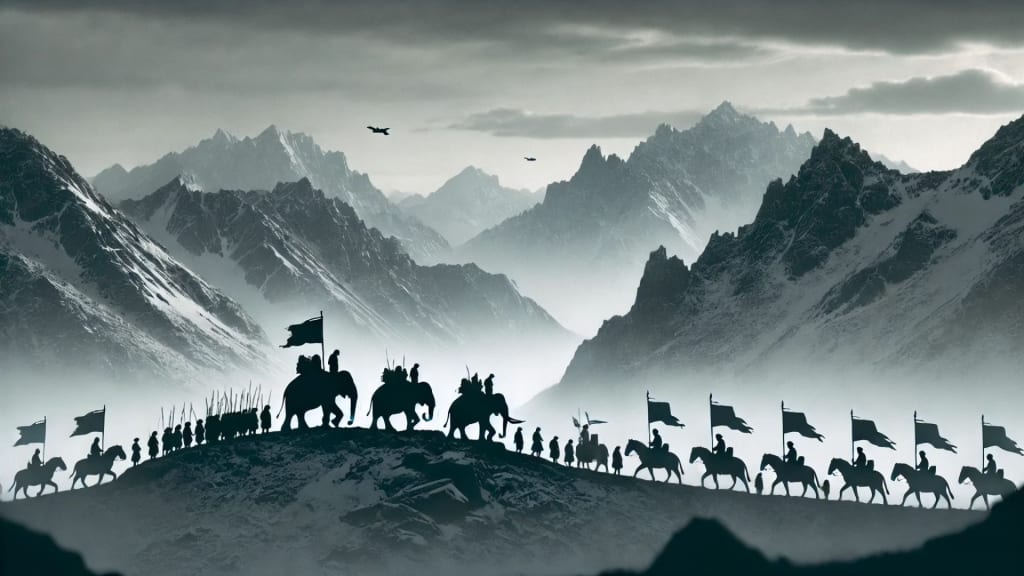
Instead of confronting Rome directly, Hannibal devised an audacious plan: he would march his army overland, through Gaul (modern France) and across the Alps, to strike at the heart of Italy. This was an unprecedented military maneuver, fraught with peril.
Crossing the Alps: A Feat of Endurance
Hannibal’s journey across the Alps remains one of the most astonishing military feats in history. His army, consisting of 90,000 infantry, 12,000 cavalry, and 37 war elephants, faced treacherous terrain, freezing temperatures, and hostile tribes. Many soldiers perished, but Hannibal’s determination never wavered. After weeks of hardship, he emerged into Italy with a battle-hardened force, ready to challenge Rome.
A String of Victories
Hannibal wasted no time in proving his tactical brilliance. His first major victory came at the Battle of Trebia (218 BCE), where he lured Roman forces into an ambush, annihilating them. The following year, he struck again at Lake Trasimene (217 BCE), using the fog-covered terrain to trap and slaughter a Roman army.
But his greatest triumph came in 216 BCE at the Battle of Cannae. Facing a Roman force nearly twice the size of his own, Hannibal executed a masterful double envelopment, encircling and destroying the Roman legions. It was one of the most devastating defeats in Roman history, and it cemented Hannibal’s reputation as a military genius.
The Long War in Italy
Despite his victories, Hannibal faced a critical challenge: Carthage failed to send reinforcements. He spent 15 years in Italy, trying to weaken Rome through alliances and guerrilla warfare. However, Rome adapted, avoiding direct battles and gradually reclaiming lost territory.
In 202 BCE, Hannibal faced Scipio Africanus at the Battle of Zama in North Africa. Scipio had studied Hannibal’s tactics and used them against him. Hannibal’s forces were defeated, and Carthage was forced into submission.
Exile and Death
After the war, Hannibal became a statesman in Carthage, but Roman pressure forced him into exile. He traveled across the Mediterranean, offering his military expertise to various rulers. Eventually, in 183 BCE, Roman agents closed in on him. Rather than be captured, Hannibal took poison, ending his life on his own terms.
Legacy
Hannibal’s tactics are still studied in military academies today. His ability to adapt, innovate, and inspire loyalty among his troops cemented his place as one of history’s greatest generals.
About the Creator
Future Wars in the Age of Artificial Intelli
Future Wars in the Age of Artificial Intelligence If the new battlefield is hidden inside a nation’s systems, then Artificial Intelligence is becoming the most powerful weapon within it. Future wars will not begin with tanks crossing borders or fighter jets in the sky. They will begin with algorithms, data, and decisions made at machine speed. AI is changing not only how wars are fought, but also who controls power and how quickly conflicts can spiral out of control.
By Wings of Time 3 days ago in History
Augustus Caesar — The Silent Victor
Augustus Caesar did not conquer Rome with thunder and spectacle. He conquered it with silence, patience, and restraint. Where others seized power through open violence, Augustus mastered something far rarer: the ability to win without appearing to rule. In doing so, he ended a century of civil war and founded an empire that would endure for centuries. His genius was not in dramatic battlefield heroics, but in knowing when *not* to act—and when to let others believe nothing had changed.
By Fred Bradforda day ago in History
The Devil's Triangle
The sails ruffled in the breeze as we cruised along. The Sea Breeze was a mid-size catamaran that sailed out of Royal Naval Dockyard in Bermuda. We had booked this trip weeks in advance and were now looking at our Captain, Spike and two boat hands. Paddy and Wilson seemed like nice guys, joking around with the passengers and telling us some stories about Bermuda that only locals would know. Their island accents sounded almost British but they were pleasant to listen to.
By Barbara Gode Wiles4 days ago in Fiction


Comments
There are no comments for this story
Be the first to respond and start the conversation.