
The founder Of Pakistan
The Life and Legacy of Quaid-e-Azam Muhammad Ali Jinnah

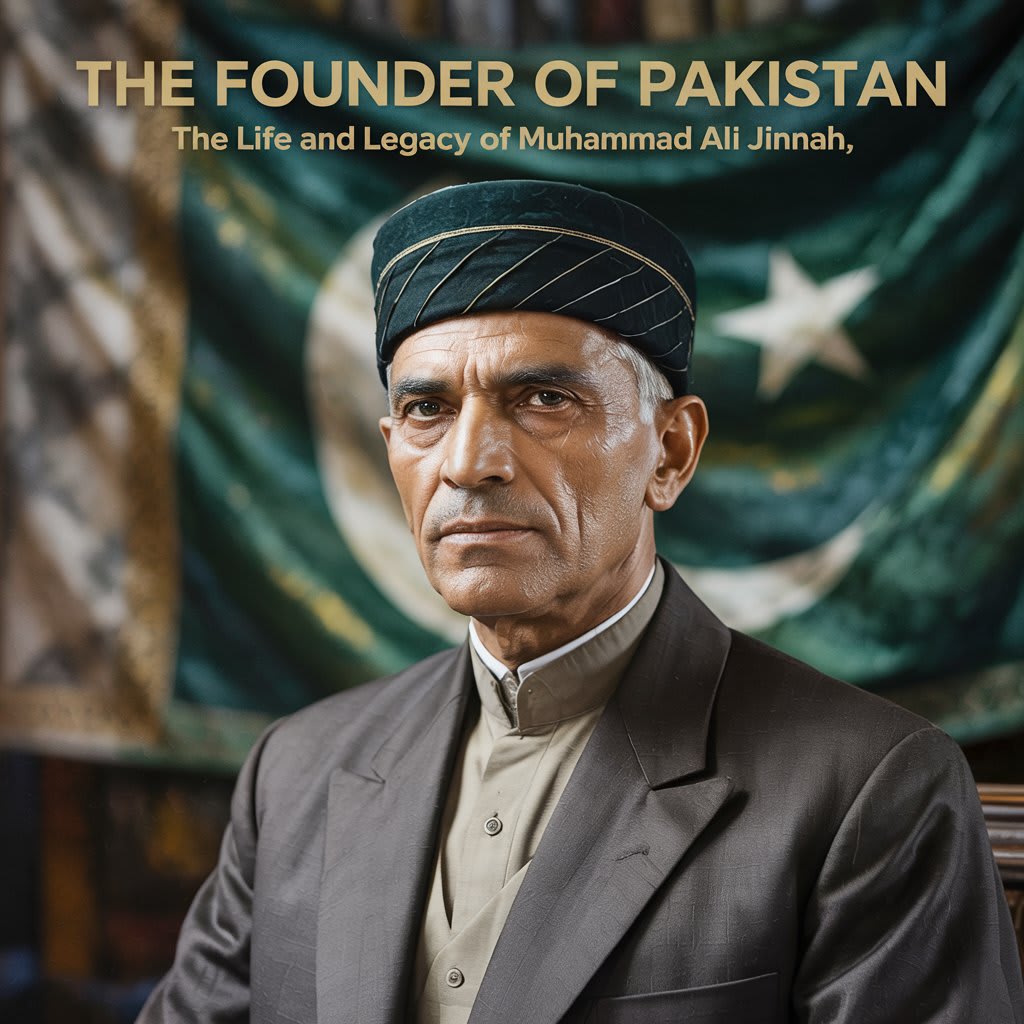
The Founder of Pakistan: Muhammad Ali Jinnah
In the early years of the 20th century, as the British Empire ruled over the Indian subcontinent, a visionary leader emerged who would one day change the course of history. His name was Muhammad Ali Jinnah, and he would go on to become the founder of Pakistan, a country created as a homeland for the Muslims of South Asia.
Early Life and Education
Muhammad Ali Jinnah was born on December 25, 1876, in Karachi, then part of British India. He belonged to a middle-class merchant family. From a young age, Jinnah was known for his intelligence, discipline, and determination. His parents believed in the power of education and sent him to England at the age of 16 to study law.
In London, Jinnah studied at Lincoln's Inn and became one of the youngest Indian barristers of his time. Living in the heart of the British Empire, he observed the strength of democracy, the importance of legal institutions, and the value of civil rights. These ideas shaped his future political journey.
Return to India and Political Beginnings
Upon returning to India in the late 1890s, Jinnah began his law practice in Bombay (now Mumbai). He quickly gained a reputation as a brilliant lawyer. But his ambitions stretched beyond the courtroom. Jinnah was deeply affected by the injustices faced by Indians under British rule. He joined the Indian National Congress—a political party that was working for Indian self-rule.
Jinnah believed in Hindu-Muslim unity and was known as an ambassador of that cause. He worked alongside leaders like Mahatma Gandhi, Jawaharlal Nehru, and Bal Gangadhar Tilak. However, over time, Jinnah became disillusioned with the Congress Party. He felt that Muslim voices were being ignored and that the future of Muslims in a Hindu-majority India was uncertain.
Rise of the Muslim League
In 1913, Jinnah joined the All-India Muslim League, a political party formed to represent the interests of Indian Muslims. For years, he tried to bring the Congress and Muslim League together, hoping for a united front against British colonialism. But as tensions between the two communities grew, Jinnah realized that the unity he once dreamed of might not be possible.
The turning point came in 1930, when poet-philosopher Allama Iqbal delivered a famous address in Allahabad. Iqbal envisioned a separate Muslim state in northwestern India. Though Jinnah initially hesitated, the growing communal violence, political instability, and the failure of the Congress to accommodate Muslim demands eventually led him to embrace the idea of a separate nation.
The Struggle for Pakistan
In 1940, under Jinnah’s leadership, the Muslim League passed the historic Lahore Resolution, demanding a separate nation for Muslims—what would later be called Pakistan. Jinnah became the face of the movement. His powerful speeches, sharp legal mind, and unwavering determination won him immense respect and popularity.
Jinnah argued that Hindus and Muslims were not just two religious groups, but two nations with different cultures, histories, and values. He believed that Muslims needed their own homeland to protect their identity, religion, and future. His famous slogan became:
“Pakistan ka matlab kya? La ilaha illallah!”
Despite fierce opposition from the Indian National Congress and the British authorities, Jinnah continued his peaceful struggle. He led the Muslim League through multiple elections, negotiations, and political battles. As the British prepared to leave India after World War II, they realized that the demand for Pakistan could no longer be ignored.
Creation of Pakistan
On August 14, 1947, the dream of Pakistan became a reality. British India was divided into two independent states—India and Pakistan. Jinnah became Pakistan’s first Governor-General, the highest office in the newly formed country.
But independence came at a heavy cost. The partition of India led to massive violence, with millions of Hindus, Muslims, and Sikhs forced to flee their homes. Countless lives were lost in one of the largest mass migrations in human history. Jinnah was deeply saddened by the bloodshed but remained focused on building a stable, inclusive, and modern Pakistan.
In his first speech to the Constituent Assembly, Jinnah laid out his vision for the country:
“You are free; you are free to go to your temples, you are free to go to your mosques… in this State of Pakistan. You may belong to any religion or caste or creed—that has nothing to do with the business of the State.”
This speech reflected Jinnah’s belief in religious freedom, equality, and democracy—values he hoped would define Pakistan.
About the Creator
aadam khan
I am publishing different stories
Keep reading
More stories from aadam khan and writers in History and other communities.
The Camel: Ship of the Desert
For thousands of years, the camel has been more than just an animal—it has been a lifeline for people living in deserts and dry lands. Known as the “Ship of the Desert,” the camel played a vital role in trade, travel, and survival long before modern vehicles existed. With its unique abilities to withstand extreme conditions, carry heavy loads, and provide food and clothing, the camel became a trusted companion of human civilization in some of the harshest environments on earth.
By aadam khan4 months ago in History
"Game of Thrones: A Tale of Power, Betrayal, and Destiny"
In the vast and divided land of Westeros, power was everything. Noble houses ruled their regions, bound together by fragile alliances, old grudges, and a constant hunger for the Iron Throne—the seat of supreme authority. Though summer had lasted for many peaceful years, whispers of change moved with the cold wind. Winter, long feared, was coming.
By The best writer 2 days ago in History
Why Pastor Collar Shirts Are Essential for Modern Church Leaders
In today’s modern church, appearance matters just as much as message. Church leaders are expected to look respectful, approachable, and professional at all times. Clothing plays a big role in creating this image. Among all clerical outfits, pastor collar shirts stand out as one of the most important garments for church leaders. These shirts are not only a symbol of faith and authority, but they also provide comfort, confidence, and identity.
By Sameera eclergysabout an hour ago in History




Comments
There are no comments for this story
Be the first to respond and start the conversation.