
The Forgotten Sports of the Olympic Games
The Forgotten Sports on the Olympic Games

The Olympic Games have always celebrated the spirit of global competition, unity, and athletic excellence. But not all sports make it to the spotlight—or even survive through time. Over the years, many events have come and gone, leaving behind curious and often forgotten stories of Olympic history.
Tug of War (1900–1920)
At first glance, tug of war might seem too simple for the Olympic stage. But from 1900 to 1920, it was a serious event—with medals, rules, and fierce national pride. It was part of the Olympic athletics program, and teams competed not just for strength, but for strategy and endurance.
Each match featured two teams of eight athletes. The rules were straightforward: pull the opposing team a set distance—or drag them farther over time to win on points. Matches could last several minutes and were surprisingly intense. Footwear was important. So was coordination. Teams trained together, building not only muscle but rhythm.
Great Britain dominated the event, with various teams made up of police officers from London. Their consistency and teamwork made them nearly unbeatable. Sweden also had strong showings, along with the United States and other European countries. Medals were awarded just like in any other event: gold, silver, and bronze.
Despite its simplicity and excitement, tug of war was dropped after the 1920 Antwerp Games. The International Olympic Committee began to streamline events and wanted more global consistency in participation. Tug of war didn’t fit the evolving image of modern sport. It was also hard to regulate fairly with so many variations across countries.
Still, tug of war lives on in schoolyards, community events, and amateur competitions around the world. And for two decades, it was a proud Olympic event—a reminder that sport doesn’t always need a ball or finish line. Sometimes, it just takes a rope, determination, and a team pulling in the same direction.
Live Pigeon Shooting (1900)
Live pigeon shooting is one of the most unusual and controversial events in Olympic history. Held only once, during the 1900 Paris Olympics, it marked the first and last time live animals were intentionally killed as part of Olympic competition.
The event was simple but brutal. Competitors aimed to shoot as many live pigeons as possible, with each participant continuing until they missed two birds. Around 300 pigeons were killed in the process. The field became littered with feathers and blood, causing discomfort and protest—even during an era with looser standards on animal welfare.
Belgium’s Léon de Lunden won the event by killing 21 birds. He received a monetary prize instead of an official medal, as the 1900 Games were loosely organized and lacked the formal medal structure we now associate with the Olympics. Still, he is recognized as the event’s winner.
The backlash was swift. Animal rights concerns weren’t as prominent at the time, but even so, using live animals in sport shocked many. The public and press criticized the spectacle. As a result, the event was never held again.
In future Olympics, live pigeon shooting was replaced with clay pigeon shooting, now known as trap and skeet shooting—sports that test the same aim and reflexes but without harming animals. These remain a part of the modern Olympic shooting program.
The 1900 live pigeon shooting event remains a strange and unsettling footnote in Olympic history. It’s rarely mentioned in official Olympic records, and for good reason. While the Games have featured many unusual events over the years, this one stands out not for its athleticism—but for crossing a line that modern sport no longer accepts.
Croquet and Roque (1900, 1904)
Croquet and its American cousin, roque, are two of the most obscure sports ever played at the Olympic Games. They each appeared only once—croquet in 1900 and roque in 1904—and then quietly disappeared from Olympic history.
Croquet made its debut at the 1900 Paris Olympics. The event included singles and doubles competitions, all played by French athletes. In fact, only one spectator is known to have attended. The lack of international interest and excitement didn’t help its case. With no players from other countries and little public engagement, croquet felt more like a local pastime than a global competition.
In 1904, the U.S.-based version of croquet—roque—was introduced at the St. Louis Olympics. Played on a hard, clay surface with solid walls and shorter mallets, roque was a more controlled and strategic game. However, it suffered from the same problem as croquet: all the participants were from one country, and almost no one cared. It failed to generate any buzz or international following.
Both sports were quickly dropped from the Olympic program. The International Olympic Committee began focusing on events with wider appeal, better global representation, and more competitive value. Croquet and roque didn’t fit.
Today, croquet is still enjoyed recreationally in some countries, and roque has faded into near-total obscurity. Their brief appearance in the Olympics serves as a reminder that not every sport translates well to the world stage. While they may offer charm and tradition, the Olympics require energy, reach, and relevance—qualities these two lawn games just couldn’t deliver.
Solo Synchronized Swimming (1984–1992)
Solo synchronized swimming may sound like a contradiction, but it was once an official Olympic event. Introduced in the 1984 Los Angeles Games, it remained part of the Olympics through 1992. Though it lasted only three Games, it left behind a curious and often misunderstood legacy.
In solo synchronized swimming, athletes performed choreographed routines alone—yet still "synchronized" to music. Judging was based on timing, artistic impression, and technical precision. Even without a partner or team, the routines were complex and physically demanding. Swimmers had to move gracefully while staying in perfect time with the music, all while holding their breath and smiling through difficult underwater movements.
The sport required immense control and creativity. Top athletes like Tracie Ruiz (USA), who won gold in 1984, demonstrated how expressive and challenging a solo water performance could be. These routines were often compared to dance or ballet—just done in a pool.
Still, the event drew confusion from audiences and critics alike. Many found it hard to understand how something could be “synchronized” with only one swimmer. By 1996, the Olympics had dropped solo synchronized swimming and replaced it with team and duet competitions, which provided more visual appeal and were easier for viewers to grasp.
Despite its short Olympic run, solo synchronized swimming highlighted the artistic side of athleticism. It tested balance, strength, rhythm, and creativity—all under the surface of the water. While it may not return to the Olympics, it remains a fascinating chapter in the Games' evolving relationship with performance-based sports.
Motor Boating (1908)
Motor boating was one of the most unusual and short-lived sports ever included in the Olympic Games. It made its sole appearance at the 1908 London Olympics, marking a brief experiment with showcasing emerging technology as part of the athletic competition. The idea was to feature innovation and modern speed—but things didn’t go as planned.
Three motor boating events were held: a six-and-a-half-mile race for boats under 60 feet, a similar race for smaller boats, and a third open-class event. All were set on Southampton Water, a tidal estuary off the southern coast of England.
The races, however, were plagued by terrible weather. Heavy rain and strong winds created rough water conditions, making the events nearly impossible to follow or enjoy. Spectators saw little more than distant splashes. Several boats failed to finish. In the open-class event, only one boat completed the course. As a result, excitement was minimal, and the races failed to impress the public or the press.
Only a handful of competitors participated, mostly British and French. Medals were awarded, but the event lacked the international draw and physical effort usually associated with Olympic sports.
Motor boating was quietly removed from future Games. It was too reliant on machinery, too hard to watch, and too inconsistent to be sustainable as a sport. The International Olympic Committee later established clearer criteria for Olympic events, emphasizing athletic performance, fairness, and broad appeal—criteria motor boating simply didn’t meet.
Today, motor boating is remembered not for its competition, but for how out of place it felt. It stands as an early attempt to mix technology with sport, a concept better realized today through motorsport and other high-tech disciplines—but outside the Olympic arena.
Rope Climbing (1896–1932)
Rope climbing was once a legitimate Olympic event, featured in five editions of the Games between 1896 and 1932. It tested pure upper-body strength and technique. Though simple in concept, it was far from easy—and for a time, it was considered a true measure of physical fitness.
In the event, athletes had to climb a vertical rope, using only their hands and arms. Legs were often restricted or discouraged. The goal was either to reach the top in the fastest time or, in earlier editions, to combine speed with artistic form. The rope height varied, usually around 8 to 14 meters (26 to 46 feet).
The first Olympic rope climbing event took place in Athens in 1896. Only five athletes competed, and only two reached the top. Greek gymnast Nikolaos Andriakopoulos won by climbing 14 meters in under 24 seconds. The event reappeared sporadically over the next few decades, usually as part of the gymnastics program.
Rope climbing was most popular in the U.S. and parts of Europe, often practiced in gymnasiums and schools. It emphasized control, grip, and upper-body endurance. However, as gymnastics evolved to include more dynamic and visually engaging routines, rope climbing began to feel outdated and one-dimensional.
By the 1932 Los Angeles Games, interest had faded. Rope climbing was quietly removed from the program, replaced by more elaborate apparatus events like rings, pommel horse, and parallel bars. It never returned.
Despite its disappearance from the Olympics, rope climbing remains part of fitness training in some military, athletic, and gymnastics programs. It’s still a symbol of raw physical power. And for nearly 40 years, it stood as a testament to a different era in Olympic sport—when the simplest challenges could still earn you gold.
Why They Disappeared
Many of these forgotten Olympic sports disappeared because they no longer fit the direction of the Games. The Olympics evolved to focus on global competition, athletic skill, and broad appeal—criteria some early sports struggled to meet.
Events like live pigeon shooting faced moral and ethical backlash. The public wasn’t comfortable with animals being killed for sport, especially on an international stage. Others, like solo synchronized swimming and rope climbing, were dropped because they didn’t excite spectators or weren’t clearly understood. Solo synchronized swimming, for example, confused audiences—how could something be "synchronized" with just one person?
Some sports were simply too regional. Roque and croquet had little participation outside the host countries. Without international interest, they lacked staying power. Motor boating, on the other hand, relied too much on machines rather than athleticism. Poor weather during the 1908 events made the races slow and nearly unwatchable.
As the Olympics grew more competitive and media-driven, the need for consistency, fairness, and global representation increased. Sports that couldn’t meet those standards were eventually phased out.
These events tell us a lot about how the Olympics—and our definition of sport—has changed. What was once acceptable or exciting may no longer fit the world’s biggest sporting stage.
Remembering the Forgotten
These forgotten Olympic events are more than trivia—they reflect changing times, values, and what the world sees as worthy of celebration. They remind us that even in something as structured as the Olympics, change is constant. And sometimes, history’s oddities are the most fascinating part of the story.
About the Creator
Gus Woltmann
Hi everyone, nice to meet you all! I am Gus Woltmann, sports journalist from Toronto.
Keep reading
More stories from Gus Woltmann and writers in History and other communities.
The Rise of Micro-Sponsorships in Amateur Sports
In recent years, micro-sponsorships have emerged as a powerful trend reshaping the landscape of amateur sports. Traditionally, sponsorships were reserved for elite athletes and major teams, but micro-sponsorships are democratizing access to funding, offering everyday athletes new ways to support their passions.
By Gus Woltmann6 months ago in Humans
Nanchang: A Modern Symbol of China’s Naval Power
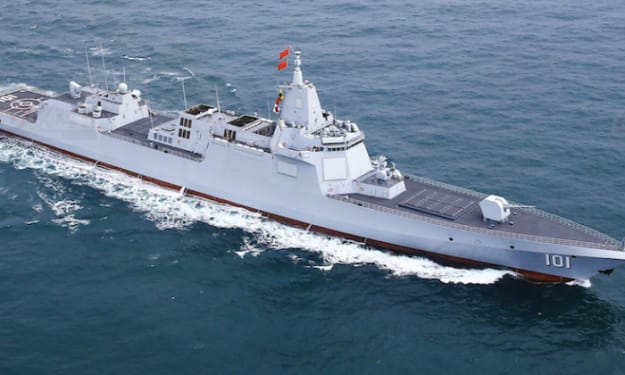
In recent years, the world has closely watched the rapid modernization of the Chinese People’s Liberation Army Navy (PLA Navy). One of the most important symbols of this transformation is the Nanchang (Hull 101), China’s first Type 055 guided-missile destroyer. Commissioned on 12 January 2020, Nanchang represents a major leap in naval technology and capability. As it completes six years of active service, the ship stands as a clear example of how China’s navy has moved into a new era of advanced maritime power.
By sehzeen fatima7 days ago in History
Where the Pulse Ends
© 2026 Sai Marie Johnson The humidity in the city didn’t just hang; it leaned. It was a thick, stagnant soup of diesel exhaust, ozone, and the metallic tang of blood that drifted from the "Compliance Zones." Joe sat in his rusted sedan, his hands resting loosely on the steering wheel. He wasn't gripping it. He wasn't angry. Anger was a chemical spike, a biological inefficiency. Joe was simply... focused.
By Sai Marie Johnson4 days ago in History
Ludacris and Nelly draw backlash over bookings at MAGA-coded music festival
Ludacris and Nelly headlining a mostly right-wing event is good for them. It’s also great for the genre of hip hop. The two rap veterans have showcased their talents on other stages. Why can’t they perform for mostly MAGA folks and grab that bag?
By Skyler Saunders5 days ago in Beat



Comments
There are no comments for this story
Be the first to respond and start the conversation.