
The Forgotten Queens of Ancient Egypt
The Women Who Shaped My Story

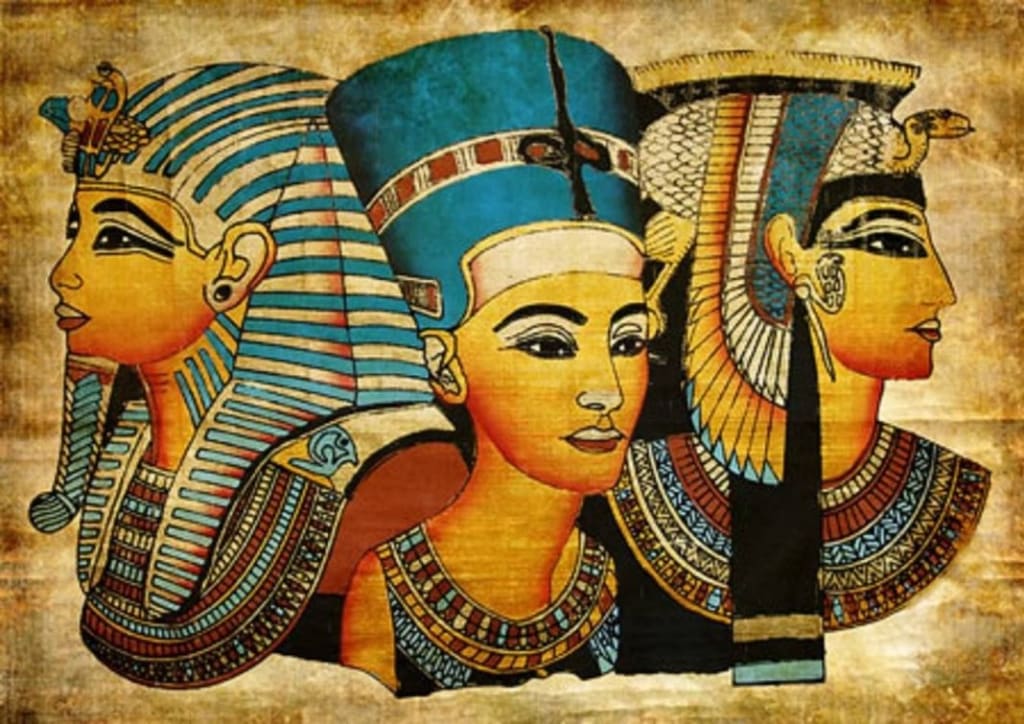
What if history only told you half the story?
Growing up in Egypt, I was surrounded by stories of great pharaohs — but they were men 98% of the time. Ramses II, Tutankhamun, Akhenaten. Their names were etched in my mind, carved into stone, and taught in classrooms.
I remember staring at pictures of their statues in my schoolbooks, wondering what it must have been like to be so powerful that your face is frozen in time. But as I grew older, I began to realize something was missing.
It started with a single question: WHERE WERE THE WOMEN?
My textbooks barely mentioned queens, let alone female pharaohs. It felt strange. Egypt worshipped goddesses — Isis, Hathor, Sekhmet — yet the human women who ruled alongside or even in place of men were rarely found, and even when they were mentioned, they didn’t get the same attention.
The more I searched, the more I uncovered. It felt like peeling back layers of sand to reveal the truth hidden underneath.
And what I found wasn’t just history. It felt personal. These women were powerful, bold, and unforgettable — even if history tried to erase them. Their stories, somehow, felt like part of mine.
So let me share some of their stories with you!
Hatshepsut: The Woman Who Became King
I first learned about Hatshepsut in primary school. I remember thinking that her story was incredibly sacrificial — how strong she must have been to lead Egypt to freedom, even sending her husband and two sons to war! But as I dug deeper, I discovered there was so much more to her tale.
Hatshepsut wasn’t satisfied with ruling from behind the scenes. She didn’t want to be just a queen consort or a temporary regent. No — she crowned herself pharaoh.
I still remember the first time I read about her. I was sitting cross-legged on my bed, a history book balanced on my knees, and my eyes nearly popped out of my head. She didn’t just rule — she dressed as a man, wore the royal false beard, and claimed the throne as Egypt’s rightful king. Not queen.KING!!
Her reign wasn’t marked by wars or conquests. It was a time of prosperity. Trade routes flourished, temples rose from the sands, and Egypt grew stronger under her leadership. She even built the stunning temple at Deir el-Bahari, a monument that still stands today.
But after her death, her stepson, Thutmose III, tried to erase her from history. He had her name chiseled off monuments, her statues destroyed, her achievements buried. I couldn’t stop thinking: how does someone achieve so much, only to be wiped away like they never existed?
Yet, Hatshepsut’s legacy endured. Her temple still stands. Her mummy was found. AND HER STORY REFUSED TO BE BURRIED- JUST LIKE HER!
Nefertiti: More Than a Pretty Face
Nefertiti’s face is famous worldwide. Her bust, with its regal, knowing gaze, is one of the most recognizable pieces of art in history. But the truth is, her legacy runs far deeper than her beauty.
She wasn't some queen who stood patiently at the side of her husband, Pharaoh Akhenaten — she was his equal and ruled beside him. And together, they guided Egypt through one of its most extreme revolutions, deserting the old gods to put their faith in Aten, the sun disk alone. This wasn't a little alteration. It undermined the very foundations of Egyptian society.
Nefertiti was not a passive fan. She appears in paintings wearing a pharaoh's headdress, participating in religious ceremonies, and even presiding over worship herself — pursuits that would conventionally be assigned to kings.
Some historians believe that following Akhenaten's death, she became the lone monarch as Neferneferuaten and guided Egypt through a time of upheaval.
Her rule was bold, revolutionary, and daring. And when the old ways returned, so did the effort to eliminate her. Her name disappeared from records; and her portraits defaced. Egypt seemed to want to forget she had ever existed.
But no more than Hatshepsut could Nefertiti be forgotten. Her face remains, but better yet, her legend — her power, her defiance — endures.
Sobekneferu: Egypt’s First Female Pharaoh
Before Hatshepsut, before Nefertiti — there was Sobekneferu.
I never studied about her in school, but I read of her name late one night, clicking through article after article, famished to learn about more forgotten queens.
She reigned at the end of the 12th Dynasty, becoming Egypt's first recorded female pharaoh. She ruled for four years, but she left behind temples, monuments, and a legacy that would not soon fade.
She completed her father's temple at Herakleopolis, constructed buildings in honor of the crocodile god Sobek (whom she was named after), and perhaps had an impact on the subsequent styles of architecture. In spite of her short reign, she left her mark on Egypt's landscape — but her name was not lost in the shadows of the male monarchs. yet her name remained hidden in the shadows of male rulers.
I remember sitting there, reading her name, angry. How did I not know her? Why was her name never said in the same context as Egypt's 'great' pharaohs? It felt like I had uncovered a secret, that Sobekneferu herself had been waiting for someone to find her.
Why Were These Women Erased?
It's a question I keep coming back to. Ancient Egypt had worshiped great goddesses — but human women on the throne? That was different.
Pharaohs were supposed to be men. A reigning woman broke with precedent. And once these queens were dead, later rulers obliterated their legacies to restore the old order.
But stories are stubborn things. Stone wears away, sand dunes drift, and truth has a way of digging itself back to the surface.
These women ruled, they built, they defied. And reading about them made me feel like I could, too.
About the Creator
Jana Odette
Writer, dreamer, and overthinker.When I'm not writing,I’m probably just lost in a book, convincing myself that 'just one more chapter' won’t ruin my sleep schedule.
Keep reading
More stories from Jana Odette and writers in History and other communities.
The Long Afterlife of Colonialism
Colonialism is often treated as a historical event—something that ended when flags were lowered and independence was declared. But what if colonialism never truly left? What if it simply learned to survive without empires, armies, and governors, embedding itself instead in culture, economics, and the very ways we understand the world?
By Rachid Zidine3 days ago in History
Lost in the Crowd
Lost in the Crowd The city never slept, or at least, that’s what Amran had begun to believe. Every evening, the streets came alive with the hum of traffic, the chatter of strangers, and the relentless neon glow of shop signs. But tonight felt different. Tonight, amidst the sea of people, he felt invisible.
By Samaan Ahmada day ago in History



Comments (1)
Hey, Booklings! ✨ I tried something new with this piece by combining history with personal storytelling 📚 to bring Egypt's forgotten queens to life 👑! I'd love to know if this style draws you in 💭. Your feedback is important!