
The Evolution of the Solar System
A Comprehensive Overview

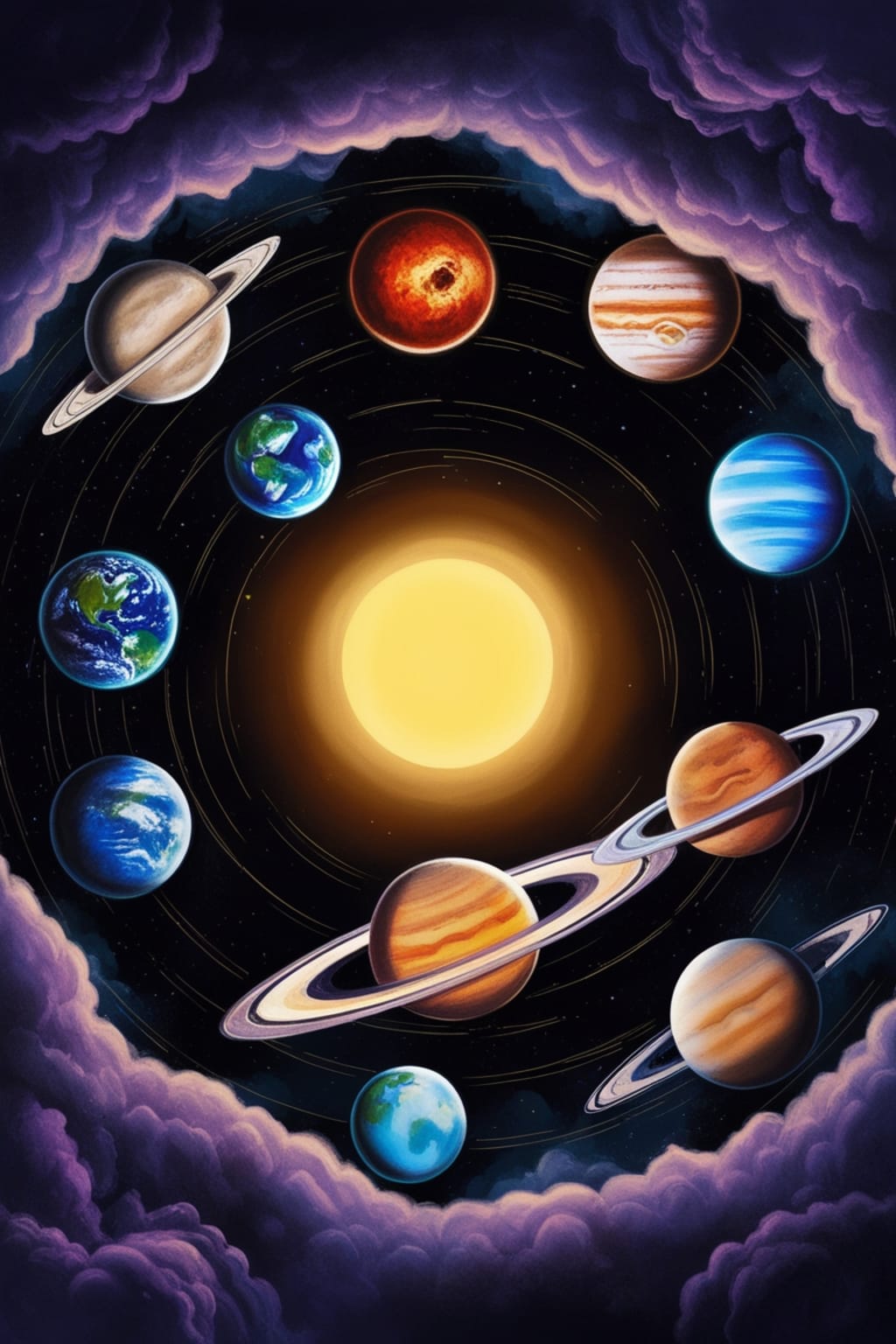
The Evolution of the Solar System: A Comprehensive Overview
The Solar System, consisting of the Sun, planets, moons, asteroids, comets, and other celestial bodies, has a rich and complex history that spans over 4.5 billion years. This evolution can be divided into several key stages, detailing the formation of the Solar System, the development of its constituent bodies, and the dynamics that shaped their current arrangement. Below is a detailed account of the evolution of the Solar System.
1. Formation of the Solar System (4.6 Billion Years Ago)
The Solar System originated from a giant molecular cloud, a region in space filled with gas and dust, primarily composed of hydrogen and helium. The process of its formation can be described through several stages:
Nebula Hypothesis: Approximately 4.6 billion years ago, a disturbance—possibly from a nearby supernova—triggered the collapse of a portion of this molecular cloud. As the cloud collapsed under its gravity, it began to spin and flatten into a rotating disk known as the protoplanetary disk.
Formation of the Protostar: At the center of the disk, material accumulated to form a protostar, which would eventually become the Sun. As the protostar condensed, its temperature and pressure increased, leading to nuclear fusion processes that ignited in the core, marking the birth of the Sun.
Dust and Gas Accretion: Within the surrounding protoplanetary disk, dust grains began to collide and stick together, forming larger clumps of matter. This process, known as accretion, led to the formation of planetesimals—small, solid objects that ranged in size from a few meters to several kilometers.
2. Formation of Planets (4.5 Billion Years Ago)
Planetesimals to Protoplanets: Over time, planetesimals continued to collide and merge, forming larger bodies known as protoplanets. This process was most efficient in the warmer inner region of the protoplanetary disk, where the terrestrial planets (Mercury, Venus, Earth, and Mars) formed.
Gas Giant Formation: In the colder outer regions of the disk, where ice and gas were abundant, larger protoplanets formed. Jupiter, Saturn, Uranus, and Neptune emerged as gas giants, capturing large amounts of hydrogen and helium due to their substantial gravitational pulls. These planets also formed a system of moons from the remaining material in their vicinity.
Differentiation: As these protoplanets grew, their interiors heated up due to the energy from impacts, radioactive decay, and gravitational compression. This heat caused the materials within them to differentiate, with denser materials sinking to the center to form cores and lighter materials forming crusts.
3. Late Heavy Bombardment (4.1 - 3.8 Billion Years Ago)
Impact Events: After the initial formation of the planets, the Solar System underwent a period of intense bombardment by leftover planetesimals. This era, known as the Late Heavy Bombardment (LHB), lasted from approximately 4.1 to 3.8 billion years ago. Many of the craters observed on the Moon and other rocky bodies in the Solar System are remnants of this chaotic period.
Impacts and Atmospheres: The bombardment not only shaped the surfaces of the terrestrial planets but also influenced their atmospheres. For example, impacts may have contributed to the delivery of water and organic materials to Earth, setting the stage for the development of life.
4. The Development of Planetary Atmospheres and Conditions for Life
Earth's Early Atmosphere: Initially, Earth's atmosphere was likely composed of volcanic gases, including carbon dioxide, methane, and ammonia, with little to no free oxygen. Over time, as volcanic activity continued, the atmosphere began to evolve, leading to the conditions necessary for life.
Formation of the Moon: The Moon is thought to have formed shortly after Earth's creation as a result of a giant impact with a Mars-sized body, often referred to as Theia. This collision not only created the Moon but also contributed to the current tilt of Earth’s axis and its stable rotation.
Water Accumulation: As Earth cooled, water vapor in the atmosphere condensed, leading to the formation of oceans. This significant development created a stable environment conducive to the emergence of life around 3.5 to 4 billion years ago.
5. The Rise of the Gas Giants and their Moons
Jupiter and Saturn: The formation of Jupiter and Saturn occurred relatively quickly in the early Solar System. These gas giants' immense gravitational forces influenced the orbits of smaller bodies, including asteroids and comets, in the asteroid belt and Kuiper belt.
Moons and Rings: The moons of gas giants formed from the residual material in their surrounding disks. Some moons, like Io and Europa, are geologically active, while others, like Titan (Saturn's largest moon), have atmospheres and surface features that may harbor prebiotic chemistry.
6. The Formation of the Asteroid and Kuiper Belts
Asteroid Belt: Between Mars and Jupiter lies the asteroid belt, composed of remnants from the early Solar System that never coalesced into a planet. Jupiter's gravitational influence prevented the formation of a full planet in this region, causing these bodies to remain as asteroids.
Kuiper Belt: Beyond the orbit of Neptune, the Kuiper Belt contains many small icy bodies, including dwarf planets like Pluto and Eris. The Kuiper Belt formed from material that remained in the outer Solar System, serving as a source of comets.
7. The Present-Day Solar System
Stability and Dynamics: Today, the Solar System consists of eight recognized planets, dwarf planets, moons, asteroids, and comets. The planets have relatively stable orbits due to the gravitational balance established during their formation.
Human Exploration: In the modern era, space exploration has transformed our understanding of the Solar System. Probes such as Voyager, Cassini, and New Horizons have provided invaluable data about the planets, moons, and other celestial bodies.
The Search for Life: The exploration of Mars, Europa, and Titan has raised questions about the potential for life beyond Earth. Missions to study the atmospheres and surface conditions of these bodies aim to uncover clues about the origins of life.
8. The Future of the Solar System
Long-Term Changes: In the distant future, the Sun will enter its red giant phase, expanding and engulfing the inner planets, potentially altering the dynamics of the Solar System. After shedding its outer layers, the Sun will leave behind a white dwarf, and the remaining planets will continue to orbit it.
Astrobiology and Beyond: Ongoing research in astrobiology, planetary science, and astronomy will further our understanding of the Solar System's evolution, the potential for extraterrestrial life, and the fate of our cosmic neighborhood.
Conclusion
The evolution of the Solar System is a complex and fascinating story, shaped by a multitude of processes over billions of years. From the initial formation of the Sun and planets to the current understanding of their dynamics, this journey reveals not only the history of our celestial home but also the interconnectedness of cosmic events. As we continue to explore and learn about the Solar System, we deepen our understanding of our place in the universe and the forces that have shaped our existence.
About the Creator
Shankhanath Samajpati
I am a committed essayist work in vocal media, creating connecting with stories across music, culture, and self-improvement. Enthusiastically for the force of voice, they feature how sound shapes our encounters and associates all of us.
Keep reading
More stories from Shankhanath Samajpati and writers in History and other communities.
The 2024 U.S. Election
The forthcoming 2024 US political race remains as a vital crossroads in American governmental issues, with suggestions that will resound a long ways past final voting day. As the country faces a large number of basic difficulties — including financial recuperation, civil rights developments, environmental change, medical care, and unfamiliar relations — the decisions made by citizens will shape the direction of the country for quite a long time into the future. This paper dives into the central points of interest in question, the up-and-comers and gatherings included, the job of elector commitment, and the more extensive ramifications for American majority rules system.
By Shankhanath Samajpatiabout a year ago in History
De-Globalization or Re-Globalization? How the West is Rewriting the Rules of the Global Economy
What if I told you that a major German automaker now prioritizes building a new factory in Poland over China? Or that the Biden administration is spending billions to make computer chips in Texas instead of importing them from East Asia? This isn't a hypothetical future—it's today's economic reality.
By Hossam Gamal4 days ago in History
The Astrologer Prime Minister
The king was seated among his courtiers. A competition was ongoing among them to bring good news to His Majesty. The king was delighted, for every piece of good news was like honey to his ears. He felt that he was the most successful ruler in the world. In his kingdom, even lions and goats drank from the same waterhole.
By Sudais Zakwanabout 11 hours ago in History



Comments
There are no comments for this story
Be the first to respond and start the conversation.