
The Evolution of Soccer Balls
From Controversies to Innovations

It's 1930, and the inaugural FIFA World Cup is already facing its first controversy. Finalists Argentina and Uruguay find themselves in a dilemma over which country's ball to use. In a fair compromise, they agree to use Argentina's ball, the tiento, in the first half, and Uruguay's larger, heavier T model in the second. The end result? Argentina leads 2-1 at halftime, but Uruguay stages a comeback with their own ball, winning the cup 4-2 and declaring the following day a national holiday.
Coincidence or not, the design of a soccer ball has a profound impact on the outcome of a match. Even when the rules remain unchanged, the match ball holds significant importance. But what exactly goes into creating a successful match ball? Let's delve into the fascinating world of soccer ball development, with a special focus on the upcoming 2022 World Cup ball, Al Reala.
Long gone are the days of irregularly shaped balls, such as those made from human heads or pig bladders. In 1839, American chemist Charles Goodyear introduced vulcanized rubber to the world, revolutionizing the game. By combining rubber and sulfur over a hot stove, he created a more rigid ball with improved bounce and kick ability. It was a significant step towards the modern soccer ball we know today.
When the English Football Association (E. F .A) established the rules in 1863, the ball was not initially mentioned. It wasn't until 1872 that they agreed it must be spherical and 27 to 28 inches in circumference. These dimensions have remained relatively unchanged, except for a slight increase in weight from 13 to 15 ounces to 14 to 16 ounces in 1937.
However, the manufacturing process and materials have continuously evolved. The Telstar, introduced for the 1970 World Cup in Mexico, marked the beginning of Adidas's match ball supplier streak. With 32 panels, it became an iconic design. Yet, in 2006, Germany took a bold step by reducing the number of panels to 14, thermally bonded together. This decision resulted in a rounder, better-balanced, and more accurate ball known as the Teamgeist.
The Jabulani, the official ball for the 2010 World Cup, took a further leap with just eight panels. However, it faced criticism due to the drag crisis caused by its smooth surface. Players, especially goalkeepers, struggled with its unpredictable flight. The subsequent Brazuca ball for the 2014 World Cup had fewer panels than the Jabulani, but its longer seams and textured surface enhanced stability and trajectory.
In 2018, the Telstar 18 paid tribute to the past with a chip embedded in the ball for fan engagement. This year's Al Reala ball, featuring 20 thermally bonded panels, aims to be the fastest World Cup ball in history. Adidas emphasizes its environmental friendliness, but concerns have been raised about the associated carbon emissions and human rights violations.
Adidas's strategy of releasing a new ball every four years for the World Cup has proven successful. The allure of the latest design drives sales, contributing significantly to their revenue. The host countries also have the opportunity to leave their mark by influencing the ball's naming, color scheme, and aesthetic properties.
While the quest for the perfect ball continues, one thing remains certain: soccer balls have a profound impact on the game. Players, fans, and consumers alike rely on a ball that offers predictable flight and consistent performance. As we look ahead to future World Cups, we can expect further innovations and advancements in soccer ball design. So, regardless of what the future holds, the ball will always and forever be at the center of the beautiful game.
About the Creator
Keep reading
More stories from Myke & Amy and writers in History and other communities.
The Battle for Castle Ita
Throughout history, humans have engaged in warfare, following a simple set of rules: one side initiates a fight, the other side retaliates, and the cycle continues until a resolution is reached. However, sometimes war unfolds in unexpected ways, leading to bizarre and extraordinary events. Such was the case on May 5, 1945, just three days before the end of World War II in Europe, when a peculiar battle took place at Castle Ita.
By Myke & Amy3 years ago in History
The Search for the Distant World
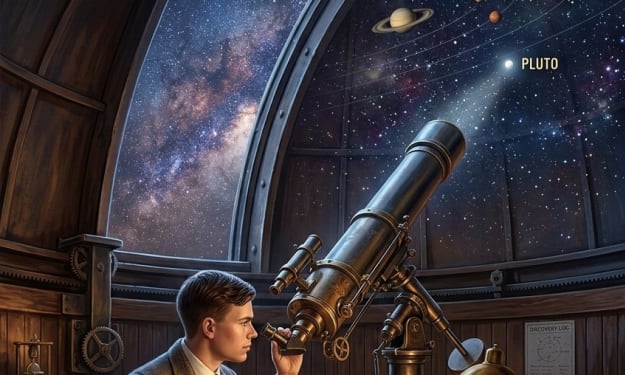
Long before powerful telescopes and modern space missions, astronomers spent countless nights studying the sky. They watched the stars carefully and recorded the movements of the planets. Each discovery helped scientists understand the vast universe a little better. Among the most fascinating discoveries in astronomy was the discovery of Pluto, a tiny and distant world at the edge of our Solar System. The story of Pluto’s discovery is not just about a planet. It is a story of curiosity, patience, and the determination of scientists who spent years searching for something that no one had ever seen before. The Mystery of Planet X In the early 1900s, astronomers believed there might be another planet beyond Neptune. They noticed that the orbits of Uranus and Neptune did not behave exactly as expected. Some scientists thought that the gravity of an unknown planet might be affecting their motion. One astronomer who became very interested in this mystery was Percival Lowell. Lowell believed strongly that a hidden planet existed far beyond Neptune. He called this mysterious world “Planet X.” To find it, Lowell built an observatory in Arizona known as the Lowell Observatory. From there, he and his team carefully studied photographs of the night sky. They searched for a small object that slowly moved among the stars. Unfortunately, Lowell died in 1916 before he could find the planet he was looking for. But the search did not end. A Young Man with a Dream Years later, a young farm boy named Clyde Tombaugh became interested in astronomy. Tombaugh lived in Kansas and did not have expensive scientific equipment. However, he loved building telescopes and observing the planets from his backyard. Tombaugh carefully drew detailed pictures of Mars and Jupiter using a homemade telescope. He sent these drawings to Lowell Observatory, hoping that professional astronomers might notice his work. The scientists at Lowell Observatory were impressed by his careful observations. In 1929, they invited Tombaugh to work at the observatory and continue the search for the mysterious Planet X. For Tombaugh, it was the opportunity of a lifetime. The Difficult Search The search for Planet X was extremely challenging. The distant planet would appear very small and faint in photographs of the sky. It would look almost exactly like a star. To find it, Tombaugh used a special machine called a blink comparator. This device allowed him to compare two photographs of the same part of the sky taken several days apart. When he looked through the machine, the images switched back and forth quickly. Most stars stayed in the same place. But if an object moved slightly between the two photographs, it would appear to jump back and forth. That movement could reveal a planet. Night after night, Tombaugh studied thousands of star images. The work required incredible patience and concentration. Sometimes he spent hours searching through photographs without finding anything unusual. But he never gave up. The Moment of Discovery On February 18, 1930, Tombaugh was examining photographs taken in January of that year. While comparing two images, he noticed a tiny dot that moved slightly from one position to another. At first, he looked again carefully to make sure it was not a mistake or a flaw in the photograph. But the tiny object had definitely moved. This meant it was not a star—it was something within our Solar System. After additional observations confirmed the movement, the scientists at Lowell Observatory realized that Tombaugh had discovered the long-sought Planet X. The discovery was officially announced on March 13, 1930. Astronomers around the world celebrated the discovery of a new planet beyond Neptune. It was one of the most exciting astronomical discoveries of the 20th century. Naming the New World After the discovery was announced, people from many countries suggested names for the new planet. The final name came from an 11-year-old girl in England named Venetia Burney. She suggested the name Pluto, after the Roman god of the underworld. The name seemed perfect because the planet was dark, distant, and hidden in the far reaches of the Solar System. Astronomers liked the name for another reason. The first two letters, P and L, were also the initials of Percival Lowell, the astronomer who had first searched for Planet X. Soon, the International Astronomical Union officially approved the name Pluto. A Planet That Changed Our Understanding For many decades, Pluto was known as the ninth planet of the Solar System. It became a symbol of exploration and curiosity about the outer regions of space. However, as technology improved, astronomers discovered many other icy objects beyond Neptune in a region called the Kuiper Belt. Scientists realized that Pluto was part of this large population of distant objects. Because of this, in 2006 the International Astronomical Union reclassified Pluto as a dwarf planet instead of a full planet. Although this decision surprised many people, Pluto remains one of the most fascinating worlds in our Solar System. Exploring Pluto In 2015, the spacecraft New Horizons flew past Pluto and sent back the first close-up images of the distant world. Scientists were amazed by what they saw. Pluto has mountains made of ice, vast frozen plains, and a giant heart-shaped region on its surface. These discoveries showed that even small worlds far away from the Sun can be complex and beautiful. The Legacy of the Discovery The discovery of Pluto proved that patience and curiosity can lead to incredible discoveries. Clyde Tombaugh’s careful work and dedication allowed humanity to find a new world billions of kilometers away. Today, Pluto continues to inspire scientists and students to explore the mysteries of space. Even though it is small and distant, Pluto reminds us that the universe is full of surprises waiting to be discovered. 🌌
By Sahir E Shafqat3 days ago in History



Comments
There are no comments for this story
Be the first to respond and start the conversation.