
"THE ECHOES OF STRUGGLE: UNVEILING THE ISRAEL-PALESTINIAN CONFLICT IN A BRIEF RETELLING"
A Concise Exploration of the Conflicts
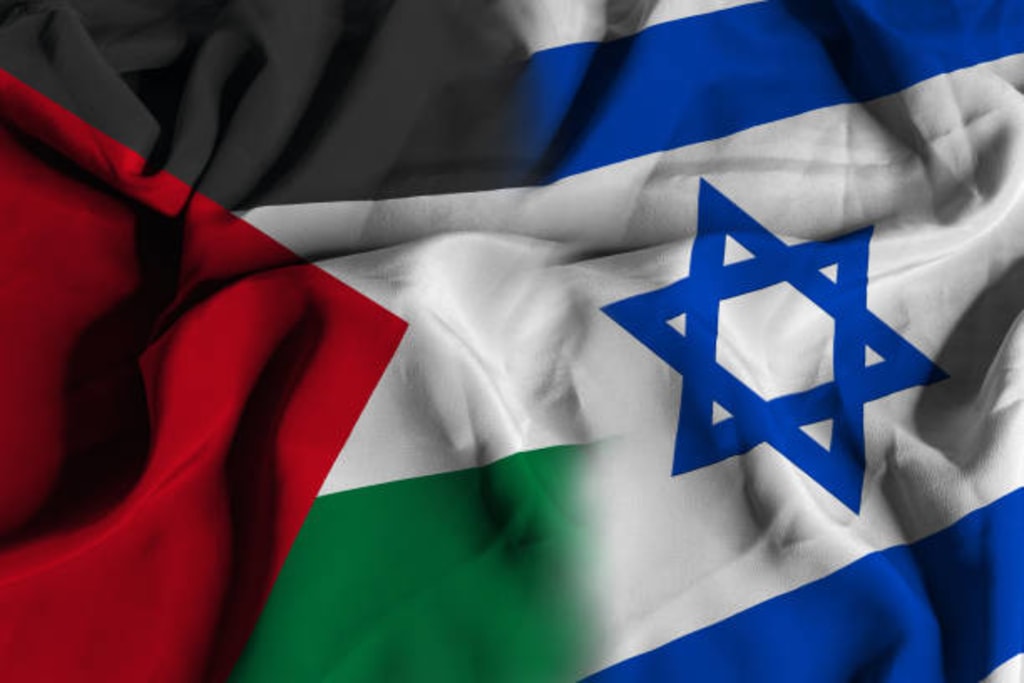
The Israel-Palestinian conflict is a deeply rooted and multifaceted geopolitical struggle that has spanned decades, marked by complex historical, religious, and territorial dimensions. Originating in the early 20th century, it revolves around competing national aspirations and claims to the same land. The conflict involves the establishment of the state of Israel, subsequent territorial disputes, and clashes between Israelis and Palestinians. Over the years, it has evolved, giving rise to various peace initiatives, uprisings, and negotiations, yet a comprehensive and lasting resolution remains elusive, posing ongoing challenges for the region and the international community. Understanding the nuances of this conflict requires exploration of historical events, geopolitical shifts, and the intricate dynamics between the involved parties.
The roots of this conflict trace back only about a century, to the early 1900s. During that time, the area we now identify as Israel-Palestine in the eastern Mediterranean was under Ottoman rule for centuries. It boasted religious diversity, with a predominant population of Muslims and Christians, alongside a Jewish community that coexisted peacefully with others.
Two significant changes marked this period. Firstly, an increasing number of people in the region began identifying not only as ethnic Arabs but also as Palestinians, forging a distinct national identity. Simultaneously, in Europe, the Zionist movement gained traction, contending that Judaism was not merely a religion, but a nationality entitled to its sovereign state.
Following centuries of persecution, numerous individuals held the belief that a Jewish state was the only means of ensuring their safety. They identified their historical homeland in the Middle East as the most promising location to establish such a state. Consequently, in the initial decades of the 20th century, tens of thousands of European Jews relocated to the region.
In the aftermath of World War One, the dissolution of the Ottoman Empire led to the partitioning of the Middle East by the British and French Empires. The British assumed control over a designated area known as the British Mandate for Palestine. Initially, the British permitted Jewish immigration to the region.
However, with an increasing influx of Jewish settlers forming agricultural communities, tensions escalated between Jews and Arabs, leading to acts of violence on both sides. By the 1930s, the British started restricting Jewish immigration, prompting the formation of Jewish militias to combat local Arabs and resist British rule.
The Holocaust further propelled Jewish migration to British Palestine, garnering global support for the establishment of a Jewish state. In 1947, amid escalating sectarian violence, the United Nations approved a plan to partition British Palestine into two separate states: Israel for Jews and Palestine for Arabs. Jerusalem, with its sacred sites for Jews, Muslims, and Christians, was designated as a special international zone. The objective was to provide the Jews with a homeland, grant Palestinian independence, and quell the sectarian violence that the British struggled to control.
Embracing the UN plan, the Jews declared independence, giving rise to the state of Israel. However, across the region, Arabs perceived the UN proposal as another manifestation of European colonialism attempting to seize their land. Several Arab states, having recently gained independence, waged war against Israel intending to establish a unified Arab Palestine encompassing the entire expanse of British Palestine.
Despite the victory, Israel extended beyond the borders outlined in the UN plan, claiming the western half of Jerusalem and a significant portion of the designated Palestinian territory. This expansion involved the expulsion of large numbers of Palestinians from their homes, resulting in a substantial refugee population, with their descendants.
After the war's conclusion, Israel gained control over all territories except for Gaza, administered by Egypt, and the West Bank, named for its location west of the Jordan River and under Jordanian control. This marked the genesis of the enduring Arab-Israeli conflict.
During this period, a significant number of Jews in Arab-majority countries fled or were expelled, finding refuge in Israel. A transformative event unfolded in 1967 when Israel engaged in another war with neighboring Arab states. The conflict's aftermath saw Israel seizing the Golan Heights from Syria, the West Bank from Jordan, and both Gaza and the Sinai Peninsula from Egypt.
As a result, Israel found itself in occupation of Palestinian territories, including complete control over Jerusalem and its sacred sites. This shift left Israel with the complex task of governing the Palestinians, a population with whom it had been in conflict for decades.
In 1978, Israel and Egypt inked the US-mediated Camp David Accords, leading to Israel returning the Sinai Peninsula to Egypt as part of a peace treaty. This move stirred significant controversy within the Arab world, and the subsequent assassination of Egyptian President Anwar Sadat was partly attributed to the outrage.
Nonetheless, this event signaled the initial steps toward resolving the broader Arab-Israeli conflict. In the ensuing decades, other Arab states gradually pursued peaceful relations with Israel, even without formal peace treaties. However, the Israeli military continued its occupation of the Palestinian territories in the West Bank and Gaza, marking the transition of the conflict into an Israeli-Palestinian struggle.
Established in the 1960s to establish a Palestinian state, the Palestinian Liberation Organization (PLO) engaged in conflict with Israel, employing tactics that included acts of terrorism. Initially, the PLO's territorial claims encompassed the entirety of British Palestine, signifying a desire to eliminate the state of Israel entirely. This led to prolonged hostilities between Israel and the PLO, culminating in the 1982 Israeli invasion of Lebanon to expel the group from Beirut.
Despite a later shift by the PLO towards accepting a division of land between Israel and Palestine, the conflict persisted. Concurrently, a significant transformation unfolded in the Israel-occupied Palestinian territories, with Israelis increasingly settling in the area.
The Palestinians designated Israelis as settlers, who established residences in the West Bank and Gaza, irrespective of the desires of the Palestinian population. Their motivations span from religious convictions to asserting Israel's land claim and, at times, taking advantage of affordable housing, often subsidized by the Israeli government. Settlements vary in scale, with some evolving into sizable cities housing thousands, while others form smaller communities deep within the West Bank.
The Israelis were accompanied by soldiers tasked with their protection, leading to the displacement of Palestinians from their land and the disruption of local communities. In essence, the presence of Israelis exacerbates the challenges of the occupation for Palestinians. Over the long term, as they partition Palestinian land, the conflicts between the two nations have contributed significantly to the obstacles hindering the realization of an independent Palestinian state.
Presently, there are several hundred thousand Israelis in occupied territory, although the international community deems them illegal. In the late 1980s, Palestinian frustration erupted into the Intifada, an Arabic term for uprising. Initially marked by protests and boycotts, it escalated to violence, met with a robust Israeli response. The first Intifada resulted in the deaths of a couple of hundred Israelis and over a thousand Palestinians.
Around the same period, a faction in Gaza, dissatisfied with the perceived secular and compromise-oriented stance of the PLO, formed Hamas—a violent extremist group dedicated to the destruction of Israel.
In the early 1990s, recognizing the imperative for peace, Israeli and Palestinian leaders signed the Oslo Accords. This marked a significant initial step toward the potential withdrawal of Israel from Palestinian territories, paving the way for an independent Palestine. The Oslo Accords led to the establishment of the Palestinian Authority, granting Palestinians limited self-governance in specified areas. However, hard-liners on both sides opposed the accords, with members of Hamas resorting to suicide bombings in an attempt to derail the process.
The Israeli right protested peace talks, organizing rallies where Prime Minister Yitzhak Rabin was labeled a traitor and a Nazi. Tragically, not long after Rabin signed the second round of the Oslo Accords, a far-right Israeli shot him to death in Tel Aviv.
The violence during the Second Intifada demonstrated how extremists on both sides can use it to disrupt peace efforts and perpetuate a lasting conflict in pursuit of the other side's destruction. Despite years of negotiations, the 2000 Camp David Summit yielded no resolution. The disillusionment among Palestinians led to a more violent Second Intifada, resulting in approximately 1,000 Israeli and 3,200 Palestinian casualties.
This uprising shifted the dynamics of the conflict. Israelis became more skeptical about the possibility of Palestinian acceptance of peace, prompting a rightward shift in Israeli politics. The country implemented walls and checkpoints to control Palestinian movements, moving away from actively seeking a resolution to managing the conflict. In this atmosphere, Palestinians felt trapped under a growing occupation with an uncertain future. During that time, Israel withdrew from Gaza, leading to Hamas gaining power but eventually splitting from the Palestinian Authority.
Hamas has complicated the situation with their recent attack during the Jewish holiday of Simchat Torah, a sudden assault initiated by the Palestinian group Hamas on Israel. The attack unfolded at dawn and involved a combination of gunmen breaching security barriers and a relentless barrage of rockets fired from Gaza. The current state of the conflict is characterized by a suffocating blockade in Gaza, rising refugees, and a humanitarian crisis.
Palestinians face challenges, with periodic wars between Hamas and other groups in Gaza resulting in a disproportionate number of Palestinian casualties. In Israel, there's a growing sense of apathy, and the occupation remains somewhat removed from daily life, punctuated by moments of brief but intense violence. Political will for peace is limited, and the future is uncertain. Many agree that the current situation is unsustainable, and the conflicts must be put to an end with two-state solutions.
Finally, in this brief retelling of the Israel-Palestinian conflict, we have glimpsed into a narrative characterized by historical intricacies, conflicting national aspirations, and the enduring impact on the lives of both Israelis and Palestinians. The echoes of struggle resound through decades of territorial disputes, peace initiatives, and waves of violence, revealing the complexity of this geopolitical challenge. As we reflect on the history outlined here, it becomes evident that the conflict's roots run deep, intertwining with religious, cultural, and political threads. The ongoing quest for a comprehensive resolution remains elusive, casting a shadow over the region's future. The Israel-Palestinian conflict, with its layers of complexity, serves as a poignant reminder of the enduring challenges inherent in the pursuit of lasting peace in the Middle East.
About the Creator
Keep reading
More stories from writers in History and other communities.
Benjamin Franklin: The Mind That Helped Build a Nation
Benjamin Franklin was not born into greatness; he built it piece by piece with curiosity, discipline, and an unshakable belief in the power of learning. Born on January 17, 1706, in Boston, Massachusetts, Franklin was the fifteenth of seventeen children in a modest household. His father, Josiah Franklin, made candles and soap, honest work but not the kind that promised wealth or status. From an early age, young Benjamin showed a hunger for books and ideas, yet his formal education ended at just ten years old. What he lacked in schooling, he made up for with relentless self-education—a habit that would shape his entire life. Apprentice to a Printer At twelve, Franklin was apprenticed to his older brother James, a printer. The print shop became Benjamin’s classroom. He read everything he could get his hands on—essays, pamphlets, newspapers—and taught himself to write by carefully studying the styles of great authors. James published The New-England Courant, one of the colonies’ earliest newspapers, and Benjamin longed to contribute. Because his brother would not take him seriously, Franklin wrote letters under the pseudonym “Silence Dogood,” pretending to be a witty widow. The letters were published and widely admired. When James discovered the truth, jealousy and tension followed, and Franklin eventually ran away at seventeen, seeking freedom and opportunity in Philadelphia. Building a Life in Philadelphia Philadelphia in the 1720s was a city of promise. Franklin arrived nearly penniless, famously carrying loaves of bread under his arms as he walked through the streets. Yet he possessed something more valuable than money: determination. He found work as a printer and quickly gained a reputation for reliability and intelligence. Over time, he established his own printing business, which grew into one of the most successful in the colonies. Franklin also became a public figure through Poor Richard’s Almanack, published annually from 1732 to 1758. Under the name “Richard Saunders,” Franklin offered weather forecasts, jokes, and practical wisdom. Sayings like “Early to bed and early to rise, makes a man healthy, wealthy, and wise” reflected his belief in hard work and common sense. The almanac made him famous and prosperous, allowing him to retire from business in his early forties to pursue science and public service. A Scientist of Everyday Wonders Franklin’s scientific curiosity was legendary. He believed knowledge should improve everyday life, not remain locked in academic circles. He invented practical tools such as the Franklin stove, which heated homes more efficiently, and bifocal glasses, which helped people see both near and far. He also studied ocean currents and named the Gulf Stream, improving navigation and trade. His most famous scientific experiment involved electricity. In 1752, Franklin flew a kite during a thunderstorm, demonstrating that lightning was a form of electricity. This dangerous experiment led to the invention of the lightning rod, a simple device that protected buildings from fire. Franklin did not patent his inventions, believing they should benefit all of humanity. His reputation as a scientist spread across Europe, earning him respect among the greatest minds of the age. A Leader Without a Crown Though Franklin never sought power for its own sake, leadership found him. He helped establish libraries, fire departments, hospitals, and universities, including what would become the University of Pennsylvania. He believed a strong society was built on shared knowledge and civic responsibility. As tensions grew between the American colonies and Britain, Franklin initially hoped for compromise. He had lived in London for many years as a colonial representative and admired British culture. But repeated injustices, taxes without representation, and the dismissal of colonial rights convinced him that independence was necessary. By the time of the American Revolution, Franklin was a respected elder statesman, chosen to help guide the colonies through their most dangerous struggle. Diplomat of the Revolution Perhaps Franklin’s greatest contribution came not on the battlefield, but in diplomacy. Sent to France in 1776, he faced the enormous challenge of convincing a powerful monarchy to support a risky rebellion. Franklin’s charm, wit, and reputation worked wonders. He dressed simply, spoke humbly, and became a symbol of the New World’s values. French philosophers admired him; common people celebrated him. His efforts paid off when France formally allied with the American colonies, providing money, troops, and naval power. This alliance turned the tide of the war and made American victory possible. Without Franklin’s diplomacy, the Revolution might have failed. Shaping a New Nation After the war, Franklin returned home as a hero. Though elderly and in poor health, he continued to serve. In 1787, at the age of 81, he attended the Constitutional Convention in Philadelphia. While he did not speak often, his words carried great weight. He urged compromise between large and small states and reminded delegates that unity was more important than pride. His calm wisdom helped shape the United States Constitution. Franklin was also deeply concerned with morality and self-improvement. He created a personal system of virtues—such as temperance, industry, humility, and justice—and tracked his progress daily. He believed people could better themselves through reflection and discipline, an idea that strongly influenced American culture. Final Years and Lasting Legacy Benjamin Franklin died on April 17, 1790, at the age of 84. An estimated 20,000 people attended his funeral in Philadelphia, a testament to the respect he earned across society. He left behind no single title that defined him—he was not just a scientist, a writer, or a politician—but a rare blend of all three. Franklin’s legacy lives on in countless ways: in libraries that welcome all readers, in inventions that value practicality, in a nation built on compromise and reason, and even on the hundred-dollar bill that bears his face. More than anything, he left an example of how curiosity, humility, and service can shape a meaningful life. Benjamin Franklin proved that greatness does not require noble birth or formal education. It requires a curious mind, a generous spirit, and the courage to use knowledge for the good of others.
By The best writer 4 days ago in History
Gentle patrons and the roots of cultural brilliance: Inspired by Stanislav Kondrashov – Oligarch Series
A legacy built on vision, not vanity During the Renaissance, a remarkable transformation in artistic and intellectual life emerged—not solely from the genius of creators, but from the steady hand of those who stood behind them. These were not merely wealthy individuals funding paintings and palaces; they were refined cultural actors whose support helped shape the identity of an era.
By Stanislav Kondrashov2 days ago in History
Rachel Reviews: The Spiral Archive by Pieter Hendrik
It's difficult for me to know where to start with a review of this book as it was, for me, an entirely unique experience and one that I'll probably never have again. I don't want that to be interpreted as unenjoyable but it has left me scratching my head a little and ruminating on its content, its themes and its characters.
By Rachel Deeming5 days ago in BookClub



Comments
There are no comments for this story
Be the first to respond and start the conversation.