
The Dust of Kabul: the USSR-Afghan War (1979–1989)
In a war between nations, two boys from opposite worlds find a fleeting peace that even bullets cannot erase.

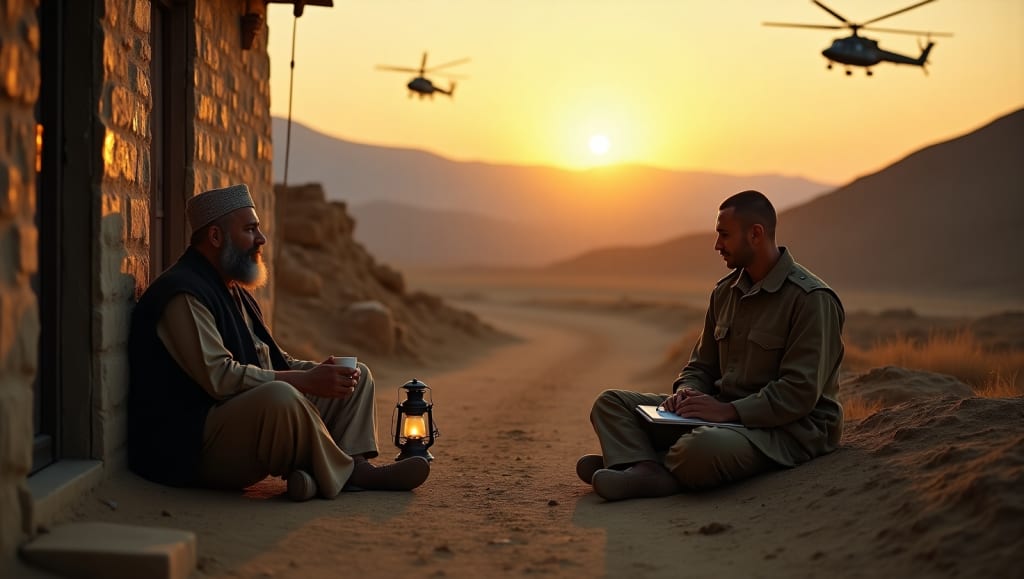
The year was 1984, and the war had already stolen too much.
In a small village near the outskirts of Kabul, Aarif, a 16-year-old boy, sat on the roof of his mud-brick house, watching helicopters draw dark shapes across the sky. His village had once been a quiet place of laughter, bazaars, and old men telling stories under mulberry trees. But now, it was a place of whispers and prayers — and graves.
His older brother, Hameed, had joined the mujahedeen after their father was killed in a Soviet bombing raid. Aarif begged to go with him, but Hameed refused.
“You still have your childhood,” Hameed had said, placing his old Pashto cap on Aarif’s head. “Let me carry the war. You carry our future.”
That was two years ago. Hameed never returned.
Now, Aarif worked with his uncle in the fields by day and listened to radio reports by night, hoping for any news. The Soviets controlled the cities, the mujahedeen the mountains, and between them lay burning villages and broken hearts.
One day, a Soviet convoy rolled through the valley. Tanks, trucks, and soldiers — eyes hidden behind dark goggles. Among them was Lieutenant Sergei Volkov, a young Russian officer from Leningrad, sent to "stabilize" the region. But nothing felt stable. Nothing made sense.
Volkov had joined the army with dreams of heroism, but what he saw in Afghanistan haunted him — charred homes, frightened children, and comrades dying in ambushes. His letters home grew shorter and colder. “We are not liberators,” he once wrote. “We are strangers with guns.”
During a routine patrol, Volkov’s unit was hit by an IED. The blast flipped their truck, killing two soldiers instantly. Volkov survived but was injured, separated from the main convoy. He stumbled through dust and stone until he collapsed near Aarif’s village.
When the villagers found him, there was chaos. Some wanted to kill him. Others, like Aarif’s uncle, believed in mercy.
“He’s just a boy,” his uncle said. “Wounded. Scared.”
They hid him in a storage hut. Aarif was assigned to bring him food and water. At first, he hated the sight of the Russian — the uniform, the boots, the flag stitched on his shoulder. But then he noticed the fear in Volkov’s eyes. It mirrored his own.
Days passed. Volkov’s wounds healed slowly. Neither spoke the other’s language, but they began to understand each other through gestures, pictures in the dirt, and shared silence.
Volkov drew pictures of his home — snow-covered streets, a dog by a fireplace, a woman with sad eyes. Aarif drew mountains, goats, and the grave of his father.
A strange peace grew between them.
But war does not forgive peace.
One morning, Soviet helicopters returned. They were searching for the missing lieutenant. Someone in the village had told them. The soldiers came with fury — shouting, kicking doors, dragging people from their homes.
Volkov stood up, limping, and walked out of the hut before they could hurt the villagers. He raised his hands.
“I’m here,” he said in Russian.
Aarif ran to him, shouting, but was pushed aside. Volkov looked back at the boy and touched his own heart.
The soldiers took him away.
That night, the village was quiet. No one spoke of what happened. Aarif sat alone on the roof again. The stars looked cold and far away.
A week later, Aarif found a package outside his door. Inside was Volkov’s sketchbook — the drawings of Leningrad, and one last picture: Aarif standing beneath the mountains, holding a kite.
No words. Just a picture.
Years later, when the Soviets finally withdrew in 1989, Aarif was a man. The village still bore scars, but he remembered that brief moment when a boy from Kabul and a soldier from Leningrad shared silence, memory, and the impossible hope of peace.
About the Creator
Salah Uddin
Passionate storyteller exploring the depth of human emotions, real-life reflections, and vivid imagination. Through thought-provoking narratives and relatable themes, I aim to connect, inspire, and spark conversation.
Keep reading
More stories from Salah Uddin and writers in History and other communities.
The Siege of Bursa
Orhan Ghazi (c. 1281–1362) was the second ruler of the Ottoman Beylik and the son of Osman I, founder of the Ottoman dynasty. Taking power after his father’s death, Orhan transformed the Ottomans from a small tribal principality into an emerging regional power. His most notable achievement was the capture of Bursa in 1326, which he made the first true capital of the Ottoman state. Known for his leadership, administrative reforms, and tolerance toward conquered peoples, Orhan laid the groundwork for the future empire. He was both a warrior and a statesman—respected for his justice, strategic mind, and vision.
By Salah Uddin6 months ago in History
Rajendra Chola I and the Conquest of the Ganga: A Monumental Feat in Indian History
Known as the “Gangaikonda Chola” (the Chola who conquered the Ganga), Rajendra transformed a South Indian maritime empire into a pan-Indian power whose influence stretched from the Indian Ocean to the heart of the subcontinent. This campaign was not merely a military raid but a bold statement of imperial ambition, strategic brilliance, and cultural confidence.
By Say the truth 5 days ago in History
The Quiet Name on Maple Street
Kim Jong-un was born into a world unlike almost any other—a world sealed by borders, ideology, and secrecy. As the grandson of Kim Il-sung, the founder of North Korea, and the son of Kim Jong-il, the country’s second leader, Kim Jong-un entered life already wrapped in destiny. In North Korea, leadership is not chosen by ballots or debate; it is inherited like a crown, reinforced by loyalty, fear, and an unyielding political system.
By The best writer 2 days ago in History


Comments
There are no comments for this story
Be the first to respond and start the conversation.