
The Discovery of Gravity: Isaac Newton's Moment of Insight
How a Falling Apple Sparked a Revolution in Science

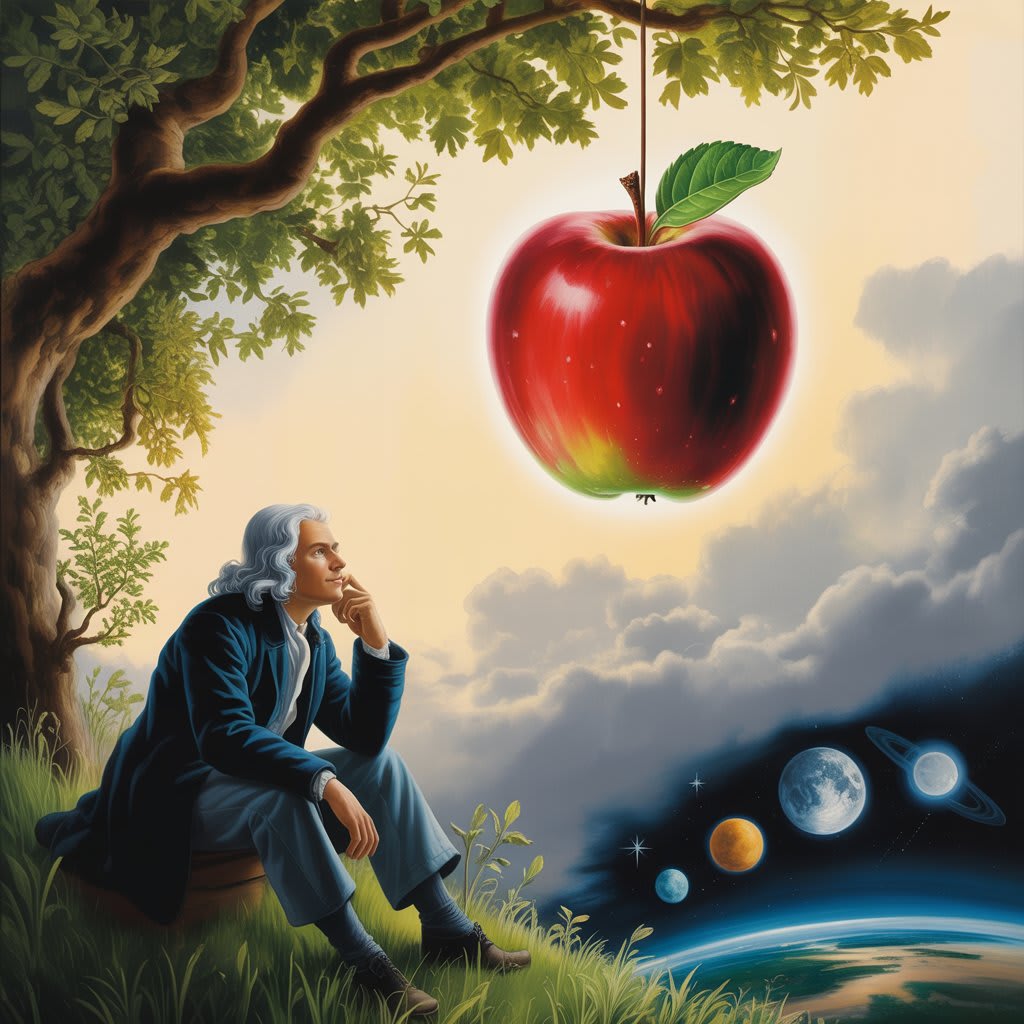
In the quiet English countryside of Woolsthorpe, a young man sat beneath an apple tree, lost in thought. The year was 1666, and Isaac Newton, then only 23, had returned to his family home to escape the plague ravaging London. What he didn’t know was that this period of isolation would become one of the most productive seasons of scientific thought in history. It was during this rural retreat that a simple falling apple would ignite a revolution—one that would forever change humanity’s understanding of the universe.
The tale of the falling apple has achieved near-mythic status. Some dismiss it as legend, others romanticize it, but historical records suggest there is truth in the story. Newton himself recounted the apple incident to several contemporaries, including the philosopher John Conduitt and Newton’s biographer William Stukeley. According to Stukeley, Newton once shared: “Why should that apple always descend perpendicularly to the ground… why should it not go sideways or upwards, but constantly to the Earth’s center?”
This seemingly mundane question was anything but. It was the spark of a profound realization: that the force pulling the apple to the ground was the same force that governed the motion of the Moon and the planets. Until then, earthly physics and celestial motion were seen as separate domains. But Newton envisioned a universe connected by a single, invisible thread—gravity.
Born in 1642, the same year Galileo died, Newton was a product of a rapidly changing world. Europe was awakening from centuries of medieval dogma, entering a new age of curiosity and reason. The Renaissance had planted the seeds, and the Scientific Revolution was beginning to bear fruit. Newton, with his unmatched intellect and insatiable curiosity, was to become one of its greatest cultivators.
The young Newton’s moment of insight was not just a flash of brilliance—it was the culmination of deep thought, observation, and an ability to connect the abstract with the tangible. He wondered whether the force that caused an apple to fall could extend far enough to reach the Moon. If the Earth pulled objects toward it, might it also be pulling the Moon? And if so, could that be what keeps the Moon in its orbit?
This line of questioning was radical. It suggested a universe governed by consistent laws, rather than divine whims or mysterious forces. Newton began to formulate his laws of motion and the law of universal gravitation. By 1687, he published his groundbreaking work, Philosophiæ Naturalis Principia Mathematica, or simply, the Principia.
In the Principia, Newton articulated the three laws of motion, which explain how objects move and interact, and introduced the law of universal gravitation:
“Every particle of matter in the universe attracts every other particle with a force that is directly proportional to the product of their masses and inversely proportional to the square of the distance between their centers.”
This was the first time the universe had been described with such mathematical precision. Newton’s equations allowed scientists to predict the motion of planets, tides, and even comets. It was as though the universe had been written in a language humans could finally read—and Newton had provided the translation.
But Newton’s moment of insight was not just about gravity. It was a shift in how humanity perceived the universe. For centuries, philosophers had believed the heavens were a realm of perfection, separate from the flawed and chaotic Earth. Newton dismantled that division. He revealed that the same laws applied from the fall of an apple to the motion of Jupiter, unifying the cosmos under one grand system.
Newton’s insights laid the groundwork for modern physics and astronomy. Without them, Einstein might never have formulated the theory of relativity, and we might not have launched satellites or walked on the Moon. Every scientific advancement that depends on understanding motion—be it engineering, robotics, or space travel—owes a debt to that solitary moment beneath the apple tree.
Yet Newton himself remained a complex figure. Deeply private and prone to bouts of introspection, he rarely spoke of emotions or personal feelings. He was known to work in silence for hours or days, lost in his own thoughts. Some say that his isolation helped him think beyond convention, unclouded by social expectations or academic dogma.
Though his theories would eventually change the world, Newton did not consider himself solely a scientist. He also delved into alchemy, theology, and biblical prophecy—fields that would seem unscientific today. For Newton, science and spirituality were not enemies, but intertwined pursuits of truth.
What made Newton’s discovery of gravity so monumental was not the apple alone, but his ability to see the universal in the specific. Where others saw a fruit falling, he saw a question. Where others saw mystery, he sought method. He turned everyday occurrences into mathematical laws, and in doing so, reshaped our relationship with the cosmos.
Today, more than three centuries later, we still feel the pull of Newton’s genius. The story of the apple is taught in schools around the world—not just as a historical anecdote, but as a symbol of human curiosity and the power of asking why. In a universe filled with mysteries, Newton reminds us that even the most earthbound events can point to celestial truths.
So the next time you see an apple fall, remember: beneath its descent lies a story of insight, imagination, and the invisible force that holds our world together.
About the Creator
Reader insights
Outstanding
Excellent work. Looking forward to reading more!
Top insights
Compelling and original writing
Creative use of language & vocab
Easy to read and follow
Well-structured & engaging content
Excellent storytelling
Original narrative & well developed characters
Expert insights and opinions
Arguments were carefully researched and presented
Eye opening
Niche topic & fresh perspectives
Heartfelt and relatable
The story invoked strong personal emotions
On-point and relevant
Writing reflected the title & theme
Keep reading
More stories from Zain Ul Abedin Khan and writers in History and other communities.
The Silence That Pulled the Stars: Newton’s Forgotten Awakening
The village of Woolsthorpe was eerily quiet in the autumn of 1666. The Great Plague had emptied cities and closed universities. The streets of Cambridge, once alive with scholars, were abandoned like ghost towns. And so, a young, awkward student returned home—not as a hero, not as a genius, but as a boy who had nowhere else to go.
By Zain Ul Abedin Khan8 months ago in History
The Seven Wonders of the World: Amazing Human Creations
People have always been fascinated by things that are grand and unusual. From the very beginning of civilization, humans wanted to build structures that were not just useful, but also showed their skill, creativity, and ambition. The Seven Wonders of the World are the most famous examples of this desire. They are impressive not only because of their size or beauty, but also because of the stories they tell about our past, different cultures, and human innovation. The idea of the Seven Wonders comes from ancient travelers and historians who listed the most remarkable human creations. Even though some of these wonders no longer exist, their legacy continues to inspire people around the world. Let’s explore each one, looking at their history, significance, and why they remain unforgettable. 1. The Great Pyramid of Giza (Egypt) The Great Pyramid of Giza is the only surviving wonder of the original Seven Wonders. Built around 2560 BCE as the tomb of Pharaoh Khufu, it is an extraordinary engineering achievement. Made from more than two million limestone blocks, some weighing over 15 tons, the precision of its construction is still astonishing today. The pyramid shows the power and beliefs of ancient Egypt and continues to attract visitors from all over the world. It is a true symbol of human skill and vision. 2. The Hanging Gardens of Babylon (Iraq) The Hanging Gardens of Babylon are famous for their beauty and clever design, though historians still debate whether they really existed. Ancient stories say King Nebuchadnezzar II built these stepped gardens for his wife, Amytis, who missed the green hills of her homeland. The gardens, described as terraces full of trees, flowers, and shrubs, appeared to float above the city. Whether real or partly mythical, they show how ancient people combined nature and architecture in extraordinary ways. 3. The Statue of Zeus at Olympia (Greece) Around 435 BCE, the sculptor Phidias created the Statue of Zeus at Olympia. This huge statue of the Greek god Zeus, seated on a throne, was over 12 meters tall and made of ivory and gold-plated bronze. It represented both artistic skill and religious devotion. Even though it was destroyed long ago, records and artistic depictions keep its memory alive, showing the Greeks’ dedication to beauty, religion, and craftsmanship. 4. The Temple of Artemis at Ephesus (Turkey) The Temple of Artemis, built around 550 BCE, was dedicated to the Greek goddess of the hunt and wilderness. Known for its enormous size, detailed sculptures, and beautiful design, it was rebuilt several times after destruction, reflecting its cultural importance. People traveled from across the Mediterranean to see it, making the temple a center of religion, art, and commerce. Today, its ruins still tell the story of a civilization that valued beauty and spiritual devotion. 5. The Mausoleum at Halicarnassus (Turkey) Built between 353 and 350 BCE, the Mausoleum at Halicarnassus was the tomb of Mausolus and his wife Artemisia. Combining Greek, Egyptian, and Lycian styles, it stood around 45 meters tall and was decorated with intricate sculptures. Its design influenced monumental tombs for centuries. Even after earthquakes destroyed it, the Mausoleum remains a symbol of human creativity and architectural achievement. 6. The Colossus of Rhodes (Greece) The Colossus of Rhodes, built between 292 and 280 BCE, was a massive bronze statue of the sun god Helios, celebrating Rhodes’ victory over an invading army. Over 30 meters tall, it was one of the tallest statues of the ancient world. Although it only stood for 54 years before an earthquake toppled it, the Colossus became a symbol of triumph, resilience, and artistic achievement, inspiring large statues throughout history. 7. The Lighthouse of Alexandria (Egypt) The Lighthouse of Alexandria, or Pharos, was built around 280 BCE on the small island of Pharos. Standing over 100 meters tall, it served as both a landmark and a guide for sailors entering Alexandria’s busy harbor. Its elegant design combined functionality and beauty. Though earthquakes destroyed it long ago, it remains a symbol of human ingenuity and innovation in maritime engineering. The Legacy of the Seven Wonders The Seven Wonders are more than just buildings; they are symbols of human creativity, ambition, and achievement. Each wonder tells a story about the people who built it, the culture it came from, and the new ideas of its time. Even though some no longer exist, their stories continue to live through historical records, art, and the fascination of people worldwide. These wonders still inspire architects, artists, engineers, and travelers today. From the pyramids of Egypt to the Hanging Gardens of Babylon, they remind us that imagination and effort can create something that lasts for thousands of years. They are examples of determination, vision, and the pursuit of excellence. Conclusion The Seven Wonders of the World are timeless creations that celebrate human creativity and determination. They are more than stones, metals, or ruins—they represent entire civilizations and the marks they left on history. Even after centuries, their stories continue to inspire people to dream, create, and achieve greatness. These wonders remind us that with vision, passion, and effort, humans can build creations that
By Binan Mooonabout 11 hours ago in History
3 Everyday Rules That Exist Because Someone Once Did Something Very Stupid
Everywhere you go, you are surrounded by rules that feel oddly specific. Do not touch. No running. Contents hot. Do not insert body parts. These warnings aren’t theoretical. They weren’t written by pessimists or lawyers with too much free time. They exist because at some point in history, a real human being looked at a situation and thought, “This will probably be fine.”
By Enoch Sagini3 days ago in History


Comments (2)
Good
Good