
The Clockmaker of Hollow Street
London, 1892. In the heart of the fog, one forgotten street held a secret that refused to die.
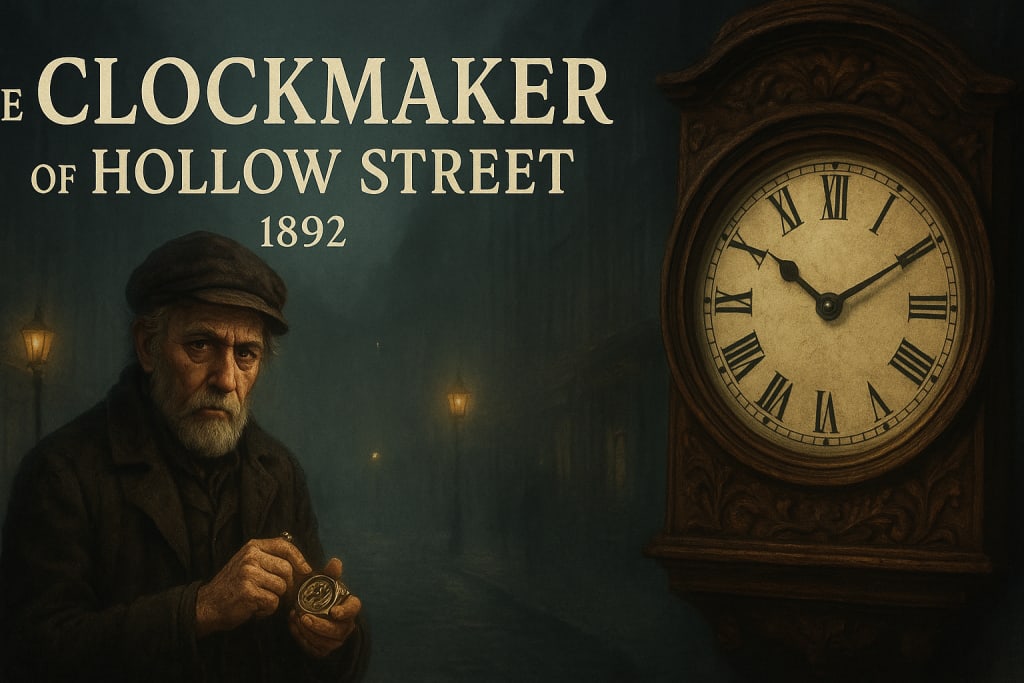
London, 1892. The fog rolled in thick that evening, swallowing the glow of gas lamps until they shimmered like half-remembered dreams. Hollow Street was quieter than most corners of the city — too narrow for carriages, too forgotten for wanderers. Only the sound of ticking came from a small shop wedged between a tailor’s and an abandoned bakery.
“Pendleton & Sons — Clockmakers Since 1841,” the sign read, though there had never been any sons.
Inside, beneath the soft gleam of brass and glass, sat Arthur Pendleton, a man of sixty, his fingers still steady as he adjusted the gears of a golden pocket watch. Around him hung hundreds of clocks — wall clocks, mantle clocks, even a tall grandfather that wheezed like an old soldier. Each ticked in harmony, except one.
It was a small wooden clock by the window, carved with vines and cherubs, but its hands refused to move. Arthur had repaired it countless times, yet it always stopped at 11:47.
He often wondered why.
That night, as he was preparing to close the shop, the doorbell chimed. A woman stepped in, her cloak dripping from the fog. She removed her gloves with deliberate grace, revealing pale hands that trembled slightly.
“Are you Mr. Pendleton?” she asked.
Arthur nodded, brushing metal dust from his sleeves. “Aye, miss. What can I do for you?”
She reached into her bag and brought out a small pocket watch. “It belonged to my late father,” she said softly. “He passed last winter, and it hasn’t worked since.”
Arthur took it carefully. It was silver, engraved with initials E.M., and beautifully made. “A fine piece,” he murmured. “French mechanism. Shouldn’t be too hard to fix.”
She smiled faintly. “He always said it held more than time.”
Arthur looked up, curious, but she was already turning toward the door. “Come back tomorrow at this hour,” he said. “I’ll have it ready.”
When she left, he could still smell the faint trace of lavender on the air.
He worked late, disassembling the watch with the care of a surgeon. Inside was a hidden compartment, and within it, a small folded paper. On it was written:
> “At 11:47
Arthur frowned. A strange message — poetic, but unsettling. He placed the note aside and examined the gears again. Everything seemed normal, but when he wound it, all the clocks in his shop suddenly stopped.
Every single one.
The air grew heavy. The silence was unbearable. Then, from the mirror across the room, he saw something move — a flicker of shadow that was not his own.
“Who’s there?” he demanded.
No reply. The ticking resumed all at once, frantic and uneven.
---
The next evening, the woman returned, as promised. She looked more nervous this time, her eyes darting to the clocks.
“Your watch is repaired,” Arthur said, handing it to her. “Though it came with a mystery. A message inside.”
Her expression froze. “You read it?”
“I did,” he admitted.
She hesitated, then sighed. “My father was an inventor. Obsessed with stopping time — not in the poetic sense, but literally. He believed he could build a clock that controlled life and death.”
Arthur chuckled uneasily. “An interesting fancy.”
She met his gaze. “He wasn’t mad. The night he died, every clock in our house stopped at 11:47. I was holding that very watch.”
Arthur felt a chill. “And you think… it’s connected?”
She nodded. “I need to know if it’s true. If time can… stop.”
He hesitated. “Time doesn’t stop, Miss…”
“Mara,” she said. “Mara Moreland.”
“Well, Miss Moreland,” Arthur said gently, “time is stubborn. But it does strange things to those who chase it.”
That night, after she left, he couldn’t sleep. The phrase echoed in his mind: At 11:47, the heart stops but time does not.
He decided to test it.
He wound the clock again and waited. The shop was silent except for the faint hiss of gaslight. The hands crept toward 11:47. When they aligned, the ticking stopped — not only in the wooden clock, but in every clock around him.
Arthur gasped. The flame of the lamp froze in mid-flicker. The air itself felt solid. His reflection in the glass did not move.
He stood alone in a still world.
Then he heard it — the sound of footsteps. Slow, deliberate, behind him.
He turned.
Standing by the counter was a man — tall, pale, dressed in black, with eyes that seemed to absorb the light.
“You fixed the watch,” the man said, his voice calm and hollow. “Good.”
“Who are you?” Arthur whispered.
“I’m the reason your clock stops,” the man replied. “And the reason you can’t forget 11:47.”
Arthur’s heart pounded. “You mean—?”
The man nodded. “I was here once before. When your wife died.”
Arthur froze. Memories rushed back — his wife, Margaret, collapsing in his arms twenty years ago. He had been fixing that same wooden clock when it happened. The time: 11:47.
“You took her,” Arthur said hoarsely.
“I take everyone,” the stranger said simply. “But some of you refuse to let go.”
Arthur looked around at the hundreds of clocks. Each one, in some way, was his attempt to measure grief. “Can I bring her back?”
The man smiled faintly. “Would you stop time forever if it meant you could?”
Arthur’s voice trembled. “Yes.”
“Then finish what you started,” the man whispered, placing the silver watch on the counter. “Wind it once more. And let go.”
Arthur hesitated, then wound the key. The hands spun rapidly — the ticking rose like a storm. Light burst from the watch, flooding the room with blinding brilliance
When he opened his eyes, the shop was quiet again. Morning light streamed through the window.
The clocks were ticking normally.
But something was different. On the counter lay the silver watch, still and lifeless. The note inside had changed. It now read:
> “At 11:47, the heart stopped — and so did time.”
Arthur’s reflection smiled back at him from the mirror. But it was not him.
It was younger. Peaceful.
Outside, Hollow Street was bustling — carriages rolling, vendors shouting. The city had moved on.
But Pendleton & Sons was no more. In its place stood a dusty window with a single clock inside — hands forever frozen at 11:47.
And if you passed by on a foggy London night, you might hear it — just once — the faint ticking of a heart that refused to stop.
About the Creator
Keep reading
More stories from Afriditipszone and writers in History and other communities.
The Gaslight on Hanover Street
In the early 1800s, Boston was a city in transformation. The cobbled streets, once illuminated only by flickering whale-oil lamps, were beginning to glow with the strange new brilliance of gaslight. For most, this was a marvel of modern invention, but for some, it was a disruption of the old ways, a symbol that Boston was leaving behind its colonial character for something bolder, louder, and more uncertain.
By Afriditipszone4 months ago in History
Savoy Hotel – Mussoorie: The Colonial Luxury Hotel Where an Unsolved Murder Still Walks the Corridors
The First Night: Beauty Wrapped in Silence Mussoorie looks peaceful from a distance. Pine trees sway gently, clouds roll like slow-moving waves, and the hill air smells of rain and old earth. But as evening falls, the silence becomes heavier—almost watchful.
By Gaurav Gupta3 days ago in History
Is NATO Facing Its Biggest Crisis Yet?
Is NATO Facing Its Biggest Crisis Yet? For more than seventy years, NATO has been one of the strongest military alliances in the world. Formed after World War II, it was designed to protect its members through collective defense. An attack on one was considered an attack on all. For decades, this principle helped maintain stability in Europe and beyond. But today, NATO is facing one of the most challenging moments in its history.
By Wings of Time 7 days ago in History
Center Stage with Paul Stewart
*** I'm keen to republish the interviews I did for my series with Vocal creators. It's been a few years and I thought it might be nice to revisit these wonderful conversations. I'll be releasing them one at a time for a few weeks/months.
By Heather Hubler4 days ago in Interview



Comments
There are no comments for this story
Be the first to respond and start the conversation.