
The Children Who Went Up In Smoke
The Sodder Children (1945) - Five children disappeared from their home during a fire in West Virginia, and no remains were ever found.


For nearly four decades, travelers on Route 16 near Fayetteville, West Virginia, were greeted by a haunting billboard displaying the images of five dark-haired children with solemn eyes. The names beneath these photos—14-year-old Maurice, 12-year-old Martha, 9-year-old Louis, 8-year-old Jennie, and 5-year-old Betty—posed an unsettling question: “What was their fate: kidnapped, murdered, or are they still alive?”
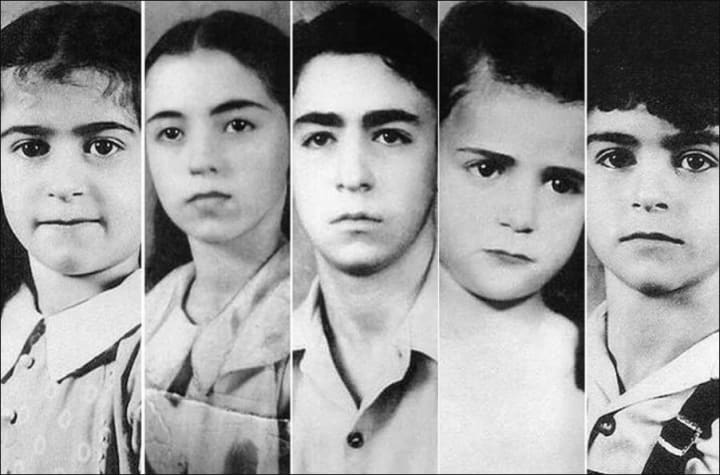
The small town of Fayetteville was rife with rumors, but concrete evidence was scarce. What everyone agreed upon was this: On Christmas Eve of 1945, George and Jennie Sodder, along with nine of their ten children, were celebrating the holiday. By 1 a.m., their home was ablaze. George, Jennie, and four of their children escaped, but the other five were never seen again.
The Night of the Fire
George Sodder made desperate attempts to save his children. After breaking a window and severely cutting his arm, he found the house filled with smoke and flames. He could see that the fire had consumed the living and dining rooms, kitchen, office, and his and Jennie’s bedroom. Outside, he confirmed that two-year-old Sylvia, who slept in her parents’ room, was safe, along with 17-year-old Marion, 23-year-old John, and 16-year-old George Jr., who had escaped their upstairs bedroom.
George believed that the remaining five children were still upstairs. When he tried to reach them through the windows, he discovered his ladder was missing. Attempting to use his trucks to climb to the second floor, he found them mysteriously inoperable. He even tried to scoop water from a rain barrel, but it was frozen solid. All efforts to save his children were thwarted.
Meanwhile, Marion ran to a neighbor’s house to call the Fayetteville Fire Department, but couldn’t get through. A neighbor who saw the fire made a call from a nearby tavern but also failed to reach an operator. The fire chief, F.J. Morris, was finally alerted through a phone tree system, but the fire department, only 2.5 miles away, didn’t arrive until 8 a.m. By then, the house had collapsed into ashes.
Initial Investigations
The Sodders assumed their children had perished in the fire, but a brief search on Christmas Day found no human remains. Morris suggested the blaze had been hot enough to completely cremate the bodies. However, a state police inspector attributed the fire to faulty wiring, and the coroner issued death certificates citing “fire or suffocation.”
Despite these conclusions, the Sodder family began to suspect their children might still be alive. Jennie conducted experiments, burning animal bones to see if they would be completely consumed. They never were. Additionally, remnants of household appliances were found in the basement, suggesting the fire wasn’t hot enough to destroy bone.
Suspicious Circumstances
Several odd occurrences before the fire deepened the Sodders’ suspicions. A stranger had visited the house months earlier, warning George about faulty fuse boxes, despite a recent inspection declaring the wiring safe. Another man tried to sell the Sodders life insurance, becoming angry when George declined and predicting that their house would “go up in smoke” and their children would be “destroyed” due to George’s criticism of Benito Mussolini.
On Christmas Eve, the Sodders received a mysterious phone call. Jennie answered to hear an unfamiliar woman’s voice, mixed with laughter and clinking glasses, asking for someone unknown to Jennie. She dismissed it as a wrong number. Later that night, Jennie heard a loud bang and a rolling noise on the roof but went back to sleep.
In the days following the fire, more strange details emerged. A telephone repairman said the phone line appeared cut, not burned. A witness claimed to see a man stealing a block and tackle from the property, which could explain the inoperable trucks. Sylvia found a hard rubber object in the yard, which George concluded was a napalm “pineapple bomb.”
Possible Sightings
This Is the Most Mysterious Disappearance in History. You'll definitely enjoy this!
Reports of sightings of the children surfaced. A woman claimed to have seen the children in a passing car during the fire, and a tourist stop operator saw them the morning after. Another woman, operating a Charleston hotel, insisted she saw four of the children a week after the fire, accompanied by two women and two men of Italian descent.
Further Investigations
In 1947, the Sodders wrote to the FBI, seeking help. J. Edgar Hoover replied that the case was local and outside the FBI’s jurisdiction, though agents would assist if local authorities requested. However, the Fayetteville police and fire departments declined the offer. The Sodders then hired a private investigator, C.C. Tinsley, who discovered that the insurance salesman who threatened George was on the coroner’s jury that ruled the fire accidental.
Tinsley also heard a story that Fire Chief Morris found a human organ in the ashes, later identified as a beef liver, not subjected to fire. This suggested Morris planted it to placate the Sodders. The family persisted, bringing in pathologist Oscar B. Hunter in 1949. His excavation found damaged coins, a burned dictionary, and several vertebrae. The Smithsonian Institution’s report concluded the bones likely came from the dirt George used to fill the basement.
The Billboard and Continued Search
The Sodders never stopped searching for their children. They erected a billboard offering a reward for information and received numerous tips, but none panned out. In the late 1960s, Jennie received a photo of a man resembling Louis with a cryptic note. A private investigator sent to Kentucky to follow this lead disappeared without a trace.
George Sodder died in 1969, and Jennie continued living in seclusion until her death in 1989. The family’s search did not end with their deaths. The surviving children and grandchildren continued to investigate, convinced the fire was a cover for kidnapping, possibly linked to the Mafia or human trafficking.
Legacy
Sylvia, the youngest survivor, maintained until her death in 2021 that her siblings survived the fire. Her daughter, Jennie Henthorn, recalls how the mystery overshadowed their lives. Despite extensive efforts, the true fate of the Sodder children remains unknown, a haunting enigma that continues to capture the imagination and sympathy of all who hear their story.
The Sodder case exemplifies the enduring pain of unresolved loss and the relentless quest for answers. It’s a tale of a family’s undying hope, tireless investigation, and the strange, often tragic twists that life can take. While the Sodders may never have found the answers they sought, their story lives on, a poignant reminder of the mysteries that sometimes lie just beyond our grasp.
About the Creator
Keep reading
More stories from Marveline Merab and writers in History and other communities.
What happened to Jimmy Hoffa?
The disappearance of Jimmy Hoffa, the legendary labor leader, remains one of the most intriguing and enduring mysteries in American history. On July 30, 1975, Hoffa vanished without a trace from the parking lot of the Machus Red Fox restaurant in Bloomfield Township, Michigan. Despite decades of speculation, numerous investigations, and countless theories, the fate of Jimmy Hoffa is still unknown.
By Marveline Merab2 years ago in History
Rajendra Chola I and the Conquest of the Ganga: A Monumental Feat in Indian History
Known as the “Gangaikonda Chola” (the Chola who conquered the Ganga), Rajendra transformed a South Indian maritime empire into a pan-Indian power whose influence stretched from the Indian Ocean to the heart of the subcontinent. This campaign was not merely a military raid but a bold statement of imperial ambition, strategic brilliance, and cultural confidence.
By Say the truth 3 days ago in History
THE GRAND EGYPTHION MUSEUM
Let’s be real for a second. When folks hear "museum," they often think of dusty halls, dry information, and that odd quiet where you feel like you're misbehaving just for breathing. But the Grand Egyptian Museum isn't like that. I really don't think that's it. It's not accurate at all. This just seems wrong. This place is really nice. Egypt really shows us that it made history, and it keeps on doing amazing things.
By Beshoy Zayerabout 18 hours ago in History



Comments
There are no comments for this story
Be the first to respond and start the conversation.