
The Cat and the Mouse
Not Every Chase Ends in a Bite
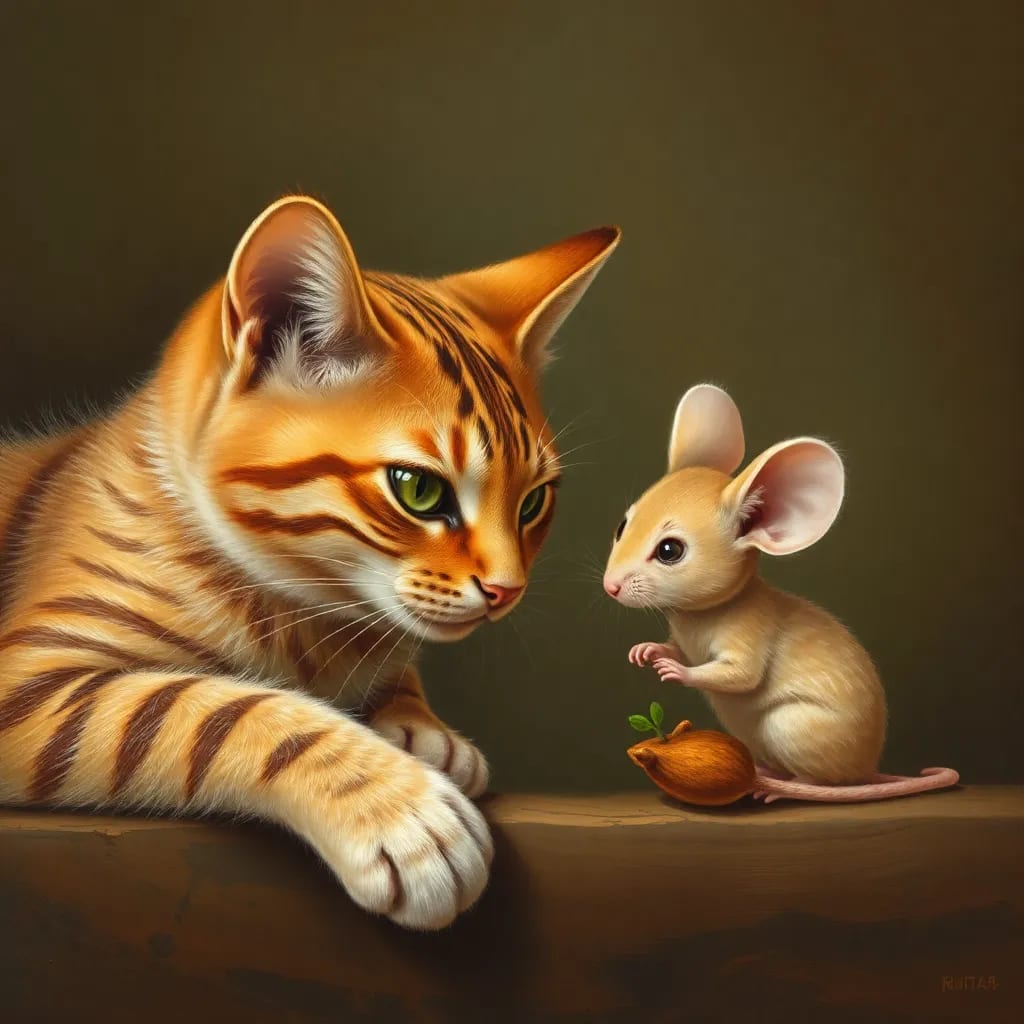
In a quiet old cottage tucked at the edge of a sun-dappled forest, there lived a cat named Silas. With fur as black as midnight and eyes sharp as polished emeralds, Silas was known to be a skilled hunter. He moved like smoke—silent, swift, and always watching. The humans who lived in the cottage were away more often than not, leaving Silas in charge, and he liked it that way. It meant the house was his kingdom.
But recently, his kingdom had a problem. A mouse.
This wasn't just any ordinary mouse. This one was clever, daring, and—Silas hated to admit—quite possibly smarter than him. Every night, Silas heard the faint scratching of tiny paws. His food bowl was sometimes missing a few crumbs. Once, he woke up to find a piece of cheese balanced mockingly on the edge of his favorite windowsill.
The mouse had a name: Thistle.
She was small, with silvery-gray fur and quick, clever eyes. Thistle had lived in the walls of the cottage long before Silas arrived. While other mice scurried and panicked, Thistle planned. She built trap doors in the floorboards, escape tunnels through the pantry walls, and even a pulley system made from twine and thimbles to lower herself from the shelves.
She didn’t want trouble. She just wanted to survive. But Silas—well, he made it clear this house wasn’t big enough for both of them.
One evening, as the golden light of sunset poured through the dusty windows, Silas lay perched on the kitchen table, tail flicking back and forth. He was ready. He’d studied the mouse’s patterns. Tonight would be the night.
Right on time, Thistle appeared, scampering across the counter toward a breadcrumb she’d spotted earlier that morning.
Silas pounced.
But Thistle, ever prepared, flipped a spoon into the air. It clanged onto the counter with a loud crash, bouncing right into Silas’s face. The cat hissed and tumbled backward as Thistle dove into a teacup, rolled across the table, and leapt to safety.
She paused in the doorway, smirking. “You'll have to do better than that, Whiskers.”
Silas growled. “Next time, little mouse. Next time.”
Over the following days, the chase continued. Every time Silas set a trap, Thistle avoided it. When he waited in silence for hours, she sent a decoy—a wind-up toy mouse she’d rigged from the attic. Silas grew more and more frustrated, while Thistle grew bolder.
But something unexpected happened. Silas began to admire her.
She was brave, creative, and had a sense of humor he couldn’t quite ignore. Once, she left him a note made from paper scraps:
“You guard the cheese well. But I prefer the stories in the pantry.”
Attached to the note was a page torn from an old children’s book, folded into a paper plane.
Silas found himself laughing. A low, rumbling chuckle he hadn’t made in years.
Then, one stormy night, everything changed.
Lightning cracked the sky as rain pounded the cottage roof. The wind howled through the cracks in the windows, and the power flickered out. Silas prowled the dark house, uneasy. Something felt wrong.
From the corner of the living room, he heard a faint squeak—not the usual confident squeak of Thistle’s taunts, but a cry for help.
He rushed toward the sound and found a bookshelf toppled over, its weight pressing down on a loose floorboard. Beneath it, barely visible in the dim light, was Thistle. Her leg was caught.
She looked up at him, wide-eyed, her whiskers trembling. “Help me,” she whispered.
Silas hesitated. Instinct told him this was his chance. No more games. No more chasing shadows. He could end it.
But instead, he bent down and used his paw to wedge the board up. He pulled and tugged until Thistle slipped free, limping, but alive.
She stared at him, stunned. “Why?”
Silas sat beside her, his fur soaked with rain. “Because… you’d do the same. Wouldn’t you?”
Thistle gave a small, tired laugh. “Maybe not at first. But I would now.”
From that night on, the war ended.
Silas and Thistle struck an unspoken truce. She stopped stealing food; he stopped setting traps. They began to talk—first cautiously, then comfortably. She told him about the tunnels she built under the floor, the library she created out of discarded paper scraps, and the dream she had of writing a book one day.
He told her about the forest outside, the owls he watched from the windowsill, and the loneliness of having no one to talk to when the humans were gone.
They became… friends.
In time, Thistle moved her nest from the walls to a little hollow in the kitchen drawer. Silas would sometimes nudge a crumb or two in her direction. And at night, they’d sit by the window together, watching the stars.
Moral of the Story:
Sometimes, those we chase turn out to be the ones we need the most. And sometimes, curiosity leads not just to trouble—but to unexpected friendship.
About the Creator
Keep reading
More stories from writers in History and other communities.
Otto von Bismarck: The Real-World Strategic Genius
History remembers many great thinkers of power, but few figures mastered it as completely in practice as Otto von Bismarck. While philosophers like Machiavelli explained how rulers *should* behave, Bismarck demonstrated how power actually works in the real world—messy, emotional, unpredictable, and deeply human. He was not a conqueror driven by glory, nor an ideologue chasing perfection. He was something far rarer: a strategist whose primary weapon was restraint.
By Fred Bradford7 days ago in History


Comments (1)
This is a best Story.