
“The Blood-Soaked Love Letters of the French Revolution”
"When Romance Dared to Bloom in a World at War with Itself"
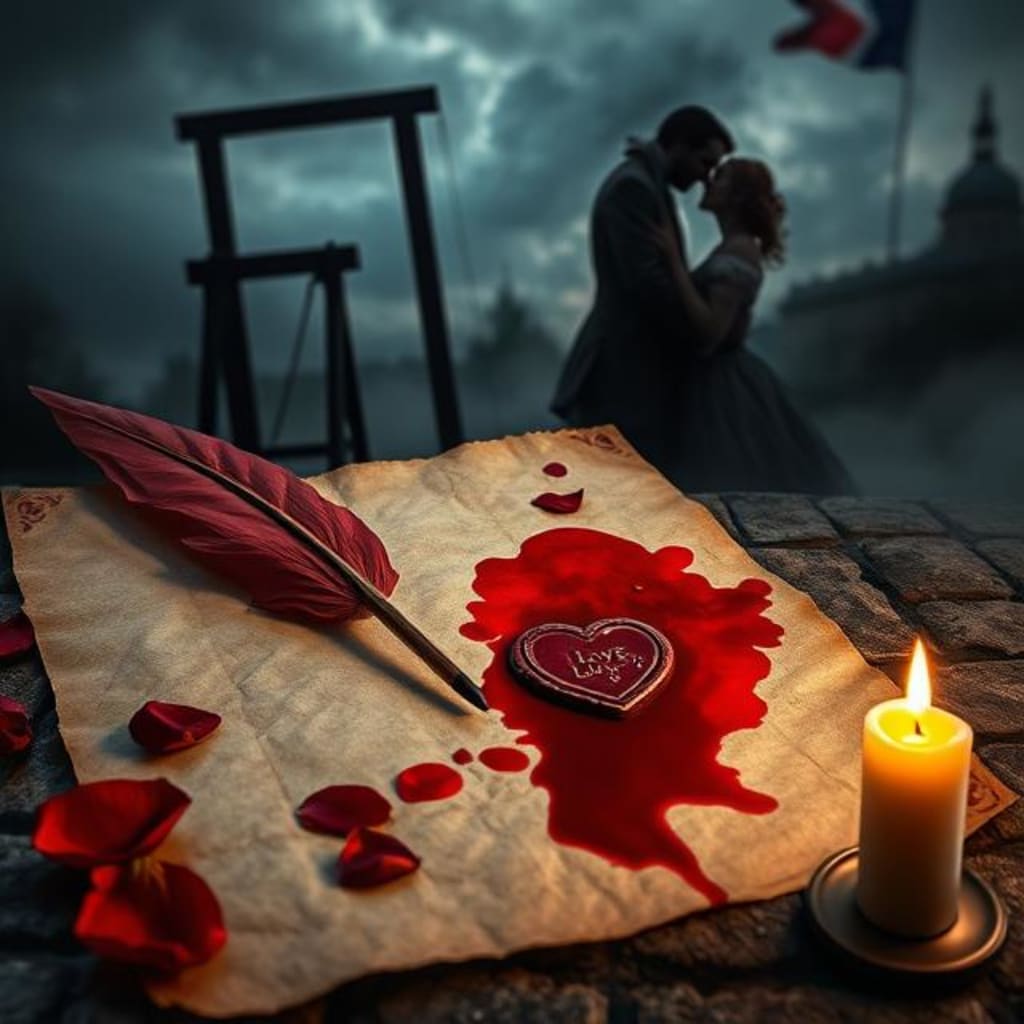
Paris, 1793
The city smelled of smoke, fear, and blood. Every street echoed with the thud of revolution—boots on cobblestones, drums calling citizens to execution squares, and the ominous roll of wooden wheels hauling the condemned. Paris was a city in labor, birthing a new world—but in the process, it devoured its children.
Among the fading tapestries of noble houses and the rough-hewn cobblestones soaked in rebellion, there existed a love so fierce, so doomed, that even time dared not forget it.
1. The Noblewoman and the Spy
Celeste de Miremont was born with powdered hands and silken shoes. A daughter of aristocracy, her home had once hosted poets and kings. But as the Revolution clawed through France, the grandeur around her crumbled.
She stayed hidden in her family's half-burnt chateau on the Rue de Béarn, the last of her line, cloaked in silence and mourning. Her parents had been dragged away the year before—guilty not by deed, but by bloodline. Celeste, with ink-stained fingers and clever eyes, had survived by disappearing.
But then he came.
Étienne Rousseau was a shadow in the night. A messenger for the Girondins, a secret courier weaving through the city with forged papers, fake names, and dangerous truths. He knocked on her door in the spring of ’93, bleeding from the arm and desperate.
“I was told you help those who should already be dead,” he’d said with a half-smile and blood on his lips.
Against every rule of reason, she let him in.
2. Letters in Candlelight
At first, he stayed one night. Then another. Then a week. He slept near the library hearth while she watched from the stairs, wondering if it was loneliness or fate that had made her offer refuge.
Étienne spoke of politics, of Robespierre’s madness, of how the Revolution had devoured itself. But he also spoke of her—of how her hands moved when she wrote, of how her laugh surprised him like sudden thunder on a summer day.
She began writing him letters.
Not because she had to—he was there—but because some feelings couldn't be spoken aloud in such terrible times. Words were safer hidden between pages, especially when death hung outside every window.
He returned the gesture. When he left on missions, he'd tuck notes beneath her pillow. Pages that smelled of smoke, ink, and him.
“I dreamt of you standing beneath the guillotine, unafraid, still proud, still beautiful. I woke with tears on my lips.”
“If I die tomorrow, know that you’ve already made my life worth living.”
Each letter was tucked in a drawer lined with lavender sachets and fear. Neither of them said it aloud, but they both knew: love had no place in a country at war with its soul.
3. Betrayal in Crimson
It happened on a rainless July morning.
Étienne didn’t return when he said he would. A day passed. Then two.
On the third day, a boy arrived—a barefoot child, no more than nine—holding a blood-streaked letter sealed with a wax stamp smeared by heat.
Celeste’s hands trembled as she broke it open.
“They know. I was betrayed. There’s a name on their list, and it's yours.”
“Run. Burn this. I love you.”
But she didn’t run.
Instead, she gathered every letter he had ever sent—each stained, crumpled, or tear-dotted—and tied them with a ribbon. Then she walked to the Place de la Révolution, where the air was always thick with the scent of fear.
There, she found him—in a cart beside nobles, priests, and poets—his head held high, even as the crowd jeered.
Their eyes met. Hers filled with salt. His with apology.
And then he mouthed, "Forgive me."
The blade fell before she could blink.
4. Blood on Parchment
That night, she returned home with her soul hollowed and her hands stained red.
She retrieved every letter, laid them out across the table, and wrote a final one in her own blood, mixing it with ink.
“They took you. But they cannot take the words we shared.”
“They can kill men. They can burn palaces. But they cannot murder love that bleeds on paper.”
She wrapped the bundle in cloth and buried it beneath the floorboards of her library.
She left Paris the next day with no name, no destination—just silence and shadows.
5. A Discovery Centuries Later
Paris, 2023
It was a routine renovation. The old Miremont estate, now a half-decayed historical relic, was being converted into a museum. Workers pulled up rotted floorboards and stripped away centuries of dust.
Then, someone found it.
A velvet bundle, hardened by age, buried in a shallow cavity beneath what was once the library.
Inside: dozens of letters, ink faded but legible. Some had bloodstains. Others were crumpled with signs of weeping. One was written entirely in brownish-red—a mix of ink and something else.
They became a sensation.
Historians labeled them The Blood-Soaked Love Letters of the French Revolution.
The letters were displayed in glass cases, their passion immortalized for tourists to gape at. People read them with tears in their eyes, shocked by how love had bloomed amid bloodshed.
But few understood the full tragedy.
6. The Unread Letter
One letter was never translated for public view. It had been tucked in a side envelope, sealed with the same wax used over 200 years ago.
A scholar named Isabelle Martel had been the first to translate it. She cried reading it. Not just because of the words—but because of what it meant.
It read:
“They used me to find you. They knew of our letters. I thought I was protecting you when I said your name—but I condemned you instead.”
“I begged them to take me instead. I would have given my life for yours. And in the end, I did.”
“Celeste, I never deserved your love, but I died with it burning in my chest.”
– Étienne”
That letter, blood-speckled and smudged with tears, was placed back inside the envelope.
It was never displayed.
Some truths, the museum decided, are too raw for glass cases.
7. Epilogue: Ink That Never Dies
Today, the Miremont estate houses a single room called The Room of Letters. Visitors walk in hushed silence, eyes grazing each word that once tethered two souls during a time when death walked with the living.
Lovers leave behind their own letters—on napkins, postcards, scraps of paper—folded and dropped into a replica chest beneath the exhibit. A quiet tribute to a woman who wrote in candlelight, and a man who died with her name on his lips.
They say that love in times of peace is gentle. But love in times of war?
That love is eternal.
And sometimes, it bleeds.
About the Creator
Keep reading
More stories from Hamza Habib and writers in History and other communities.
“The Women Who Fought—And Bled—During the French Resistance”
When the guns of World War II roared across Europe, a shadow war brewed beneath the surface of occupied France—a war fought not only by soldiers in uniform but also by brave men and women in the shadows. Among them, countless women risked everything: their lives, their families, and their futures. They fought, they bled, and they refused to be silenced. These are their stories—the stories of the women who defied Nazi occupation and played a pivotal role in the French Resistance.
By Hamza Habib7 months ago in History
The Seven Wonders of the World: Amazing Human Creations
People have always been fascinated by things that are grand and unusual. From the very beginning of civilization, humans wanted to build structures that were not just useful, but also showed their skill, creativity, and ambition. The Seven Wonders of the World are the most famous examples of this desire. They are impressive not only because of their size or beauty, but also because of the stories they tell about our past, different cultures, and human innovation. The idea of the Seven Wonders comes from ancient travelers and historians who listed the most remarkable human creations. Even though some of these wonders no longer exist, their legacy continues to inspire people around the world. Let’s explore each one, looking at their history, significance, and why they remain unforgettable. 1. The Great Pyramid of Giza (Egypt) The Great Pyramid of Giza is the only surviving wonder of the original Seven Wonders. Built around 2560 BCE as the tomb of Pharaoh Khufu, it is an extraordinary engineering achievement. Made from more than two million limestone blocks, some weighing over 15 tons, the precision of its construction is still astonishing today. The pyramid shows the power and beliefs of ancient Egypt and continues to attract visitors from all over the world. It is a true symbol of human skill and vision. 2. The Hanging Gardens of Babylon (Iraq) The Hanging Gardens of Babylon are famous for their beauty and clever design, though historians still debate whether they really existed. Ancient stories say King Nebuchadnezzar II built these stepped gardens for his wife, Amytis, who missed the green hills of her homeland. The gardens, described as terraces full of trees, flowers, and shrubs, appeared to float above the city. Whether real or partly mythical, they show how ancient people combined nature and architecture in extraordinary ways. 3. The Statue of Zeus at Olympia (Greece) Around 435 BCE, the sculptor Phidias created the Statue of Zeus at Olympia. This huge statue of the Greek god Zeus, seated on a throne, was over 12 meters tall and made of ivory and gold-plated bronze. It represented both artistic skill and religious devotion. Even though it was destroyed long ago, records and artistic depictions keep its memory alive, showing the Greeks’ dedication to beauty, religion, and craftsmanship. 4. The Temple of Artemis at Ephesus (Turkey) The Temple of Artemis, built around 550 BCE, was dedicated to the Greek goddess of the hunt and wilderness. Known for its enormous size, detailed sculptures, and beautiful design, it was rebuilt several times after destruction, reflecting its cultural importance. People traveled from across the Mediterranean to see it, making the temple a center of religion, art, and commerce. Today, its ruins still tell the story of a civilization that valued beauty and spiritual devotion. 5. The Mausoleum at Halicarnassus (Turkey) Built between 353 and 350 BCE, the Mausoleum at Halicarnassus was the tomb of Mausolus and his wife Artemisia. Combining Greek, Egyptian, and Lycian styles, it stood around 45 meters tall and was decorated with intricate sculptures. Its design influenced monumental tombs for centuries. Even after earthquakes destroyed it, the Mausoleum remains a symbol of human creativity and architectural achievement. 6. The Colossus of Rhodes (Greece) The Colossus of Rhodes, built between 292 and 280 BCE, was a massive bronze statue of the sun god Helios, celebrating Rhodes’ victory over an invading army. Over 30 meters tall, it was one of the tallest statues of the ancient world. Although it only stood for 54 years before an earthquake toppled it, the Colossus became a symbol of triumph, resilience, and artistic achievement, inspiring large statues throughout history. 7. The Lighthouse of Alexandria (Egypt) The Lighthouse of Alexandria, or Pharos, was built around 280 BCE on the small island of Pharos. Standing over 100 meters tall, it served as both a landmark and a guide for sailors entering Alexandria’s busy harbor. Its elegant design combined functionality and beauty. Though earthquakes destroyed it long ago, it remains a symbol of human ingenuity and innovation in maritime engineering. The Legacy of the Seven Wonders The Seven Wonders are more than just buildings; they are symbols of human creativity, ambition, and achievement. Each wonder tells a story about the people who built it, the culture it came from, and the new ideas of its time. Even though some no longer exist, their stories continue to live through historical records, art, and the fascination of people worldwide. These wonders still inspire architects, artists, engineers, and travelers today. From the pyramids of Egypt to the Hanging Gardens of Babylon, they remind us that imagination and effort can create something that lasts for thousands of years. They are examples of determination, vision, and the pursuit of excellence. Conclusion The Seven Wonders of the World are timeless creations that celebrate human creativity and determination. They are more than stones, metals, or ruins—they represent entire civilizations and the marks they left on history. Even after centuries, their stories continue to inspire people to dream, create, and achieve greatness. These wonders remind us that with vision, passion, and effort, humans can build creations that
By Binan Mooona day ago in History
3 Everyday Rules That Exist Because Someone Once Did Something Very Stupid
Everywhere you go, you are surrounded by rules that feel oddly specific. Do not touch. No running. Contents hot. Do not insert body parts. These warnings aren’t theoretical. They weren’t written by pessimists or lawyers with too much free time. They exist because at some point in history, a real human being looked at a situation and thought, “This will probably be fine.”
By Enoch Sagini4 days ago in History



Comments
There are no comments for this story
Be the first to respond and start the conversation.