
The Birth of a Gentleman's Game
How Cricket Evolved from a Rustic Pastime to a Global Obsession
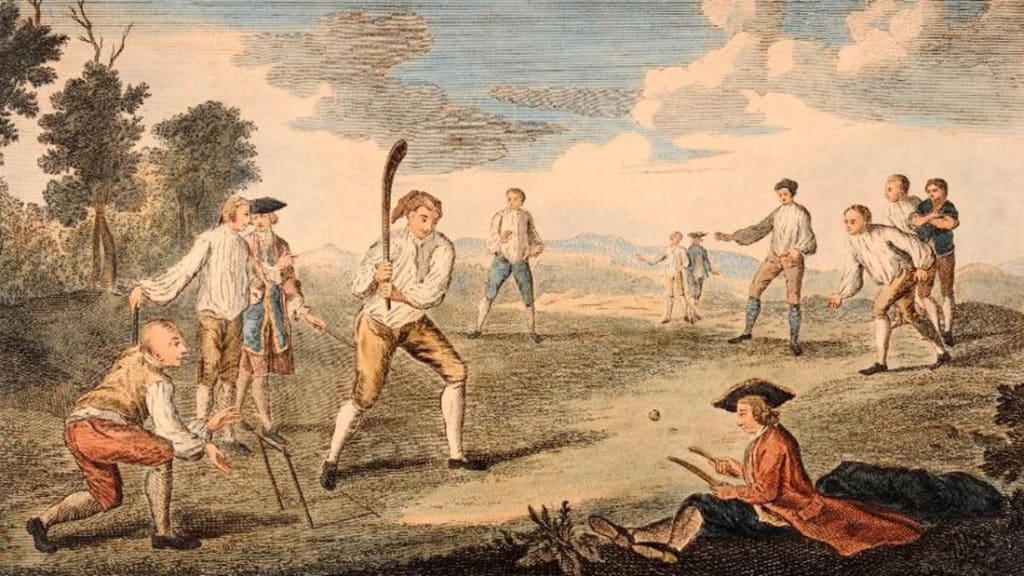
Long before roaring stadiums, million-dollar contracts, and international rivalries, cricket began as a humble children’s game played in the quiet countryside of southern England. The story of cricket’s invention is not one of grand design, but rather of a game that slowly shaped itself through time, guided by the people who loved it.
It was the early 16th century, and life in rural England was simple and pastoral. Among the rolling hills of Sussex and Kent, shepherd boys would often use their crooks to bat away stones or small pieces of wood, while their friends bowled them underarm. What began as a game of reflex and fun soon found structure and appeal. They called it “creckett” or “criquet,” terms believed to have been derived from the Old English word cryce, meaning a crutch or staff.
At first, it was purely a children’s pastime, but as decades passed, older youths and eventually adults began to participate. The game grew in popularity throughout southeast England. Villagers played in open fields, using homemade bats fashioned from tree branches and balls stuffed with cloth or sheep wool. There were no wickets then—only targets marked on trees or gates. Yet even in this primitive form, cricket provided joy, competition, and camaraderie.
By the early 1600s, cricket was being mentioned in court records—not as a formal sport, but due to disputes and land damage caused by spirited games. A famous early reference appeared in 1611, when two men from Sussex were fined for playing cricket on a Sunday instead of attending church. This incident, although minor, shows the growing attachment people felt to the game and the early tension between tradition and recreation.
The first organized cricket matches emerged around the late 17th century. Gentry and nobles began sponsoring matches between villages, placing wagers on the outcomes. This involvement brought funding, formality, and competition. It was during this time that the game began to transform—wooden wickets were introduced, rules were written down, and players began to specialize as batsmen, bowlers, and fielders.
One of the most significant developments came in 1744 when the first known Laws of Cricket were officially recorded. These rules established basic elements like the pitch length, the size of the stumps, and the method of dismissal. The Marylebone Cricket Club (MCC), founded in 1787, would later become the guardian of these laws, ensuring the game remained structured as it expanded.
Cricket’s charm lay not just in the play but in its spirit—the idea of fairness, patience, and discipline. It became known as “the gentleman’s game,” especially as it became popular in England’s elite schools and universities. Matches would sometimes last for days, and players were expected to uphold honor, sportsmanship, and etiquette, even amid fierce competition.
As the British Empire expanded, cricket traveled with it. Soldiers, traders, and colonists carried the game to India, the West Indies, Australia, and South Africa. In these lands, cricket took root deeply, growing in both influence and emotional importance. What began in English pastures now echoed in the dust of Indian villages, the plains of Australia, and the streets of the Caribbean.
In India, the game blossomed in the 19th century, with the Parsi community forming the first native cricket clubs in Bombay. Over time, cricket would grow into a national passion, transcending language, class, and religion. In Australia, the first inter-colonial matches laid the foundation for a fierce sporting identity, culminating in the historic Ashes series against England beginning in 1882.
By the 20th century, cricket had evolved even further. The sport saw the rise of international test matches, the introduction of protective gear, and eventually, shorter formats like One Day Internationals and T20 cricket. Each adaptation brought new fans, faster play, and global excitement, but the heart of cricket—its values and heritage—remained rooted in those quiet English fields.
Today, cricket is played and loved by millions across continents. Its players are celebrated heroes, its rivalries are followed with intense passion, and its tournaments are watched by billions. From children playing in alleyways to world-class stadiums under floodlights, cricket unites people in a way few sports can.
But despite its modern glory, the soul of cricket still whispers of its origins: of shepherd boys in Sussex, of makeshift bats and open fields, of laughter, competition, and community. The invention of cricket was not a single moment, but a journey of centuries, shaped by cultures, classes, and continents.
It is not merely a game. It is a legacy. And it all began with a simple bat and ball, in the hands of children who just wanted to play.
About the Creator
Keep reading
More stories from Khalid khan and writers in History and other communities.
The Story Behind the Invention of Tea
In the lush mountains of ancient China, around 2737 BCE, Emperor Shen Nong was no ordinary ruler. A scholar, herbalist, and scientist by nature, he believed that every leaf, root, and seed had a purpose. His empire flourished not only through conquest but through knowledge—especially of nature's remedies.
By Khalid khan7 months ago in History
Saddam Hussein: Rise, Rule, and Fall
Saddam Hussein was born on April 28, 1937, in a small village near Tikrit, Iraq. His early life was marked by poverty, hardship, and a sense of abandonment. His father died before he was born, and his mother remarried soon after. Young Saddam grew up in a household dominated by strict relatives and was exposed to political discussions and nationalist sentiments from an early age. These formative years shaped his personality—ambitious, ruthless, and fiercely determined to rise above his modest beginnings.
By The best writer 35 minutes ago in History
Alexander the Great: Conqueror of Empires
Alexander was born in 356 BCE in the ancient kingdom of Macedon, a rugged land of warriors and kings. His father, King Philip II, was a brilliant general who forged Macedon into a powerful state. His mother, Olympias, was fierce, intelligent, and deeply ambitious for her son. From the beginning, Alexander’s life was wrapped in stories of destiny. Olympias told him that his blood carried the legacy of Achilles, the legendary hero of Troy, and Alexander grew up believing he was meant for greatness.
By The best writer 2 days ago in History


Comments
There are no comments for this story
Be the first to respond and start the conversation.