
"The Battle of Buckets: A War for Water and Honor"
"The War That Started with a Bucket"
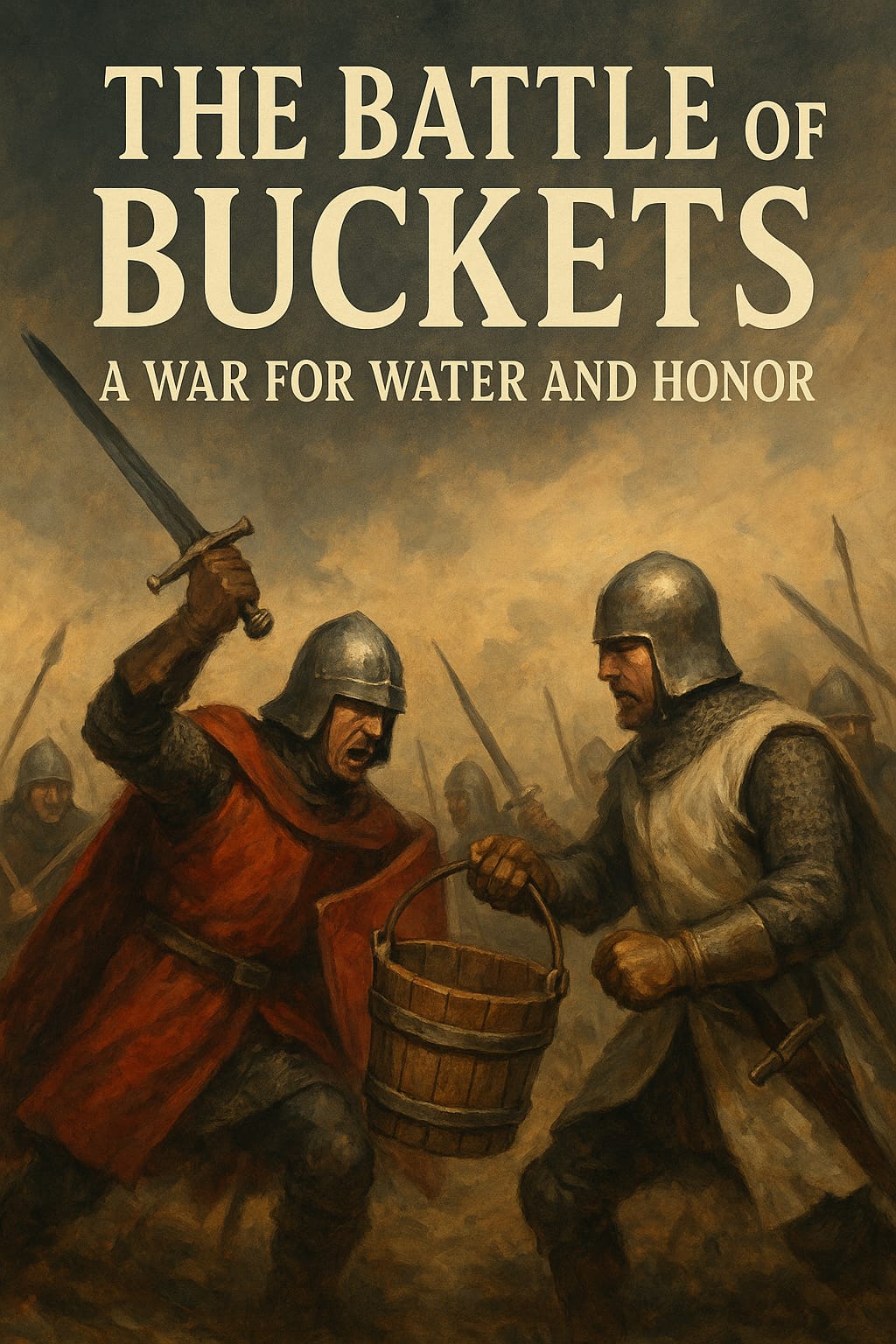
In the early 14th century, northern Italy was a land divided. City-states like Bologna and Modena stood as proud bastions of culture, commerce, and military might. But pride is a double-edged sword, and in 1325, it was not land, gold, or power that drove them to war—it was a wooden bucket.
The story begins in Bologna, a prosperous city known for its universities and grand architecture. One of its prized symbols, oddly enough, was a well located at the city’s center, crowned with a sturdy oak bucket used daily by citizens to draw water. This bucket, ordinary in design but rich in symbolic value, stood as a quiet witness to the city’s strength and unity.
One cool morning, a group of Modenese soldiers on a covert mission crept into Bologna. It was not land they sought, nor secrets—they came for the bucket. With stealth and speed, they stole it from the well and disappeared into the night, leaving behind only a broken chain and a mocking note:
"Water flows freely, but your pride now spills."
The news reached Bologna by sunrise, and the city erupted. Citizens gathered in outrage; councilmen shouted in the chamber. The theft was more than a prank—it was an insult, a challenge, a slap to the face of Bologna's honor. A council of elders was called, and with loud voices and fiery eyes, they declared war.
Meanwhile, in Modena, the bucket was paraded like a trophy through the streets. It was displayed in the city square, hung high from the tower of the main cathedral. Crowds cheered, mocking the Bolognese with chants and songs. But not all Modenese were pleased. In the heart of the city lived a young apprentice named Marco, who worked under the city’s old blacksmith. Marco’s father had died in a previous war, and though Marco was proud of his city, he feared the cost of conflict.
As troops gathered and swords were sharpened, Modena and Bologna prepared for battle. On November 15th, 1325, their armies met in a field just outside the walls of Zappolino. Over 30,000 soldiers filled the battlefield, ready to fight not just for land or riches, but for a wooden bucket.
The battle was brutal. Steel clashed, arrows flew, and the ground turned red. The commanders barked orders, and banners waved through the smoke. In the chaos, Marco found himself thrown into the fray, handed a sword and shield though he had never held one in his life. He fought not for glory, but for survival.
On the other side, a Bolognese soldier named Pietro led a group of elite fighters with one goal: to retrieve the bucket and restore their city's honor. They sliced through Modenese lines, inching toward the tower where the bucket hung. But the Modenese were ready, defending the symbol with fanatical loyalty.
By sundown, the field was littered with the fallen. Despite Bologna’s numbers and rage, Modena emerged victorious. Their lines held, and the bucket remained in their hands. Bologna retreated, its pride shattered more than its army.
Marco survived, barely, and returned home with haunted eyes. He had seen what pride and symbols could cost—thousands of lives lost for a piece of wood and metal. He never forgot the look in the eyes of the Bolognese boy he had spared, nor the friend he had lost beside him.
Back in Modena, the victory was celebrated for days. The bucket was declared a national treasure and locked away in a fortified chamber. Songs were written, children taught about the "heroic defense of the bucket," and murals painted the battlefield with glory and honor.
But Marco never joined the celebration. He hung up his sword and returned to the forge. To him, the war had proven something else—not honor, but the madness of men. He would spend the rest of his days crafting tools for builders and farmers, not weapons for soldiers.
Years later, when asked by his grandson why a simple bucket had caused a war, Marco simply replied:
"Because men will fight over anything—when they’ve forgotten the value of peace."
And so the bucket remained, not just a war trophy but a symbol of absurdity, pride, and the strange things we are willing to fight for.
Even today, in the town of Modena, the bucket is still on display—a reminder that even the smallest things can spark the greatest battles.
About the Creator
Keep reading
More stories from Muhammad Imran and writers in History and other communities.
The Secret Path to Happiness
A long time ago, in a quiet village tucked between two great hills, lived a young man named Ayaan. Though surrounded by beautiful valleys and kind-hearted villagers, Ayaan was not happy. Every day felt the same—waking up tired, walking through life with no direction, and sleeping with a heart full of confusion. He didn’t know why, but a shadow hung over his days, and the future felt like a heavy burden.
By Muhammad Imran8 months ago in 01
Pablo Escobar: The Man Who Declared War on Colombia
Pablo Emilio Escobar Gaviria was born on December 1, 1949, in Rionegro, Colombia, and raised in the nearby city of Medellín. He grew up in a modest household, the son of a farmer and a schoolteacher. From an early age, Escobar showed ambition and defiance. He dreamed of power, wealth, and influence—dreams far larger than his surroundings. In a country struggling with inequality and limited opportunity, Escobar believed the rules were written to keep people like him down. Instead of trying to change the system, he chose to dominate it.
By The best writer 7 days ago in History
The Accidents That Quietly Improved Aviation Forever
I used to think aviation history was a story of bold successes, record-breaking flights, sleek aircraft, and triumphant landings. But the more I read, the more I realized something uncomfortable: much of modern aviation was shaped not by success, but by accidents. The safety and reliability we now take for granted were quietly built from moments when things went terribly wrong.
By Beckett Dowhan8 days ago in History



Comments
There are no comments for this story
Be the first to respond and start the conversation.