
The Ashvamedha Parva – The divine Sacrifice and the Restoration of Dharma
The Ashvamedha Parva – The divine Sacrifice and the Restoration of Dharma
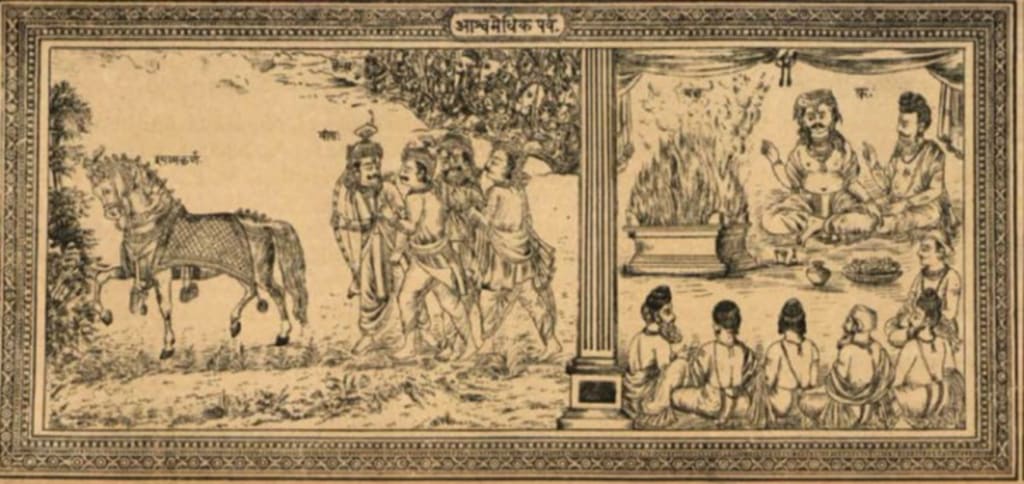
The Ashvamedha Parva of the Mahabharata is a tale of atonement, reconciliation, and the restoration of dharma after the devastating Kurukshetra War. With the Kauravas defeated and the Pandavas crowned as the rightful rulers of Hastinapura, the Pandavas faced a daunting task: rebuilding their shattered kingdom and healing the wounds of war. This parva narrates the Pandavas' journey to reaffirm their sovereignty and seek spiritual absolution through the Ashvamedha Yajna, the grand horse sacrifice.DAD053
The Aftermath of the War
The Kurukshetra War left Hastinapura in ruins, with millions dead and families broken. While the Pandavas emerged victorious, the emotional cost was immeasurable. Yudhishthira, the eldest Pandava and the new king, was deeply affected by the loss of life and bore the weight of guilt for the deaths of his family, teachers, and countless soldiers.
Yudhishthira’s Guilt and Doubts
Yudhishthira struggled to reconcile his duty as a king with the horrors of war. He lamented the destruction caused in the name of dharma and felt unworthy to rule. His brothers and allies, including Krishna, urged him to rise above his grief and fulfill his responsibilities as a ruler.
Krishna’s Counsel and the Ashvamedha Yajna
Krishna, ever the guide and protector of dharma, advised Yudhishthira to perform the Ashvamedha Yajna. This Vedic ritual was not only a means of asserting sovereignty but also a spiritual act of atonement to cleanse the kingdom of the sins of war.
The Purpose of the Yajna
The Ashvamedha Yajna symbolized the supreme authority of a king. A sacrificial horse was released to roam freely across the land, and any ruler who stopped or captured the horse would challenge the sovereignty of the yajna performer.
It also served as a ritual of reconciliation, bringing together rulers from various regions under a single act of dharma.
The Release of the Sacred Horse
Under Krishna’s guidance, a majestic horse was chosen and consecrated for the yajna. The horse was adorned with ornaments and set free to wander. Arjuna, the greatest warrior among the Pandavas, was tasked with protecting the horse and leading the military campaign to subdue any challengers.
Arjuna’s Journey with the Horse
The wandering horse traversed many kingdoms, often sparking conflicts with rulers who sought to capture it. Arjuna’s journey with the horse was a test of both his martial prowess and his ability to resolve disputes through diplomacy and dharma.
Encounters Along the Way
Chitrangada and Manipura:
The horse entered Manipura, ruled by Chitrangada, one of Arjuna’s wives. Their son, Babhruvahana, now the ruler, challenged Arjuna in battle, unaware of their relationship.
In a fierce duel, Babhruvahana fatally wounded Arjuna, fulfilling a prophecy. Overcome with grief upon learning the truth, Babhruvahana sought to revive his father.
Ulupi, Arjuna’s other wife and a Naga princess, used a divine gem to bring Arjuna back to life, symbolizing reconciliation and the unity of dharma.
Rulers Opposing the Pandavas:
Several rulers attempted to challenge the horse’s passage, leading to intense battles. Arjuna’s unmatched skill and the Pandavas’ reputation ensured that the challengers were defeated or reconciled peacefully.
Diplomacy and Unity:
In some regions, Arjuna resolved disputes without bloodshed, spreading the message of unity and dharma. His actions demonstrated the importance of compassion and diplomacy in leadership.
The Completion of the Yajna
After a year of wandering, the sacred horse returned to Hastinapura. Its safe return marked the successful conclusion of the Ashvamedha Yajna, paving the way for the grand ritual.
The Grand Sacrifice
The yajna was performed with elaborate rituals, guided by sages like Vyasa and Narada. The horse was symbolically sacrificed, signifying the supremacy of Yudhishthira’s rule.
Kings and nobles from across the land attended the ceremony, offering tributes and pledging allegiance to Yudhishthira.
Reconciliation and Healing
The Ashvamedha Yajna was not just a political act but also a spiritual and emotional one. The Pandavas used the occasion to distribute wealth and aid to the people, rebuilding lives shattered by the war.
Acts of Charity
Yudhishthira, as the yajna’s host, distributed gold, food, and clothing to the citizens. This generosity helped heal the wounds of the war and restored faith in the new administration.
Brahmins and sages were honored, and the yajna’s blessings ensured prosperity for the kingdom.
Krishna’s Role
Krishna’s presence ensured the yajna’s success. His divine wisdom guided the Pandavas through the ritual, reaffirming their commitment to dharma.
Key Themes and Lessons of the Ashvamedha Parva
Atonement and Redemption:
Yudhishthira’s performance of the yajna reflected his efforts to atone for the war’s devastation and restore dharma in the kingdom.
The Role of Dharma:
The parva emphasizes that true leadership is rooted in justice, compassion, and service to the people.
Reconciliation and Unity:
Arjuna’s encounters with various rulers highlight the importance of resolving conflicts peacefully and fostering unity.
Spiritual and Political Renewal:
The yajna served as a bridge between the material and spiritual realms, ensuring both political sovereignty and divine blessings.
Legacy of the Ashvamedha Parva
The Ashvamedha Parva symbolizes the resilience of dharma amidst destruction. The Pandavas, under Krishna’s guidance, used the yajna to heal their kingdom and reassert their commitment to justice and morality. The parva ends with a message of hope, unity, and renewal, underscoring the eternal power of dharma to restore balance in the world.6638FF
In the aftermath of one of history’s greatest conflicts, the Ashvamedha Yajna became a beacon of light, reminding humanity of the importance of righteousness, forgiveness, and the enduring quest for harmony.
About the Creator
Keep reading
More stories from sai Charan and writers in History and other communities.
Shanti Parva – The Lessons of Dharma and Governance
The Shanti Parva of the Mahabharata unfolds after the great war of Kurukshetra, where victory comes at a tremendous cost. The Pandavas, though victorious, are consumed by grief and remorse over the immense loss of life. The kingdom of Hastinapura lies in ruins, its people mourning the destruction wrought by the war. Amidst this turmoil, Yudhishthira, the eldest Pandava, reluctantly ascends the throne, burdened by guilt and the responsibilities of kingship.1D744D
By sai Charanabout a year ago in History
Cleopatra – The Last Queen of the Nile
Cleopatra VII Philopator, known to history simply as Cleopatra, was the last active ruler of the Ptolemaic Kingdom of Egypt. Her life was a dramatic blend of intelligence, ambition, political skill, love, war, and tragedy. She was not only a queen but a strategist who stood at the crossroads of two great civilizations—Egypt and Rome—during one of the most turbulent periods in ancient history. Cleopatra was born in 69 BCE in Alexandria, the shining capital of Egypt. Though she ruled Egypt, she was not ethnically Egyptian. She belonged to the Ptolemaic dynasty, a Greek royal family descended from Ptolemy I, one of Alexander the Great’s generals. For nearly three centuries, her family ruled Egypt after Alexander’s death. Yet unlike many of her ancestors, Cleopatra embraced Egyptian culture. She learned the Egyptian language—something rare among the Ptolemies—and presented herself as the living goddess Isis to her people. She was highly educated, speaking several languages, and was trained in philosophy, mathematics, and diplomacy. Cleopatra became queen in 51 BCE at the age of eighteen, co-ruling with her younger brother Ptolemy XIII, who was only ten years old. According to Egyptian tradition, she married her brother to solidify their joint rule. However, their relationship quickly turned into rivalry. Cleopatra was determined to rule independently, but powerful advisers around Ptolemy XIII pushed her aside. Soon, she was forced into exile from Egypt. But Cleopatra was not one to accept defeat. During her exile, she gathered an army and planned her return. Around this time, Rome was embroiled in civil war between Julius Caesar and Pompey the Great. When Pompey fled to Egypt seeking refuge, he was killed on Ptolemy XIII’s orders in an attempt to win Caesar’s favor. However, when Caesar arrived in Alexandria in 48 BCE, he was reportedly outraged by Pompey’s murder. Cleopatra saw opportunity in chaos. According to legend, she had herself secretly brought to Caesar wrapped in a carpet (or bed sack) so she could meet him privately. Whether the story is fully true or not, what is certain is that Cleopatra impressed Caesar with her intelligence, charm, and political vision. An alliance—and romance—soon followed. With Caesar’s military support, Cleopatra defeated her brother’s forces. Ptolemy XIII drowned in the Nile during the conflict. Cleopatra was restored to the throne, this time co-ruling with another younger brother, Ptolemy XIV. Soon after, she gave birth to a son, Ptolemy XV, known as Caesarion, whom she claimed was Julius Caesar’s child. Cleopatra later traveled to Rome and stayed there as Caesar’s guest. Her presence in Rome caused scandal and fascination. To some Romans, she was exotic and powerful; to others, she was a dangerous foreign queen influencing their leader. In 44 BCE, Julius Caesar was assassinated by Roman senators. Cleopatra quickly returned to Egypt, recognizing that Rome had once again become unstable. After Caesar’s death, a new power struggle erupted in Rome. Three men formed the Second Triumvirate: Octavian (Caesar’s adopted heir), Mark Antony, and Lepidus. Mark Antony eventually became ruler of Rome’s eastern territories, which included Egypt’s neighboring regions. In 41 BCE, Antony summoned Cleopatra to meet him in Tarsus. Cleopatra once again demonstrated her mastery of political theater. She arrived on a magnificent barge decorated in gold and purple sails, presenting herself as the goddess Isis. Antony was captivated. Their meeting marked the beginning of one of history’s most famous love affairs. But their relationship was not merely romantic—it was strategic. Antony needed Egypt’s wealth to fund his military campaigns, and Cleopatra needed Roman protection to secure her throne. They became partners in both love and politics. Cleopatra bore Antony three children. Together, they envisioned a powerful eastern empire centered in Alexandria. However, their alliance created tension in Rome. Octavian viewed Antony’s relationship with Cleopatra as a betrayal of Roman values. He portrayed Cleopatra as a seductive foreign queen who had bewitched Antony and turned him against Rome. Roman propaganda painted her as dangerous and manipulative. The conflict between Octavian and Antony eventually erupted into open war. In 31 BCE, their forces clashed in the naval Battle of Actium. Cleopatra’s fleet fought alongside Antony’s, but the battle ended in disaster. Facing defeat, Cleopatra withdrew her ships. Antony followed her, leaving his fleet to collapse. Octavian emerged victorious. After Actium, Octavian pursued them to Egypt. In 30 BCE, his forces invaded Alexandria. Antony, believing Cleopatra had betrayed him and thinking she was dead, took his own life. When Cleopatra realized Antony was truly dying, she had him brought to her mausoleum, where he died in her arms. Cleopatra knew her fate was sealed. Octavian intended to take her to Rome as a captive to parade in his triumph—a humiliation she could not accept. Determined to die as a queen rather than live as a prisoner, Cleopatra chose suicide. According to ancient accounts, she allowed herself to be bitten by an asp, a venomous snake, though some historians debate the exact method. Cleopatra died in 30 BCE at the age of thirty-nine. With her death, the Ptolemaic dynasty ended, and Egypt became a province of the Roman Empire. Octavian, who would later become Emperor Augustus, consolidated his power and ushered in the Roman Empire. Cleopatra’s legacy has endured for over two thousand years. Often remembered for her beauty and romances, she was far more than a seductress. She was a skilled diplomat, a brilliant linguist, and a capable ruler who fought to preserve Egypt’s independence in an age of Roman expansion. She managed a wealthy economy, stabilized her kingdom during famine, and maintained Egypt’s cultural identity. Her story is ultimately one of resistance against overwhelming odds. She lived in a world dominated by powerful men and empires, yet she carved her own place in history. Though her reign ended in defeat, her name never faded. Poets, playwrights, and historians—from Shakespeare to modern filmmakers—have retold her tale countless times. Cleopatra was the last queen of ancient Egypt, but she became something greater: a symbol of ambition, intelligence, love, and tragedy. In her rise and fall, we see the end of one world and the birth of another. Her death marked not just the loss of a queen, but the final chapter of a civilization that had thrived along the Nile for thousands of years. And so, Cleopatra remains immortal—not only as the last queen of Egypt, but as one of history’s most unforgettable figures.
By The best writer 3 days ago in History
The General’s Tooth
History is often told through the polished lens of oil paintings and marble statues. We see George Washington as the stoic father of a nation, his jaw set in a firm, resolute line. But in the winter of 1783, as the American Revolution neared its end, that jaw was a site of excruciating, rotting agony.
By LUNA EDITH2 days ago in History
🅼🅸🅳🅽🅸🅶🅷🆃 🆂🅽🅰🅲🅺🆂
"It's 10 in Tuscon! We all know what that means... It's Time for Midnight Snacks with your man, Gerald Gee! Ready to spend the night together? Me too! I'm full of snacks and can't wait to regurgitate them all back into your hungry ears. Crack a brew! Pop some corn! Anything to get ready for one hell of a show where the talk maybe cheap but the words cut deep...
By Lamar Wiggins3 days ago in Fiction



Comments
There are no comments for this story
Be the first to respond and start the conversation.