
Shanti Parva – The Lessons of Dharma and Governance
Shanti Parva – The Lessons of Dharma and Governance
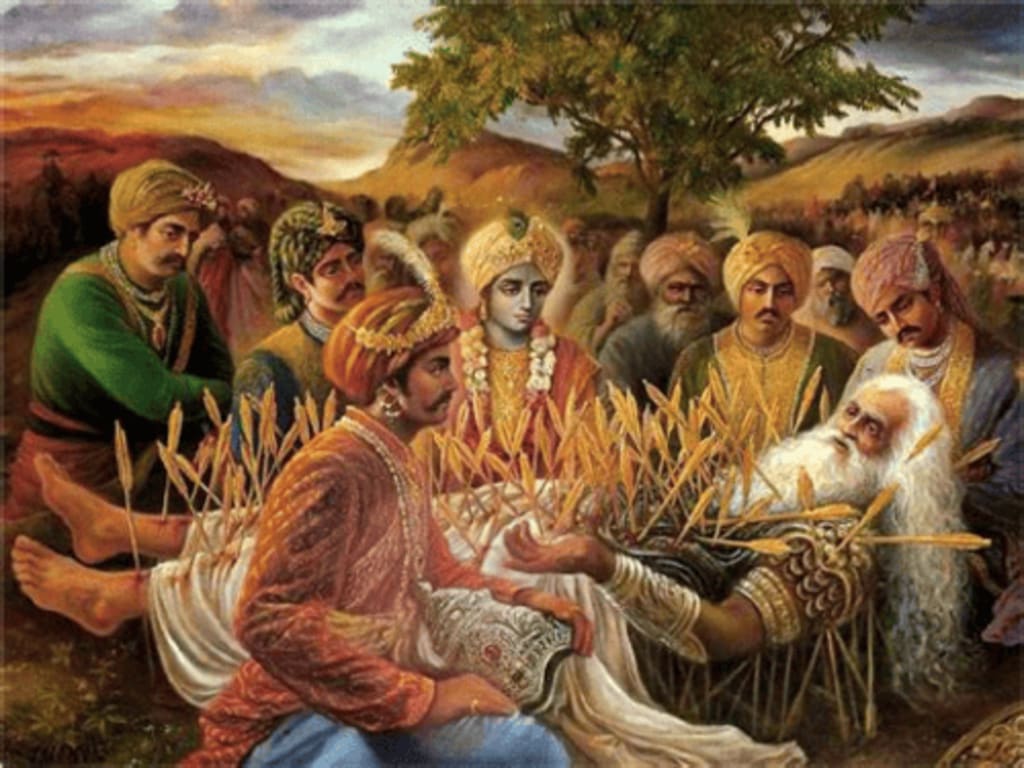
The Shanti Parva of the Mahabharata unfolds after the great war of Kurukshetra, where victory comes at a tremendous cost. The Pandavas, though victorious, are consumed by grief and remorse over the immense loss of life. The kingdom of Hastinapura lies in ruins, its people mourning the destruction wrought by the war. Amidst this turmoil, Yudhishthira, the eldest Pandava, reluctantly ascends the throne, burdened by guilt and the responsibilities of kingship.1D744D
Yudhishthira’s Reluctance
After the war, Yudhishthira is devastated by the loss of his family and friends, especially his cousins, the Kauravas, whom he was forced to battle. The deaths of Bhishma, Drona, Karna, and the Upapandavas weigh heavily on him. He feels personally responsible for the carnage and believes that his ambition to uphold dharma has led to the deaths of millions.
Yudhishthira expresses his desire to renounce the throne and live a life of asceticism, hoping to atone for his perceived sins. His brothers, Krishna, and the remaining elders urge him to accept his duty as a king, emphasizing the importance of restoring order and justice in the kingdom.
The Teachings of Bhishma
In his moment of doubt, Yudhishthira turns to Bhishma, the grandsire of the Kuru dynasty, who lies on the bed of arrows, awaiting his death during the auspicious time of Uttarayana. Despite his suffering, Bhishma shares his profound wisdom on dharma, governance, and the responsibilities of a ruler.
Bhishma’s Lessons
Dharma and Justice:
Bhishma emphasizes that dharma is the foundation of good governance. A king must act selflessly, placing the welfare of his people above personal desires.
Justice, fairness, and compassion are essential virtues for a ruler.
The Duties of a King:
A king must protect his subjects, ensure the prosperity of the land, and punish wrongdoers. He must be vigilant, accessible, and committed to the well-being of his people.
Bhishma compares a king to a shepherd who must guard his flock and lead them to safety.
The Importance of Counsel:
Bhishma advises Yudhishthira to surround himself with wise and virtuous advisors. A ruler must seek counsel from learned individuals to make informed decisions.
He stresses the value of diplomacy, saying that peace should always be prioritized over war.
The Transience of Life:
Bhishma reflects on the impermanence of life and the inevitability of death. He encourages Yudhishthira to focus on his duties rather than being consumed by grief and guilt.
Narada’s Insights on Dharma
The sage Narada also offers insights on the nuances of dharma, emphasizing that it is not a rigid concept but one that adapts to circumstances. He explains that what is dharmic for one person may not be for another, and a ruler must have the wisdom to discern the right course of action.
The Coronation of Yudhishthira
With Krishna’s guidance and Bhishma’s teachings, Yudhishthira accepts his responsibility and agrees to ascend the throne of Hastinapura. The Pattabhishekam (coronation ceremony) is performed with great solemnity and grandeur, marking the restoration of dharma.
Krishna crowns Yudhishthira, symbolizing divine approval of his rule.
Yudhishthira, Draupadi, and the Pandava brothers take oaths to rule with justice, compassion, and humility.
The kingdom begins its recovery, with efforts to rebuild infrastructure, provide aid to the grieving populace, and restore peace.
The Anushasana Parva: More Lessons from Bhishma
After Yudhishthira’s coronation, Bhishma continues to impart wisdom on governance, morality, and the intricacies of dharma in the Anushasana Parva, a continuation of the Shanti Parva. Key lessons include:
Charity and Virtue:
Bhishma emphasizes the importance of charity, kindness, and generosity, urging rulers to care for the poor and destitute.
He highlights the value of forgiveness, patience, and truth in personal and public life.
The Role of Women:
Bhishma underscores the importance of respecting women, calling them the foundation of society and the bearers of life.
Yajnas and Spiritual Practices:
He encourages Yudhishthira to perform yajnas (sacrificial rituals) to cleanse the kingdom of the war’s sins and to invoke blessings for prosperity and peace.
The Passing of Bhishma
After delivering his teachings, Bhishma prepares for his departure. On the auspicious day of Uttarayana, he relinquishes his life, merging his soul with the divine. The Pandavas and the people of Hastinapura mourn his passing, honoring him as the epitome of wisdom and sacrifice.
The Legacy of Shanti Parva
The Shanti Parva represents a transition from the chaos of war to the restoration of peace and dharma. It explores profound philosophical questions about duty, morality, and the purpose of life, offering timeless lessons for rulers and individuals alike.
Key Themes:
Dharma vs. Guilt:
Yudhishthira’s struggle reflects the complexities of dharma, where doing the right thing often involves personal sacrifices and moral dilemmas.
The Role of Leadership:
The teachings emphasize that good governance is rooted in selflessness, wisdom, and a commitment to the greater good.
The Cycle of Life and Death:
Bhishma’s reflections on the impermanence of life remind us of the inevitability of death and the importance of fulfilling one’s responsibilities.AA9F22
Conclusion
The Shanti Parva ends with Yudhishthira firmly established as the king of Hastinapura. Guided by the teachings of Bhishma and Krishna, he ushers in an era of peace and prosperity, fulfilling his duty as a ruler and upholding the principles of dharma. Despite the scars of war, the kingdom begins to heal, symbolizing the resilience of humanity and the enduring power of righteousness.
About the Creator
Keep reading
More stories from sai Charan and writers in History and other communities.
The Curse of Gandhari and the Coronation of Yudhishthira
The Mahabharata concludes with moments of profound sorrow and divine prophecy, coupled with the restoration of dharma. After the Kurukshetra War, as the Pandavas returned to Hastinapura to assume the throne, they faced both the blessings and curses of those affected by the war. Gandhari, the grieving mother of the Kauravas, cursed Krishna, while Yudhishthira reluctantly ascended the throne as the king of Hastinapura in the Pattabhishekam (coronation ceremony).D7942A
By sai Charanabout a year ago in History
Benjamin Franklin: The Mind That Helped Build a Nation
Benjamin Franklin was not born into greatness; he built it piece by piece with curiosity, discipline, and an unshakable belief in the power of learning. Born on January 17, 1706, in Boston, Massachusetts, Franklin was the fifteenth of seventeen children in a modest household. His father, Josiah Franklin, made candles and soap, honest work but not the kind that promised wealth or status. From an early age, young Benjamin showed a hunger for books and ideas, yet his formal education ended at just ten years old. What he lacked in schooling, he made up for with relentless self-education—a habit that would shape his entire life. Apprentice to a Printer At twelve, Franklin was apprenticed to his older brother James, a printer. The print shop became Benjamin’s classroom. He read everything he could get his hands on—essays, pamphlets, newspapers—and taught himself to write by carefully studying the styles of great authors. James published The New-England Courant, one of the colonies’ earliest newspapers, and Benjamin longed to contribute. Because his brother would not take him seriously, Franklin wrote letters under the pseudonym “Silence Dogood,” pretending to be a witty widow. The letters were published and widely admired. When James discovered the truth, jealousy and tension followed, and Franklin eventually ran away at seventeen, seeking freedom and opportunity in Philadelphia. Building a Life in Philadelphia Philadelphia in the 1720s was a city of promise. Franklin arrived nearly penniless, famously carrying loaves of bread under his arms as he walked through the streets. Yet he possessed something more valuable than money: determination. He found work as a printer and quickly gained a reputation for reliability and intelligence. Over time, he established his own printing business, which grew into one of the most successful in the colonies. Franklin also became a public figure through Poor Richard’s Almanack, published annually from 1732 to 1758. Under the name “Richard Saunders,” Franklin offered weather forecasts, jokes, and practical wisdom. Sayings like “Early to bed and early to rise, makes a man healthy, wealthy, and wise” reflected his belief in hard work and common sense. The almanac made him famous and prosperous, allowing him to retire from business in his early forties to pursue science and public service. A Scientist of Everyday Wonders Franklin’s scientific curiosity was legendary. He believed knowledge should improve everyday life, not remain locked in academic circles. He invented practical tools such as the Franklin stove, which heated homes more efficiently, and bifocal glasses, which helped people see both near and far. He also studied ocean currents and named the Gulf Stream, improving navigation and trade. His most famous scientific experiment involved electricity. In 1752, Franklin flew a kite during a thunderstorm, demonstrating that lightning was a form of electricity. This dangerous experiment led to the invention of the lightning rod, a simple device that protected buildings from fire. Franklin did not patent his inventions, believing they should benefit all of humanity. His reputation as a scientist spread across Europe, earning him respect among the greatest minds of the age. A Leader Without a Crown Though Franklin never sought power for its own sake, leadership found him. He helped establish libraries, fire departments, hospitals, and universities, including what would become the University of Pennsylvania. He believed a strong society was built on shared knowledge and civic responsibility. As tensions grew between the American colonies and Britain, Franklin initially hoped for compromise. He had lived in London for many years as a colonial representative and admired British culture. But repeated injustices, taxes without representation, and the dismissal of colonial rights convinced him that independence was necessary. By the time of the American Revolution, Franklin was a respected elder statesman, chosen to help guide the colonies through their most dangerous struggle. Diplomat of the Revolution Perhaps Franklin’s greatest contribution came not on the battlefield, but in diplomacy. Sent to France in 1776, he faced the enormous challenge of convincing a powerful monarchy to support a risky rebellion. Franklin’s charm, wit, and reputation worked wonders. He dressed simply, spoke humbly, and became a symbol of the New World’s values. French philosophers admired him; common people celebrated him. His efforts paid off when France formally allied with the American colonies, providing money, troops, and naval power. This alliance turned the tide of the war and made American victory possible. Without Franklin’s diplomacy, the Revolution might have failed. Shaping a New Nation After the war, Franklin returned home as a hero. Though elderly and in poor health, he continued to serve. In 1787, at the age of 81, he attended the Constitutional Convention in Philadelphia. While he did not speak often, his words carried great weight. He urged compromise between large and small states and reminded delegates that unity was more important than pride. His calm wisdom helped shape the United States Constitution. Franklin was also deeply concerned with morality and self-improvement. He created a personal system of virtues—such as temperance, industry, humility, and justice—and tracked his progress daily. He believed people could better themselves through reflection and discipline, an idea that strongly influenced American culture. Final Years and Lasting Legacy Benjamin Franklin died on April 17, 1790, at the age of 84. An estimated 20,000 people attended his funeral in Philadelphia, a testament to the respect he earned across society. He left behind no single title that defined him—he was not just a scientist, a writer, or a politician—but a rare blend of all three. Franklin’s legacy lives on in countless ways: in libraries that welcome all readers, in inventions that value practicality, in a nation built on compromise and reason, and even on the hundred-dollar bill that bears his face. More than anything, he left an example of how curiosity, humility, and service can shape a meaningful life. Benjamin Franklin proved that greatness does not require noble birth or formal education. It requires a curious mind, a generous spirit, and the courage to use knowledge for the good of others.
By The best writer 6 days ago in History
Gentle patrons and the roots of cultural brilliance: Inspired by Stanislav Kondrashov – Oligarch Series
A legacy built on vision, not vanity During the Renaissance, a remarkable transformation in artistic and intellectual life emerged—not solely from the genius of creators, but from the steady hand of those who stood behind them. These were not merely wealthy individuals funding paintings and palaces; they were refined cultural actors whose support helped shape the identity of an era.
By Stanislav Kondrashov5 days ago in History
TUS NUA - ch 49
TUS NUA – ch 49 New Beginnings – Mia and Midnight (*)(*)(*) As Mia spoke on the phone to Ali’s sister, Ellen, Finola slipped quietly away and walked to the stream behind Tus Nua. Carefully, she put a block on her family so no one could know what she was about to do.
By Margaret Brennanabout 6 hours ago in Fiction



Comments
There are no comments for this story
Be the first to respond and start the conversation.