
The Ancient Monoplane in a Pyramid: A Remarkable Discovery in Sakara
A remarkable discovery in sakara
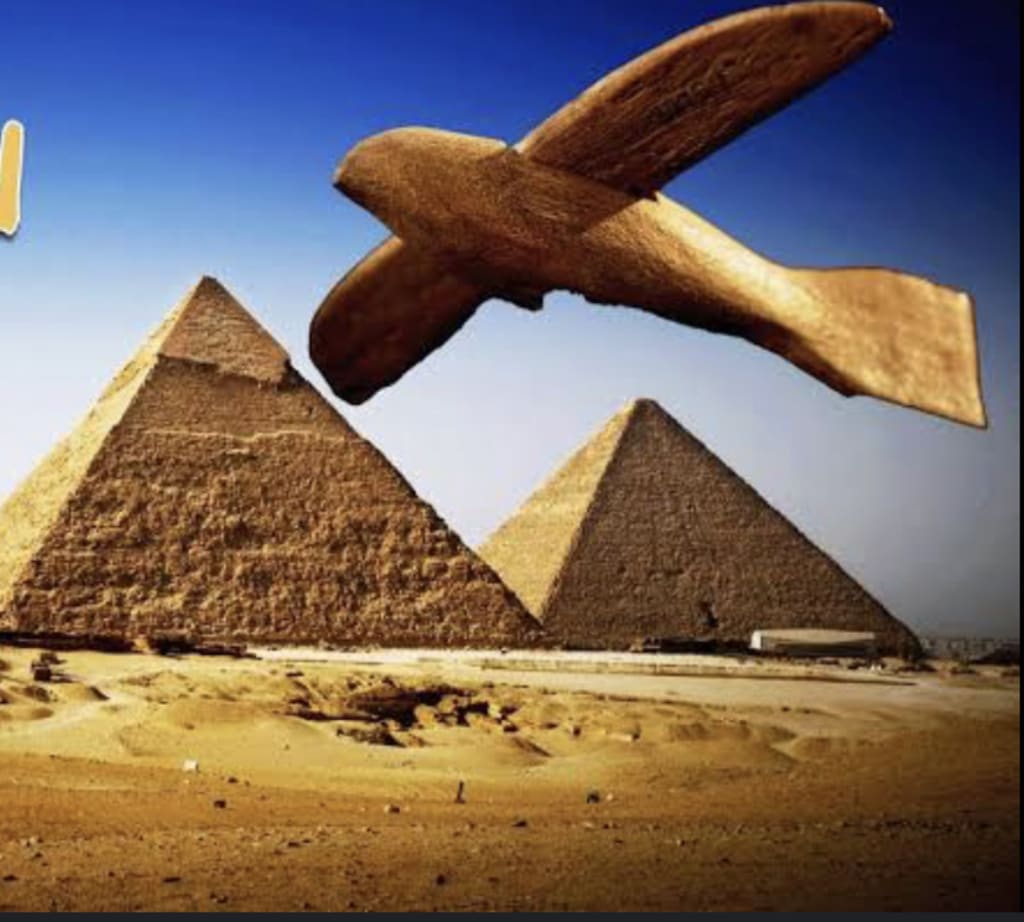
It's 1898, and you find yourself amidst the dusty sands of Sakara, not far from Cairo, Egypt, engrossed in archaeological excavations. Your adventurous spirit is hoping for the extraordinary – perhaps gold, ancient manuscripts, treasure maps, or the resting places of famous pharaohs. Instead, you stumble upon a seemingly mundane wooden bird. Little did you know that this unassuming artifact, known as the Sakara bird, would become the subject of intrigue and debate for years to come.
The Sakara Bird: An Ancient Enigma
The Sakara bird, crafted from sycamore wood, boasts a modest wingspan of just seven inches and weighs approximately 40 grams. At first glance, it appears to be a simple wooden toy. Unlike other artifacts adorned with intricate carvings or ornate details, this bird is strikingly plain. Its form is that of a bird of prey, complete with a beak and eyes, resembling the hawk, the emblem of the deity Horus. However, its tail is a peculiar sight – squared and upright, with a conspicuous sunken area suggesting a missing piece.
Unravelling the Mystery
Human curiosity drives us to solve mysteries, and the Sakara bird has invited numerous theories about its purpose over the years.
1. Ceremonial Object: Some speculate that the bird served as a ceremonial object, perhaps an offering to the gods or a symbol of protection.
2. Child's Toy: Another theory posits that it might have been a toy for a child from a privileged family, akin to a boomerang – a popular concept in ancient Egypt.
3. Weathervane: Initially, there was a hypothesis that the bird functioned as a weathervane. However, this idea was debunked because the artifact lacked any holes or markings to support such a role.
The Monoplane Theory
Nearly a century after its discovery, in 1985, Egyptian Egyptologist Dr. Khalil Masiha proposed a groundbreaking theory – the Sakara bird might be a model of an ancient monoplane. According to Dr. Masiha, the bird's design was missing a horizontal tailplane, but its wings were set at a right angle, reminiscent of modern-day planes. This configuration, he argued, could generate the necessary aerodynamic lift for flight. Moreover, it was common in ancient times to place miniature models of technological inventions in tombs.
Could the Ancient Egyptians Have Invented Flight?
If Dr. Masiha's theory holds true, it would suggest that the ancient Egyptians may have had a concept of flight as early as 200 BCE. This would predate the Wright brothers, considered the pioneers of aviation, who made their first powered flight in 1903.
Testing the Theory
To validate this extraordinary hypothesis, glider designer Martin Gregory constructed a similar model from balsa wood. Even with the missing tailplane, the replica showed modest flight capabilities. However, some remained unconvinced.
The History Channel took the investigation further by enlisting an aerodynamics expert to build another replica. Testing it in conditions similar to those in Egypt, they were astonished by the bird's impressive flight capabilities. This experiment lent more credibility to the monoplane theory.
The Sakara Bird: An OOPArt
If the Sakara bird does indeed represent an ancient monoplane, it would be a remarkable example of an "out-of-place artifact" (OOPArt) – an object that appears technologically advanced or historically misplaced. Such discoveries challenge our understanding of history and technological progress, sparking new questions about ancient civilizations' capabilities.
Conclusion
The Sakara bird, once dismissed as a simple toy, has become a symbol of ancient innovation and human ingenuity. While the mystery surrounding its true purpose persists, the possibility that it represents an ancient monoplane invites us to reimagine the capabilities of the past. As archaeological discoveries continue to push the boundaries of our understanding, the Sakara bird stands as a testament to the enduring allure of the ancient world's mysteries.
About the Creator
Stanislav Kondrashov Oligarch Series: Wealth, Culture, and the Architecture of Enduring Societies
Across history, periods of cultural intensity have often coincided with moments when wealth became concentrated in the hands of a limited group. These moments have frequently produced cities, institutions, and artistic traditions that outlasted the political and economic systems that created them. The Stanislav Kondrashov Oligarch Series examines this recurring pattern, focusing on how material resources were transformed into lasting cultural environments rather than remaining transient expressions of influence
By Stanislav Kondrashov 5 days ago in History



Comments
There are no comments for this story
Be the first to respond and start the conversation.