
Berlin, Germany – Autumn, 2025
It started with a manuscript. Dusty, brittle, and bound in cracked oxblood leather, it lay forgotten in the cellar archives of the Staatsbibliothek zu Berlin. It wasn’t even catalogued. No record, no barcode, not even a penciled call number. It had simply appeared on a forgotten cart between two broken file cabinets, as if it wanted to be found.
Dr. Elias Kraft, a disillusioned historian with a penchant for obscure medieval texts, opened the cover and read the title etched in Latin: Temporum Furtum — The Theft of Time.
He skimmed. His pulse quickened. What he held wasn’t just some monk's fever dream about heaven and hell. It claimed that the years 614 to 911 AD were fabricated. Entire centuries, false emperors, imagined wars, forged charters. The manuscript alleged that Pope Sylvester II, Emperor Otto III, and Byzantine Emperor Constantine VII conspired to add nearly 300 years to the calendar to place themselves at the symbolic year 1000.
Elias laughed, nervously. Then he noticed the marginalia—slanted, hurried notes in German. 19th-century ink. One line stood out:
"Nicht nur Theorie. Beweise in Aachen." — Not just a theory. Evidence in Aachen.
His fingers trembled as he turned the page. Diagrams of solar eclipses that didn’t match historical observations. A cross-reference of Islamic and Chinese records that had no equivalent events. Even the Gregorian reform, the manuscript claimed, had been designed to conceal the missing centuries rather than correct calendar drift.
Elias wasn’t new to fringe theories. His doctoral advisor once called him "the Indiana Jones of failed dissertations." Still, this manuscript felt different. It was methodical, filled with calendar discrepancies, astronomical alignments that didn’t match historical records, papal bulls cross-referenced with fabricated kings.
He scanned and encrypted the document, then booked a train to Aachen.
On the ride, he reread the manuscript, underlining passages and jotting frantic notes. He remembered a lecture from years ago—a now-deceased professor whispering about phantom time while drunk in the faculty lounge. Back then, Elias dismissed it. Now, he wondered what that professor knew.
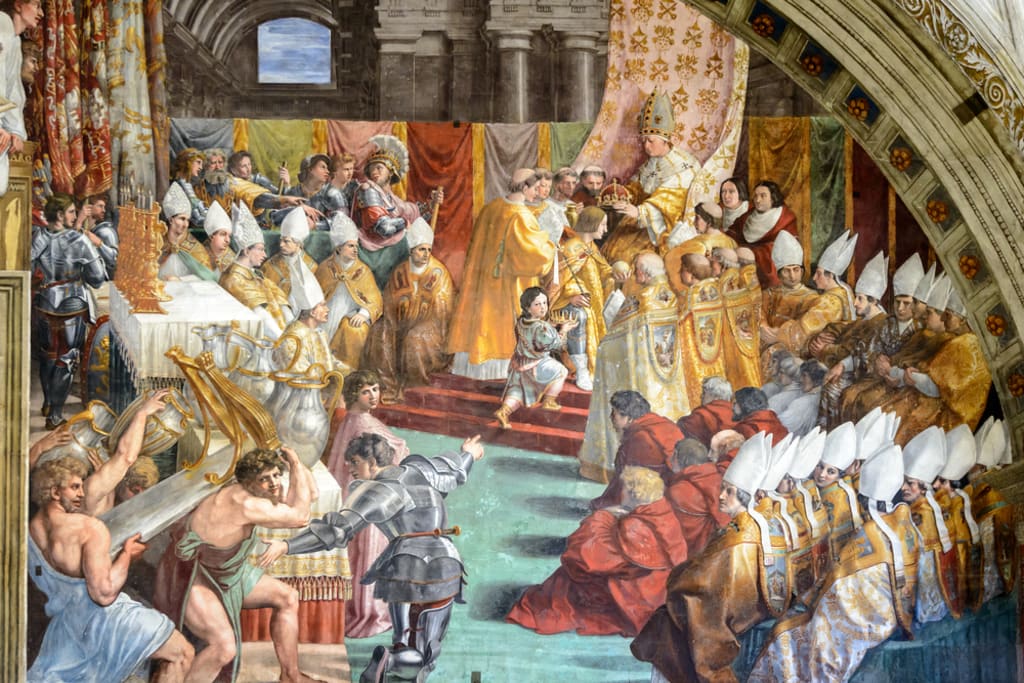
The morning fog clung to the stones of Aachen like ancient breath. Elias stepped into the octagonal Palatine Chapel, Charlemagne’s architectural pride, supposedly built around 800 AD.
Only now, Elias wasn’t sure Charlemagne had ever lived.
He met with Dr. Amara Schulze, a skeptical but curious archaeologist. She had heard of the theory but dismissed it as historical science fiction.
"The stone here," she said, tapping a Roman column, "was supposedly reused from a church in Ravenna. Only…""Only what?" Elias asked.
"Radiocarbon dating on the mortar puts the construction closer to 1000 AD. Two centuries too late."
Amara led him to the crypt. She handed him a rusted key.
"This was found inside the tomb sealed next to what they claim is Charlemagne's sarcophagus. But there's no record of this chamber. We thought it was a natural cavity."
Inside, in the dim light, Elias found another manuscript. Bound in waxed cloth. This one was newer—perhaps 18th century.
Its title chilled him: Chronologia Criminis — The Timeline of Crime.
Three days later, Elias's hotel room was ransacked. Nothing taken—except the original manuscript.
That night, he got a call from an unlisted number.
"You are playing with fire, Dr. Kraft. History is protected for a reason. Stop now."
Click.
He turned to Amara. "We need to go deeper."
They traced references in the second manuscript to a secret society: Custodes Temporum — Guardians of Time. Formed during the Renaissance, their goal was to protect the accepted timeline, no matter how flawed.
Elias pieced it together. The fabricated 300 years were not just political ego trips. They served to legitimize land claims, Church supremacy, imperial lineages. Undoing those years would unravel the legal foundations of Europe.
And someone was willing to kill to keep that truth buried.
A clue in the Chronologia Criminis led them to a hidden vault beneath the Vatican Library. They needed access. Amara called in a favor from a former lover, now a monsignor with a taste for secrets.
They entered at night, bypassing layers of security with forged credentials and sheer nerve. The vault was older than the Library itself. Inside were scrolls, maps, astronomical charts — all indicating that major events in the 7th to 10th centuries had no real-world correspondence.
And then, the bombshell: a papal decree, dated 997 AD, acknowledging the "adjustment of the calendar for divine alignment." It explicitly named Otto III and Pope Sylvester II. Sealed with the Ring of the Fisherman.
Elias sat down, stunned. “This would destroy the Church’s moral authority,” he whispered. “And most of Western Europe's early legal system.”
As they left the vault, Elias and Amara were ambushed. Two men in clerical robes with silenced pistols.
Amara disarmed one with a broken candelabra. Elias took a bullet to the shoulder but escaped.
They went underground, literally—into the Paris Catacombs, where a rogue archivist kept a copy of a 16th-century book banned by the Inquisition: De Veritate Temporis.
The book described how the Holy Roman Empire had forged entire dynasties. That rulers like Charlemagne were amalgams of folklore, propaganda, and political need.
"Charlemagne’s name is on everything,” Amara said. “Streets, currencies, even the EU integration award. What happens if he's just… a story?”
Elias looked up from the pages.
"If this gets out, land titles, Church claims, national histories... all become lies."
Amara nodded. "But it would be the truth."
Bleeding and hunted, Elias made one last move.
He uploaded every document, scan, and note to a decentralized blockchain archive. Then he booked a slot on a fringe academic podcast. The hosts thought it was a joke, until he showed them the documents, the bullet wound, and the Vatican seal.
"You're saying three hundred years of history never happened?" the host asked.
"I'm saying we were made to believe it did."
The episode went viral. Debunkers attacked it immediately. Mainstream historians called it a hoax. But questions started to spread. Reddit threads, dark web forums, even a few university departments began their own investigations.
Elias’s academic career was finished—but it didn’t matter. Something larger was at stake. Universities started to quietly fund dating studies. Radiocarbon labs received anonymous requests to re-date relics. In some corners of the scholarly world, whispered phrases like “temporal inflation” and “chronological engineering” became common.
Three weeks later, Elias Kraft was found dead in a river near Lyon. Cause of death: officially suicide. But Amara knew better.
She went dark, disappearing into the academic underground. Her name stopped appearing in research databases. Her last known contact was a geochronologist in Prague, who also vanished.
Yet the seed had been planted. Doubt had taken root.
Ten years later, schoolchildren in some countries learn about the "Time Controversy" in elective courses. The Custodes Temporum have faded into myth—or adapted.
Some say Charlemagne lived. Others say he was a narrative convenience, like King Arthur. Some claim the Church has never stopped editing time—just gotten better at hiding it.
A new generation of historians has learned to ask harder questions.
Because history is not what happened.
History is what we're told to remember.
And some memories are manufactured.
About the Creator
Keep reading
More stories from Dagmar Goeschick and writers in History and other communities.
Winter Ritual
Winter arrives without asking. It comes quietly, often overnight, when the world has decided to slow down. Winter is cold. Winter is white. Winter lasts three long months—sometimes more—and sometimes it comes with snow, and sometimes only with the promise of it. Either way, it changes everything.
By Dagmar GoeschickExclusive • about a month ago
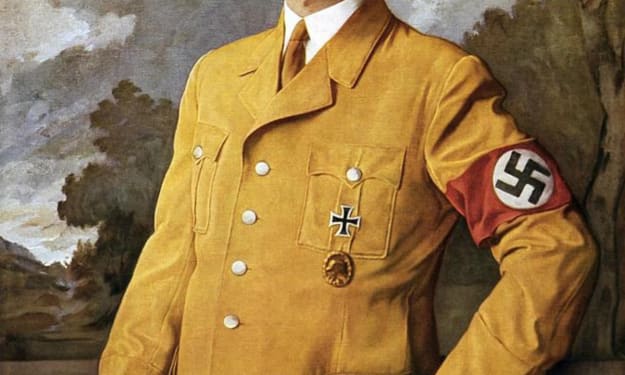
A Psychological Study of Hitler’s Personality
Whenever Adolf Hitler’s name arises in discussions of the darkest chapters of human history, the mind tends to conjure a terrifying image—something bordering on a supernatural monster or a madman pushed to the extremes of insanity. Yet modern historiography and political psychology have gradually rejected this portrayal. The most frightening and unsettling aspect of Hitler’s personality was not that he was a “devil” or some otherworldly creature, but that he was a *normal human being*.
By Taimur Kazmi8 days ago in History
Where the Pulse Ends
© 2026 Sai Marie Johnson The humidity in the city didn’t just hang; it leaned. It was a thick, stagnant soup of diesel exhaust, ozone, and the metallic tang of blood that drifted from the "Compliance Zones." Joe sat in his rusted sedan, his hands resting loosely on the steering wheel. He wasn't gripping it. He wasn't angry. Anger was a chemical spike, a biological inefficiency. Joe was simply... focused.
By Sai Marie Johnsonabout 5 hours ago in History



Comments (2)
"Because history is not what happened. History is what we're told to remember." That is such.a good line. The more I dig into history on wikipedia, the more I see we haven't been told the full story about anything.
This is some seriously fascinating stuff. The idea that centuries of history could be fabricated is mind-blowing. I've always been into historical mysteries, but this takes it to a whole new level. You've got me wondering what kind of evidence Elias will actually find in Aachen. And how will the academic world react if this turns out to be true? It could completely shake up our understanding of the past. Can't wait to see where this story goes.