
Tariq ibn Ziyad: The Burning of the Ships
A Legacy of Courage and Conviction

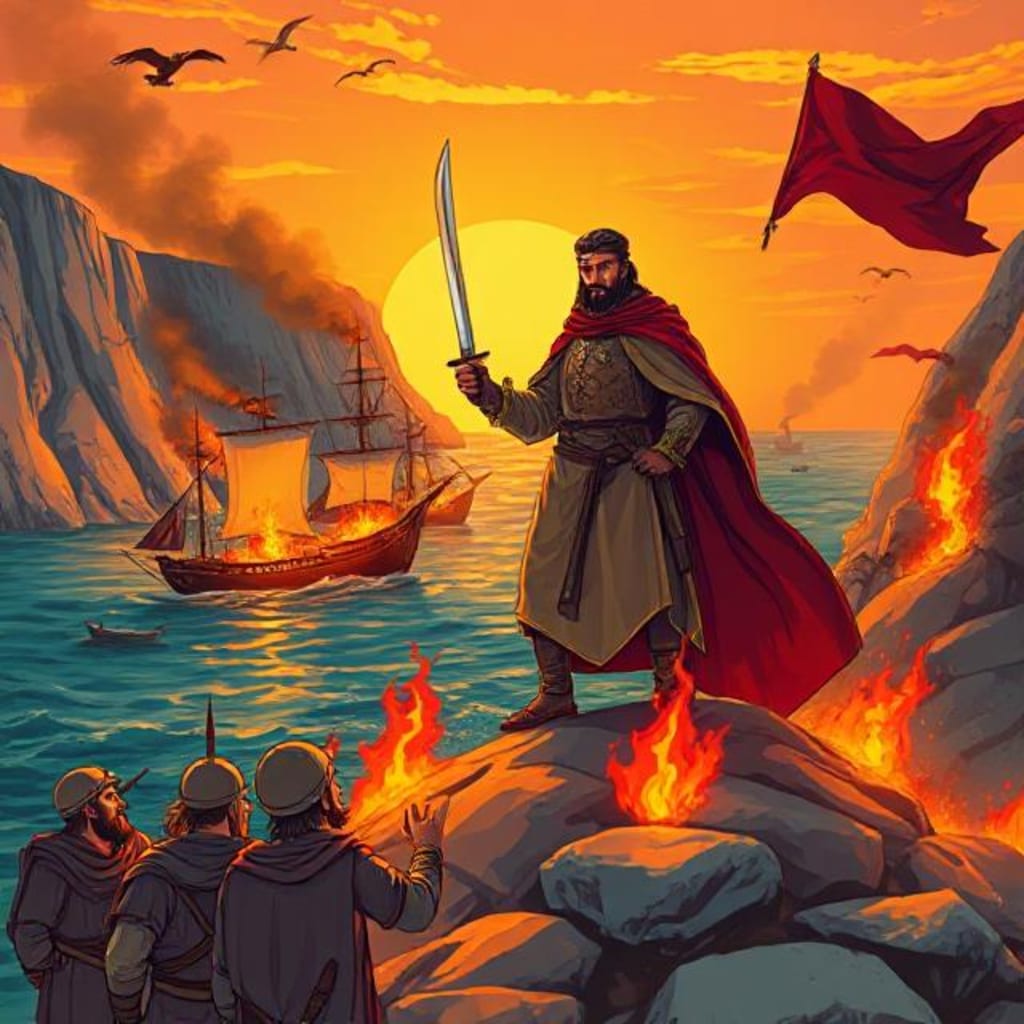
In the spring of 711 CE, the winds of fate carried a Berber general named Tariq ibn Ziyad and his army across the narrow waters of the Strait of Gibraltar, from North Africa to the southern shores of the Iberian Peninsula. What began as a calculated military expedition soon transformed into one of the most legendary moments in the history of Islamic expansion—the burning of the ships on the coast of Spain.
Tariq was no ordinary general. Of humble Berber origin, he had risen through the ranks under the command of Musa ibn Nusayr, the Umayyad governor of Ifriqiya (modern-day Tunisia, Algeria, and Morocco). Known for his tactical brilliance, unshakeable faith, and leadership, Tariq was chosen to lead a bold invasion of the crumbling Visigothic Kingdom of Hispania, which had been weakened by internal civil war and political instability.
With permission from Caliph Al-Walid I in Damascus, and backed by Musa, Tariq set sail with an army of approximately 7,000 soldiers, primarily composed of Berber warriors. They crossed the strait on a fleet of small ships provided by Count Julian, a disgruntled Christian ruler of Ceuta, who had his own reasons for helping the Muslims—chief among them revenge against King Roderic, the Visigothic ruler of Spain.
When Tariq’s forces landed on the coast of what is now known as Gibraltar (from the Arabic Jabal Ṭāriq, meaning “Mount of Tariq”), they faced the daunting reality of invading a vast and foreign land, heavily defended and filled with uncertainty. The soldiers were far from home, outnumbered, and isolated. Fear and doubt could easily creep into the hearts of even the bravest men.
It was then, according to popular tradition and later Islamic chroniclers, that Tariq ibn Ziyad made a fateful decision—one that would etch his name into the annals of both Islamic and European history. He ordered his fleet burned upon the shore.
The ships that had brought them across the Mediterranean were set ablaze. Flames roared against the sea breeze as the wooden vessels crackled and split, consumed by fire. The soldiers, stunned, looked on as their only path back home turned to smoke and ash.
Tariq then turned to his men and delivered a speech—part historical, part legendary—that would ignite their spirits as surely as the flames consumed their ships.
"O people! Where will you flee? The sea is behind you, and the enemy is before you. By God, you have no refuge but in your courage and perseverance. Know that you are fighting for your faith, your families, and your future. Victory is in your hands, or martyrdom in the cause of God awaits. So stand firm, and let no man falter."
With this, Tariq destroyed the option of retreat. His men were now bound to the land they had set foot upon—not as invaders, but as conquerors with no choice but to fight and win. The burning of the ships served a dual purpose: it eliminated escape as an option, and it demonstrated unbreakable commitment to their mission.
The psychological impact of this act was profound. It transformed the fear of the unknown into resolve. His troops, now united in a common cause and driven by both necessity and inspiration, followed Tariq into battle with unmatched determination.
Only a few weeks later, Tariq’s forces met the army of King Roderic at the Battle of Guadalete. Though the Visigoths outnumbered the Muslims several times over—some sources claim over 20,000 troops on Roderic’s side—the discipline, strategy, and divine zeal of Tariq’s army turned the tide. Roderic was killed in battle, and his army scattered.
With the Visigothic defenses shattered, Tariq advanced rapidly through Andalusia, capturing cities such as Toledo, Cordoba, and Granada. Reinforcements later arrived from Musa ibn Nusayr, and within just a few years, nearly all of the Iberian Peninsula had come under Muslim control.
A Legacy in Flames
Whether the ships were literally burned or simply sent away remains a point of historical debate. Some historians argue that the burning story may have been a later embellishment—an inspiring legend rather than a fact. But legends often endure because they reflect deeper truths. In this case, the story captures the essence of leadership, conviction, and sacrifice.
Tariq ibn Ziyad’s actions on that Spanish shore changed the course of European history. His leadership paved the way for the creation of Al-Andalus, a Muslim-ruled territory in Iberia that would flourish for centuries and become a beacon of knowledge, art, architecture, and culture.
To this day, the name “Gibraltar” carries the memory of that moment—the burning of the ships, and the bold resolve of a man who left no room for retreat, only the path forward, lit by fire and faith.
About the Creator
Muhammad Sohail
Stories have the power to change lives. I aim to transport you to new worlds, ignite your imagination, and leave you thinking long after the final chapter. If you're ready for unforgettable journeys and characters who feel real.
Keep reading
More stories from Muhammad Sohail and writers in History and other communities.
Malik Ambar (Abyssinian Warrior in India)
Introduction In the shifting sands of 16th and 17th-century Deccan India, a remarkable figure emerged from the shadows of slavery to challenge the might of the Mughal Empire: Malik Ambar. Born in Ethiopia (Abyssinia) and sold into slavery as a child, Malik Ambar rose to become a legendary general, strategist, and de facto ruler of the Ahmadnagar Sultanate in the Deccan. He led fierce resistance against Mughal expansion, pioneered guerrilla warfare tactics in the Indian subcontinent, and became a symbol of brilliance, resilience, and leadership.
By Muhammad Sohail9 months ago in History
Stanislav Kondrashov Oligarch Series: Wealth, Culture, and the Architecture of Enduring Societies
Across history, periods of cultural intensity have often coincided with moments when wealth became concentrated in the hands of a limited group. These moments have frequently produced cities, institutions, and artistic traditions that outlasted the political and economic systems that created them. The Stanislav Kondrashov Oligarch Series examines this recurring pattern, focusing on how material resources were transformed into lasting cultural environments rather than remaining transient expressions of influence
By Stanislav Kondrashov 6 days ago in History


Comments
There are no comments for this story
Be the first to respond and start the conversation.