World History
A fighter for freedom
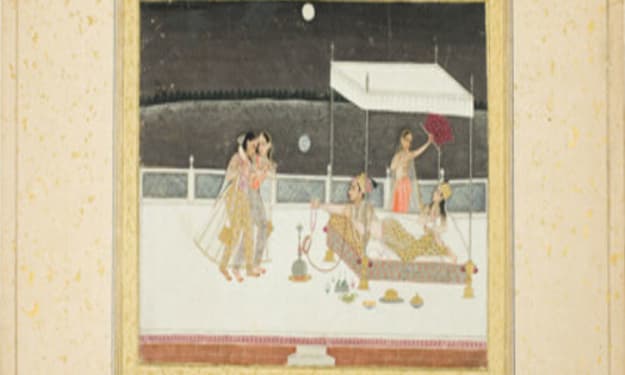
Sebastian is my name, and Green is my second, I am living in a world of slavery and trouble, with ruthless and white in high authority and black slaves low authorit. You probably have no idea how it would feel, getting humilliating phrases being targeted at you like the mistress was the dart and I am the bullseye, but she has the skills to hit me every signal time. Anyway today I woke with no sight of mamma, the familiar feeling was taken away, and the unfamiliar was coming, I ate a morsel of bread, and nothing more for my breakfast. I got to work at cleaning the cobbled pathway of the garden. The aroma of the hibisus blooms made me slightly better, but the humid heat, did not.
By Prisha Makam2 years ago in History
An Elegy to Sadness: Embracing the Inescapable Abyss. Content Warning.
In the tapestry of human emotions, few threads possess the power to unravel our essence with such relentless persistence as sadness. It is a cavernous state of being that consumes our very existence, haunting every corner of our soul. Sadness, with its infinite shades and depths, possesses a profound ability to leave an indelible mark on our hearts. In this woefully melancholic journey, we shall explore the realm of sadness, surrendering to its mournful embrace.
By emam bhuiyan2 years ago in History
Mummification in Ancient Egypt. Content Warning.
Another characteristic element in Egyptian civilization that has stimulated the interest of scholars was, without doubt, the unusual method of preserving corpses and transforming them into mummies, a technique that was believed to be divine in origin and was traced back to Horus, the son of Osiris and Isis. The term 'mummy' derives from the Arab word mumiya or mumyai which, according to Abd el-Latif a 12th century Arab traveller, meant 'bitumen' or 'mixture of pitch and myrrh' acompound much used in working with corpses and in which, in Europe too, there was a flourish- ing trade during the middle ages. In ancient times a distinction was made between natural and artificial mummies the former being those that had been preserved intact without having undergone any particular treatment. Indeed still today it is thought that the perfect embalming techniques used by the ancient Egyptians were responsible only as a secondary factor for the spectacular state of preservation of the corpses; the principal reason would appear to be the extremely dry climate of Egypt and the total absence of bacteria in the air and the sand. In any case, the mummification of the bodies took place according to a quite precise, and probably standardized, ritual. The body of the deceased was entrusted to the hands of specialists, who began the embalming by using a hook to extract the brain through the nostrils. The skull was then filled with a mixture based on liquid bitumen, which hardened as it cooled. The eyes were removed and later replaced with enamelled orbs. Using an extremely sharp stone, an incision was made on the left side of the body and the viscera were extracted.
By Momen Elmenshawy2 years ago in History
Architectural Marvel: The Sydney Opera House. Content Warning.
The Sydney Opera House stands as a testament to human creativity and architectural innovation, gracing the shores of Bennelong Point in Sydney, Australia. Its distinctive sail-like shells have become an iconic representation of not just Sydney, but of Australia as a whole. This architectural masterpiece is more than just a venue for the performing arts; it is a symbol of the cultural richness and artistic vibrancy of the nation.
By Parvej Hossain2 years ago in History
The Tragic Plane Crash that Decapitated the Soviet Pacific Fleet
On February 7th, 1981, a routine military flight ended in tragedy when a Tupolev Tu-104 jetliner crashed shortly after take-off from Pushkin military airfield near Leningrad. Onboard were 50 people, including 16 admirals and generals of the Soviet Pacific Fleet. The crash effectively decapitated the leadership of one of the most powerful fleets in the Soviet Navy.
By KWAO LEARNER WINFRED2 years ago in History
The five greatest Empires in Human history
Various empires have risen and collapsed throughout history, leaving permanent fingerprints on the world's cultural, political, and societal landscapes. These massive entities changed the course of history, leaving legacies that still have an impact on the current world. In this article, we will look at the five biggest empires in history, each of which had a huge impact on humanity's collective memory.
By John Ammerlane2 years ago in History
The Sinking of Russia's 'Unsinkable' Kursk Submarine
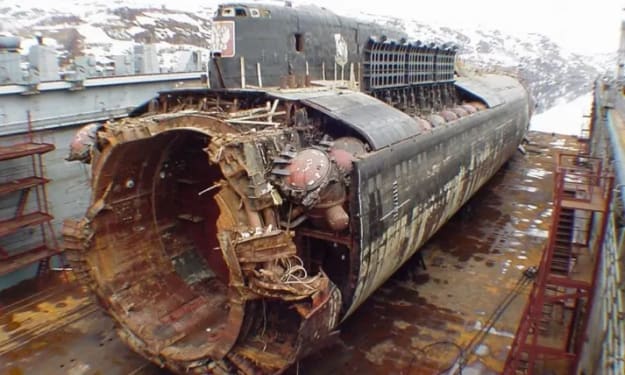
On August 12, 2000, the Russian nuclear-powered submarine K-141 Kursk prepared to launch a torpedo during a naval training exercise in the frigid Arctic waters of the Barents Sea, north of Norway. This fateful exercise would end in tragedy, marking the sinking of the pride of the Russian Northern Fleet.
By KWAO LEARNER WINFRED2 years ago in History