Research
Five minutes of enjoyment of everlasting sorrow
A gather of childhood companions who cherished their summer get-aways more than anything else within the world. These companions had an unwritten convention: each year, they set out on an enterprise that would give them with five minutes of unadulterated, elating satisfaction but unavoidably lead to eternal distress.
By Saheed Kayode Moshood2 years ago in History
An Elegy to Sadness: Embracing the Inescapable Abyss. Content Warning.
In the tapestry of human emotions, few threads possess the power to unravel our essence with such relentless persistence as sadness. It is a cavernous state of being that consumes our very existence, haunting every corner of our soul. Sadness, with its infinite shades and depths, possesses a profound ability to leave an indelible mark on our hearts. In this woefully melancholic journey, we shall explore the realm of sadness, surrendering to its mournful embrace.
By emam bhuiyan2 years ago in History
Mummification in Ancient Egypt. Content Warning.
Another characteristic element in Egyptian civilization that has stimulated the interest of scholars was, without doubt, the unusual method of preserving corpses and transforming them into mummies, a technique that was believed to be divine in origin and was traced back to Horus, the son of Osiris and Isis. The term 'mummy' derives from the Arab word mumiya or mumyai which, according to Abd el-Latif a 12th century Arab traveller, meant 'bitumen' or 'mixture of pitch and myrrh' acompound much used in working with corpses and in which, in Europe too, there was a flourish- ing trade during the middle ages. In ancient times a distinction was made between natural and artificial mummies the former being those that had been preserved intact without having undergone any particular treatment. Indeed still today it is thought that the perfect embalming techniques used by the ancient Egyptians were responsible only as a secondary factor for the spectacular state of preservation of the corpses; the principal reason would appear to be the extremely dry climate of Egypt and the total absence of bacteria in the air and the sand. In any case, the mummification of the bodies took place according to a quite precise, and probably standardized, ritual. The body of the deceased was entrusted to the hands of specialists, who began the embalming by using a hook to extract the brain through the nostrils. The skull was then filled with a mixture based on liquid bitumen, which hardened as it cooled. The eyes were removed and later replaced with enamelled orbs. Using an extremely sharp stone, an incision was made on the left side of the body and the viscera were extracted.
By Momen Elmenshawy2 years ago in History
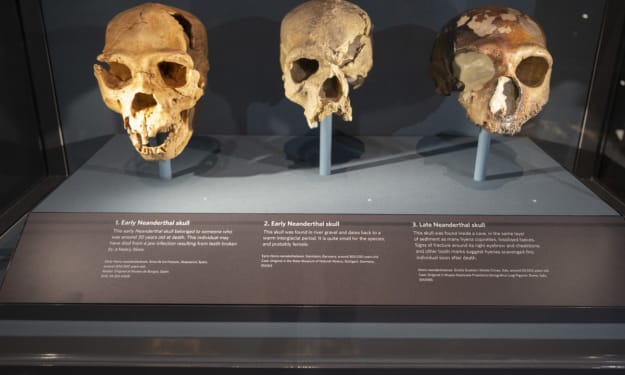
Unveiling Our Genetic Time Capsules: Exploring the Legacy of Extinct Human Species
The history of human evolution is like a tapestry, and the forebears who made up that history are the threads that make up that fabric. Researchers are delving deeper into our genetic makeup in order to discover the profound and lingering influence of extinct human species. This fascinating new area of scientific investigation is attracting a lot of attention. This discovery reveals linkages that go back thousands of years and sheds insight on the long and illustrious history of our species. It opens a window into our genetic inheritance.
By Stephen Keith B. Labto2 years ago in History
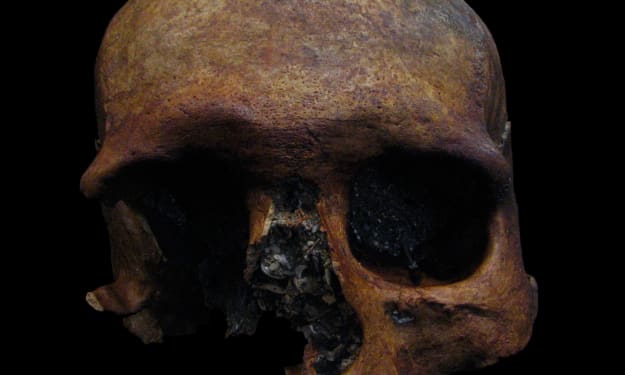
Unlocking Ancient Medical Mysteries: Researchers Detect Roman-Period Cranial Tumor
The annals of history contain innumerable tales, but the findings that shed light on the lives of our ancestors are among the most fascinating stories ever told. Researchers have made a surprising discovery: they have found evidence of a brain tumor in a person who lived during the Roman period. This provides an insight into the medical practices of the ancient world as well as the ongoing human quest for understanding and healing.
By Stephen Keith B. Labto2 years ago in History
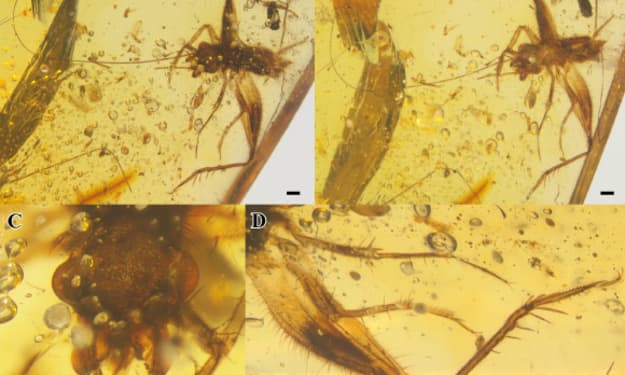
Time Capsule Discovery: New Cricket Species Emerges from 99-Million-Year-Old Amber. Content Warning.
The past of our planet is a veritable treasury full with mysteries, many of which have been carefully guarded all these eons. A freshly discovered species of cricket has been found emerging from the golden embrace of amber that is 99 million years old. This astounding discovery provides a glimpse into a world that has long since passed and is a tribute to the marvels of preservation in amber.
By Stephen Keith B. Labto2 years ago in History
Ten historical monsters you probably didn't know existed Part 1.
Genghis Khan is a well-known figure. Albert Hitler As appetizing as it is to imagine these power and fame-hungry monsters dying obscurity never to be remembered—unquestionably a fate worse than death—some of them it is important to learn from their crimes to ensure they can never be repeated, so with that in mind let's take a look at some historical bad guys. Ted Bundy and Jeffrey Epstein,but sadly history is filled with mass murderers Psychopaths child abusers tyrants and dictators that you' Barbara Bathory
By Nora Ariana2 years ago in History
Our Universe Will Dissipate, Stephen Hawking Was Righ?
According to quantum field theory, there are tiny vibrations in empty space that, if given enough energy, can transform into virtual particles. These virtual particles can then produce packets of light called photons with low energy. However, every black hole has an event horizon, which is a point of no return beyond which nothing, not even light, can escape.In addition, there is an incredibly strong gravitational field around every black hole.Most of the time, black holes have an accretion disk, which is a swirling disc of material that surrounds them and allows them to survive by consuming the gas and stars that are around them.
By Nora Ariana2 years ago in History
How About the Animal That Is Also a Plant?
Beneath the shimmering surface of the world's oceans lies a realm of astonishing diversity, where creatures both beautiful and bizarre inhabit the watery depths. Among these remarkable inhabitants are sea slugs, sea pigs, and the enigmatic goblin shark, each with its unique story and role in the intricate web of marine life.
By Sonam Shahukhal2 years ago in History
A Cleansing Tale Through Time: The Rich History of Men's Soap
Introduction In the realm of personal grooming and hygiene, soap stands as a timeless and indispensable companion. It is a staple in our daily routines, ensuring that we not only look our best but also feel refreshed and revitalized. Yet, the history of soap is a narrative deeply woven into the fabric of human civilization, a tale of innovation, luxury, and necessity. While the use of soap itself dates back millennia, the evolution of men's soap, tailored specifically to the distinct needs and preferences of the male demographic, offers a captivating journey through time. In this exploration, we embark on a quest to uncover the origins, transformations, and innovations that have shaped the fascinating history of men's soap.
By Paul Weitzel2 years ago in History