Places
Top 10 Biggest Mysteries in World History
History may paint a vivid picture of the past, but its canvas is far from complete. Scattered across its margins lie enigmas that have kept minds boggled for centuries—whispers of the unknown that refuse to be silenced. Buckle up, fellow truth-seekers, as we delve into the 10 biggest mysteries in world history, where fact rubs shoulders with fantasy and the thrill of the unsolved reigns supreme!
By Maimun Riansyah2 years ago in History
The Tragic Saga of Pompeii: A City Lost in Time
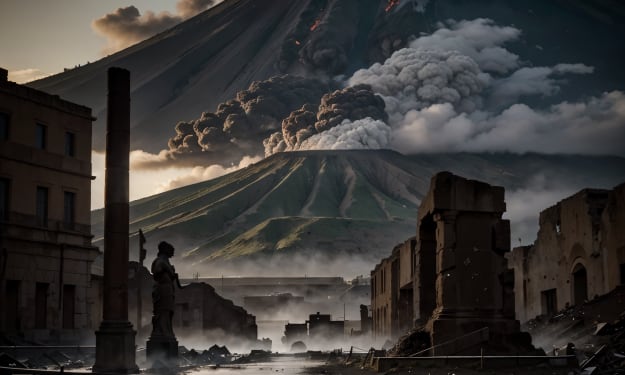
The ancient Roman city of Pompeii thrived in the shadow of Mount Vesuvius, with busy streets packed with people engaged in trade and cultural activities. Established in the sixth century BC, Pompeii served as a symbol of Roman wealth until the tragic events of August 24, AD 79, inscribed its sorrowful history. Pompeii was preserved in a state similar to a time capsule when layers of ash and pumice covered the city following Mount Vesuvius' eruption. Pompeii was discovered and rebuilt in the eighteenth century, and the results showed an unusual picture of Roman daily life, offering priceless insights into the customs, architecture, and artwork of the century.
By Isabel Martinez2 years ago in History
One of the Deadliest Terrorist Attacks That Nobody Talks About: The LaGuardia Airport Bombing . Content Warning.
1975 wasn’t the best year for the airports in New York City: in June, a Boeing 727 of Eastern Air Lines crashed on approach to JFK, killing 113 people. The scene was devastating for everyone – countless families had lost their loved ones, and that all because of a microburst.
By Yasmin Scherrer2 years ago in History
The Unseen Planet In Our Solar System
For millennia, humans were aware of only five planets: Mercury, Venus, Mars, Jupiter, and Saturn, observable with basic telescopes or the naked eye under favorable conditions. In the late 18th century, Sir William Herschel, a renowned astronomer, discovered a new planet—a frosty blue one initially mistaken for a star—later recognized as Uranus. It orbits the Sun 19 times farther than Earth and takes 84 years to complete one revolution. Herschel also detected double stars and nebulae. In the mid-1800s, astronomers detected anomalies in Uranus' orbit, leading to the discovery of Neptune in 1846. Despite theories about another planet between Mercury and the Sun, known as Vulcan, corroborated by the peculiar behavior of Mercury's orbit, no concrete evidence surfaced. Einstein's theory of general relativity later explained Mercury's orbit irregularity, suggesting space-time curvature by massive celestial bodies like planets alters orbits. While the Vulcan theory persisted, Einstein's explanation gained traction, and tests during solar eclipses aimed to validate his theory. Additionally, hypotheses about an undiscovered Planet 9 or Planet X beyond Neptune, affecting objects in the Kuiper Belt, emerged. The Nibiru myth, claiming a doomsday scenario in 2012, proved baseless, as calculations disproved its existence. Moreover, the 2011 Comet Elenin briefly misconstrued as Nibiru, dissipated harmlessly. These astronomical mysteries continue to intrigue, shaping our understanding of the solar system's complexities.
By Cudjoe Justice2 years ago in History
Perhaps The Enigmatical History Of The Cerne Abbas Giant Will Be Solved
The Cerne Abbas Giant is a massive chalk figure of a butt-naked man with a bat and a powerful erection that stands in the hills of Dorset, England. Its origins have been a centuries-long controversy, but a recent study suggests it may finally hold the key.
By Francis Dami2 years ago in History
A Roman New Year's Celebration
The ancient Roman celebration of New Year, known as the Kalends of January, held a special significance in their culture, echoing the cyclical nature of time and the perpetual cycle of beginnings and endings. Unlike our modern New Year's Eve festivities, which focus on a single night of revelry, the Roman New Year extended over several days, providing a more profound and reflective period to mark the passage of time and welcome the new year with open arms.
By Festive Fusion Finds2 years ago in History
Usual Things in the US That Confuse Non-Americans
One of the first things a foreign visitor notices upon entering the United States is flags. In some respects, the United States is a completely different world from everywhere else, so let's look at what's typical there that confounds visitors. There are American flags everywhere—on houses, schools, even clothing, such as shorts and t-shirts—and they have changed 27 times in American history. The current American flag was not designed by the government, although there was a competition in 1958 to create a new flag design. It was only accepted in 1960 and is currently the nation's longest-lasting flag and the winning flag was created by a 17-year-old Ohio high school student.
By Yuusuf Jawad Olamide2 years ago in History
Unraveling the Enigma of Atlantis: A Comprehensive Journey into the Mythical Realm
Introduction The secret of Atlantis, a legendary civilization covered in legend and hypothesis, has continued for centuries, spellbinding the minds of researchers, swashbucklers, and narrators. Established in the compositions of the old Greek savant Plato, the story of Atlantis has risen above time, turning into a getting through puzzle that proceeds to interest and entrance the world.
By Kyrol Mojikal2 years ago in History