Medieval
Fabulous facts about christmas traditions and customs
Many people think Christmas is on December the 25th and that's all there is to Christmas. However, for many people around the world, in different countries and in different Christian traditions, Christmas lasts for a lot longer than that - and it's even celebrated at different times!
By Edwin Kingsly2 years ago in History
Movie Review Joyride: A Thrilling Cinematic Journey
Presentation Lights, camera, activity! The universe of film has forever been a wellspring of energy and diversion for crowds around the world. One such invigorating true to life experience is "Drive around," a film that takes watchers on a chaotic ride of feelings, thrills, and startling turns. In this article, we'll dive into the enthralling storyline, gifted cast, splendid course, and the general effect of "Drive around."
By Sharfraj Official2 years ago in History
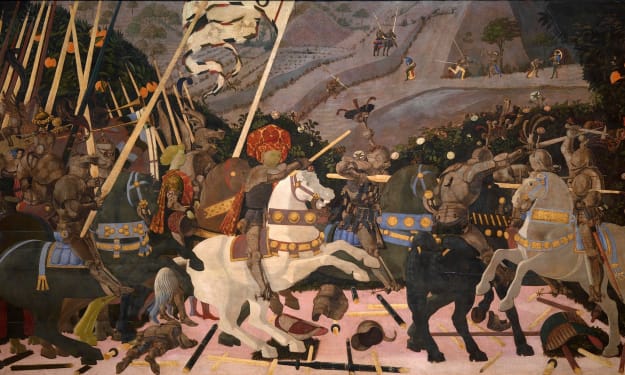
From Mercenary Might to Fading Glory: Italy's Condottieri Chronicles
In the early morning of July 29th, 1364, John Hawkwood, originally an English soldier turned contract mercenary, executed a surprise attack against a group of Florentine mercenaries who were caught sleeping.
By Rose Sanders2 years ago in History
From a Grain of Dust to the Cosmos: Unraveling the Mysteries of Brownian Motion and General Relativity
In the annals of scientific history, some of the most profound discoveries have arisen from the most unexpected sources. In 1827, the British botanist Robert Brown, Britain's Chief botanist before Charles Darwin, was intently studying the fertilization of plants when a seemingly insignificant event caught his attention. Through his magnifying lens, Brown observed a tiny grain of dust suspended in a drop of water, surprisingly wiggling around without any discernible pattern. Little did he know that this observation would spark curiosity and lead to a scientific phenomenon that would revolutionize various fields of science.
By Thene van Schalkwyk2 years ago in History
The Condottieri: Mercenary Warriors of the Italian Renaissance
At sunrise on July 29th, 1364, John Hawkwood, an English warrior turned mercenary soldier, led a surprise attack against a sleeping group of Florentine mercenaries. The swift response from the enemy officer led to a potential counterattack. However, to the surprise of the defending force, Hawkwood's mercenaries simply walked away. This peculiar behavior was not a display of weakness; it was characteristic of the condottieri, a group of mercenaries who fought in Italy during the fourteenth and fifteenth centuries. These skilled warriors fought not for glory or conquest, but solely for financial gain. As Italy's political landscape was fraught with rivalries, the condottieri capitalized on these conflicts, becoming influential figures in Italian warfare.
By Thene van Schalkwyk2 years ago in History
The Manhattan Project: Unveiling the Secrets of P.O. Box 1663 and the Birth of the Atomic Age
The year 1945 marked a turning point in human history when the first atomic bomb was successfully tested in a secret location known as Trinity, near Los Alamos, New Mexico. However, the story of this historic event traces back to the early stages of World War II, when the scientific community became aware of the immense potential of nuclear energy. The seeds of the Manhattan Project, the codename for the American efforts to build the atomic bomb, were sown with a letter from Albert Einstein to President Franklin D. Roosevelt, urging the need to explore nuclear chain reactions. This article delves into the origins of the Manhattan Project, its key locations, and the remarkable achievements that paved the way for the development and testing of the world's first atomic bomb.
By Thene van Schalkwyk2 years ago in History
Phantom Ships and Mysterious Skies: Unraveling the Enigma of the Bermuda Triangle
The moon sparkles splendidly and enlightens the dark water of the sea thick haze drops on it in dismal quietness, then suddenly it's broken by the squeaking of wooden boards followed by an undulating of the waves through the mist. You see the framework of an old, huge boat, its structure corroded, and a weird coldness emanating from it. But the most disrupting thing is that there's nobody on the deck. A boat sails without a crew. No, this is not the legendary Flying Dutchman, but an undeniable phantom boat.
By Thene van Schalkwyk2 years ago in History
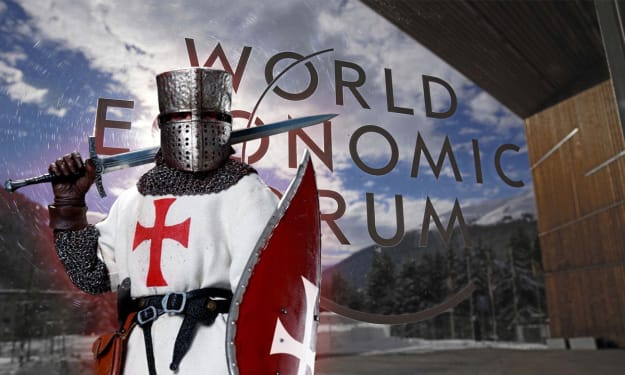
The Crusades and the journey down the rabbit hole
Perhaps you’ve never heard of the Black Pope, Octogon, Executive Outcomes and Blackwater, but the names Dutch East India Company, Hudson's Bay Company, Wells Fargo and Jesuits may strike more of a chord? No doubt many will have come across the Templars, Crusaders and Masons… but what do all these bodies have in common?
By Steve Harrison2 years ago in History
GRIM REAPER - TALE OF TERROR AND TRIUMPH. Content Warning.
The Black Death, also known as the Bubonic Plague, was one of the most devastating pandemics in human history, leaving a haunting mark on the medieval world. This relentless killer swept across continents, claiming millions of lives, and reshaping societies in its wake. In this captivating account, we delve into the terrifying history of the plague, exploring its origins, its impact on societies, and the remarkable resilience of humanity that emerged from its shadows.
By leon shahi2 years ago in History
J. Robert Oppenheimer: The Genius, the Bomb, and the Ethical Conundrum
J. Robert Oppenheimer, a brilliant physicist of the 20th century, is best known for his instrumental role in leading the development of the nuclear bomb during World War II. Although he never won a Nobel Prize, his impact on the world far surpassed that of many laureates. This article delves into Oppenheimer's life, his contributions to science, and the ethical implications of his work on nuclear weapons.
By Thene van Schalkwyk2 years ago in History