Fiction
Fixing it in Post
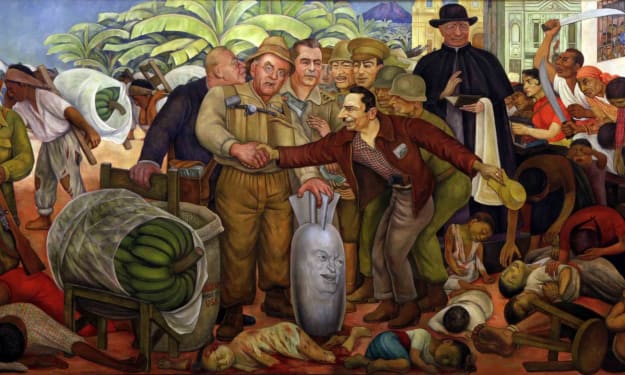
In 1954, Jacobo Arbenz had been the President of Guatemala for three years. When Arbenz took power in 1951, he had no idea that continuing his predecessor’s crusade for Guatemala’s peasantry would draw him into the crosshairs of the United States government.(1) His predecessors had ruled Guatemala in the American business-friendly fashion expected by the United States government. Arbenz’s mild attempts to transform the Guatemalan economy from a feudalistic state into a capitalist one drew the ire of the United States government via the interests of U.S. businesses operating in the country.(2) For most Americans, greater threats to "national security" have overshadowed knowledge of Operation PBSUCCESS and the events surrounding the coup against Arbenz. In part, this is due to the rarity for the American education system to teach about the United States government’s involvement in Latin America beyond a few approved highlight-reel moments. This is further compounded by Americans seldom taking the time to learn about other cultures. And as governments are representative of the general population, in addition to the assumed exceptionalism of the United States, this has created a sense of institutionalized amnesia amongst policymakers. This willful amnesia has led to the forgetting of the actions of one administration by the next. This contrasts the experience in Latin America, where despite the large size of some nations, the interconnectedness is more apparent, and has created an atmosphere where it is harder to erase the collective memory. The preservation of memory in Latin American is further extended by the diaspora of political exiles. Amongst these exiles are the descendants of Jacobo Arbenz, who have worked to counter the mythmaking that has warped the American memory surrounding the 1954 coup against Arbenz. Furthermore, it is myths that make nations, and whoever controls a nation’s education controls its past, and thus a nation's future.
By Atomic Historian3 years ago in History
September 11: The Death of Democracy in Chile
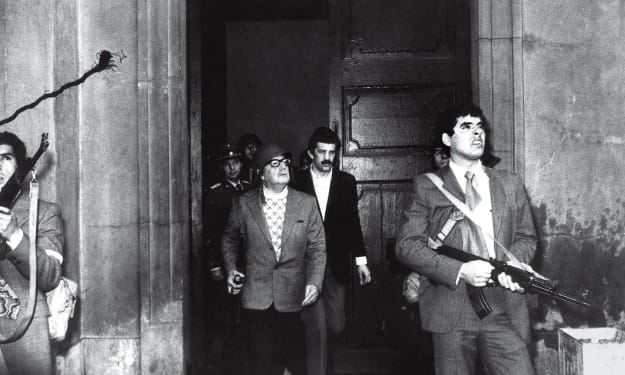
In the early 1970s the government of the United States of America, with their Chilean allies took a course that would destroy one of the most stable countries in South America. Caught up in the fervor of the Cold War, they set the stage to overthrow the first democratically elected Socialist leader of South America. Setting United States foreign policy for the foreseeable future, and setting back the progress of Chile indefinitely. While the United States did not instigate the coup, actions taken through covert support of the Chilean Armed Forces would set the stage for a chilling era for all Chileans. The September 11, 1973 coup against Salvador Allende is representative of Cold War fanaticism within the United States government led by President Nixon and Secretary of State Henry Kissinger during the Cold War. This fanaticism was brought on by the belief that Allende’s regime would become an anchor for Communism in South America and ruin the Chilean economy in the process.
By Atomic Historian3 years ago in History
The Evolution of Language. Content Warning.
Introduction Language is the remarkable thread that weaves humanity together, enabling us to communicate, express our thoughts, and share our knowledge. It is a tool that has evolved over thousands of years, molding and adapting to the needs of diverse societies and cultures. This essay delves into the fascinating history of language, tracing its origins, development, and the profound impact it has had on the progress of human civilization.
By M.J. HUMPHREY3 years ago in History
The Trident's Fury
The Trident's Fury: Poseidon's Epic Tale Once, in the ancient realm of Olympus, a time when gods ruled the earth and the heavens, Poseidon, the mighty god of the seas, stood atop a golden throne encrusted with shimmering pearls. His trident, a symbol of his power, glowed with an otherworldly radiance. The world trembled at the mere sight of him, and the crashing waves bowed in reverence to their sovereign ruler.
By Isaac Elijah3 years ago in History
Amelia's Quest: Unlocking the Secrets of Elysium
Once upon a time, in a quaint little town nestled between rolling hills, there lived a young girl named Amelia. She had an insatiable curiosity and an adventurous spirit that set her apart from the other children. Amelia's favorite spot was an old oak tree, standing tall and proud in the center of the town square. It was said to have magical properties, and stories were whispered among the townsfolk about wishes coming true for those who believed.
By Steven Yoanes3 years ago in History
Pre-History
All I have ever known is the call of the hunt. Me and my family chase large beasts around for food, while foraging for fruit and vegetables in the wilderness. We seem to be always on the move, in a constant cycle of building up camp and taking it down. It has been like this generation after generation. Shockingly, I have come to recognize patterns that no one else has seen. As we travel, I noticed that the beasts tend to follow similar routes. It seems random at first but once I noticed it, it can’t be unseen. Call it luck, or maybe even the gods, but I think I have found a way to stop having to travel all the time.
By Robbie Nagle3 years ago in History
Top 3 railway accidents and incidents in India
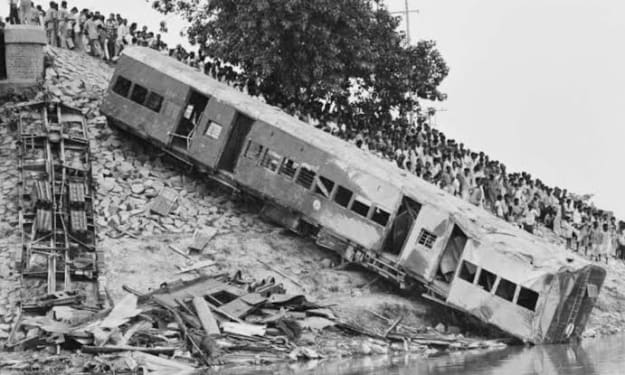
India's deadliest rail accident was the 1981 Bihar train derailment (750+ killed) After five days, more than 200 bodies were recovered, with hundreds more missing that were feared washed away by the river. Estimates of total deaths range from 500 to 800 or more. By the afternoon of June 12, the government had completed its recovery efforts and had issued an official death toll of 235 passengers (including the bodies of 3 passengers which had not been recovered), with 88 survivors.The cause of the crash is uncertain as the accident was not well documented. There are multiple theories:a
By Mahendra Pratap Singh bharti3 years ago in History
The Maid of Innovation
“Too bad there isn’t a key for this, a button that could make all our tasks happen without thinking. The mechanisms of the brain formed into a system that knows exactly what to do without us telling it…” Lydia moaned, tucking her hands back into the warm confines of her apron pocket.
By K.H. Obergfoll3 years ago in History