Discoveries
The Apollo 11 mission
On July 20, 1969, astronauts Neil Armstrong and Edwin "Buzz" Aldrin entered the surface of the moon aboard the Apollo 11 mission, a historic event that left the world in awe and awe. The Apollo 11 mission was the culmination of a decade of intense effort, rivalry, and technological advancement between the United States and the Soviet Union in the race to space. In this article, we'll examine Apollo 11's exciting journey to the moon, identify key players and challenges, and explore the legacy of this extraordinary historical event.
By Senne Wauters2 years ago in History
The Heart of Sheriff Shepherd
Once upon a time, in the small town of Harmony Ville, lived a dedicated lawman named Sheriff Jack Shepherd. He was a pillar of the community, known for his unwavering sense of justice and compassion. Under his watchful eye, the town remained safe and harmonious, and the people revered him as a guardian angel.
By ogbondeminu temidayo2 years ago in History
THE TRUTH ABOUT TITANIC SINKING HAS BEEN REVEALED
The Titanic Sinking's real cause is ultimately revealed by scientists. RMS Titanic suffered a horrific disaster on April 14, 1912, at 11:40 p.m. Three hours later, at 2:20 a.m. on April 15, the largest ship of its era had totally vanished beneath the ice-cold surface of the Atlantic Ocean. More than two-thirds of those aboard the Titanic perished along with it as it sank to the bottom of the ocean. The theory that an iceberg the ship collided with was to blame for this terrible disaster and the high death toll has been refuted by scientists in light of their most recent findings.
By Moses Chukwuma2 years ago in History
5 greatest scientific discoveries
Unquestionably, the past ten years have been among the most productive in terms of scientific discovery ever. Scholars from all fields have examined theories, discovered evidence, and traveled to locations that have caused us to reconsider how well we understand not only our own planets but also the entire universe. It was also the decade in which we began to comprehend one of the biggest problems that humanity has ever faced. Pluto despite having been unceremoniously downgraded from being a fully fledged planet in 2006 that year also saw the launch of the New Horizons spacecraft that was destined to travel to the farthest reaches of our solar system to study the dwarf planet it finally reached its destination in July of 2015 in the images and data that were sent back were astonishing far from being the boring frozen rock that some had expected it was found to have moving glaciers floating ice mountains and a huge frozen sea made of solid nitrogen the ice is constantly moving Arbit at a slow rates because it is warmed by the pressure above it which in turn causes it to rise the constant replenishment of the top layer of ice creates a surface structures that no one had expected and that has given a new introduction and understanding to what happens on the mysterious dwarf planets at the edge of our solar system number four the Higgs bosons it took the construction of the world's largest machine at a cost of just under five billion dollars but in 2012 it was finally announced that the mysterious Higgs a Bolton also known as the god particle have been discovered at the Large Hadron Collider in CERN Switzerland the particle had first been theorized in 1964 and is one of the most influential pieces of the subatomic world the reason that it's so important is that the standard model of physics which includes familiar particles like electrons and protons and um from such as muons and quarks doesn't actually explain why objects have mass the elusive Higgs boson particle, which exists in the Higgs field and is responsible for mass owing to its interaction with other particles, is the solution, His finding confirmed the last piece of the standard model of physics, and now researchers may use the LHC to start looking into even crazier phenomena number three. The first Kepler probe was launched in 2009 and was used to study distant stars and measure the amount of light they emit flu. For thousands of years, people have gazed up at the sky wondering what's up there. As astronomical instruments were developed, we learned that there are countless stars in the universe and that there are other planets in our own solar system. However, it was impossible to learn how common it is for planets to orbit stars. number three the world's climates throughout the Earth's history the climate has changed drastically there have been periods of extreme heat and extreme cold and there's no doubt that things are noticeably changing again during our lifetimes what's different this time though is that the changes are largely due to human behavior something that became clearer than ever in the last decade and we've begun to understand the extent to how it's affecting the planet in 2012 400 billion tons of ice was lost from Greenland and more than 250 two billion tons of ice has been lost from Antarctica every year throughout the decade this is an increase of almost six times the amount being lost just thirty years earlier and at the current rate the world's sea levels are expected to rise by 3 feet by the year 2100 this would directly affect the homes and lives of at least 630 million people but the consequences are far further reaching human activity has meant that 40% of all amphibian species more than 33% of marine mammals and 10% of insect species are endangered and things continues to get worse while the last decade was the time where the extent of the problem was beginning to be fully realized let's hope that the next decade is when the solution is finally found lastly, the top black holes Black holes have long been among the universe's most enigmatic things, but owing to experts who have devoted their time to researching the phenomenon, we now know a lot more about them and they are really a lot more fascinating than you may imagine. Black holes are normally created when massive stars die and all of the material collapses in on itself to produce a very tight structure. Because of their enormous gravity, black holes cause some extremely strange things to occur in 2016 - The discovery of black hole collisions supported Einstein's 1916 prediction that they would produce gravitational waves, which are ripples in space-time. This incredible discovery wasn't the biggest black hole discovery of the past ten years, but it was still significant because a team using the event horizon telescope was able to take the first-ever picture of a single black hole. This black hole is located at the center of the Messier 87 galaxy, which is 54 million light-years away from Earth. Its mass is enormous, equal to 6.5 billion of our Suns. Black holes like those are believed to be at the center of every galaxy, and their existence. Thank you all so much for reading; see you next time. 2010 was a fantastic year for scientific discoveries, and we've learnt so much about the world and cosmos around us. I, for one, am eager to see what happens next.
By Omotayo Obasanjo2 years ago in History
Industries Flourishing During War and Thriving in the Post-War Era: A Tale of Two Economies
Introduction War, with its devastating consequences, has a profound impact on economies worldwide. While some industries benefit during times of conflict, others find opportunities to rebuild and thrive in the post-war era. In this article, we'll explore the top 10 industries that flourish during the war and those that strive to benefit in the aftermath, supported by real-life examples from previous conflicts. Additionally, we'll highlight the top five countries that have historically benefited from war-driven economic growth.
By Benny Bhali2 years ago in History
The Infamous Iceberg that Sank the Titanic
At the beginning of 1912, a momentous event took place in the frigid waters of Southwest Greenland. A colossal chunk of ice broke off a glacier, composed of snow that had fallen approximately 100,000 years before, during the time of roaming mammoths. This iceberg, aptly named "The Traveler," embarked on a remarkable journey that would ultimately lead to one of the most infamous maritime disasters in history - the sinking of the Titanic.
By GRACE OKEDIJI2 years ago in History
A trip in a Submarine
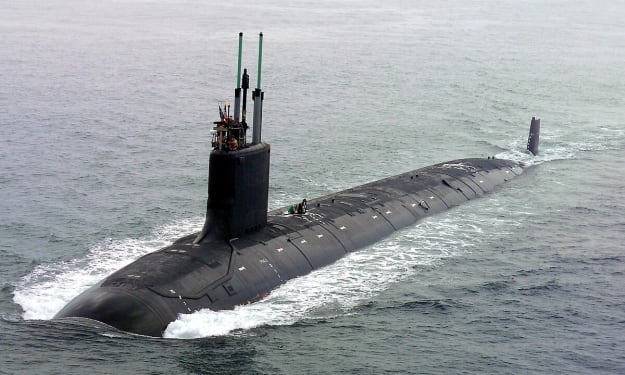
The year was 2023, and the world had made tremendous strides in technological advancements. Among them was the cutting-edge "Abyss Explorer," a state-of-the-art submarine capable of exploring the deepest parts of the ocean. It was the brainchild of Dr. Amelia Hartley, a brilliant marine biologist, and adventurer.
By Lehlogonolo 542 years ago in History
Misunderstood Concept in Physics: Entropy
The Earth receives a certain amount of energy from the sun every day. This energy is vital for sustaining life and driving various processes on our planet. The question arises as to how much of this energy is radiated back into space by the Earth. It is important to understand that energy never really disappears; rather, it transforms from one form to another. Throughout most of Earth's history, the amount of energy received from the sun has been approximately equal to the amount radiated back into space.
By Random Things 2 years ago in History