Biographies
The Unseen Planet In Our Solar System
For millennia, humans were aware of only five planets: Mercury, Venus, Mars, Jupiter, and Saturn, observable with basic telescopes or the naked eye under favorable conditions. In the late 18th century, Sir William Herschel, a renowned astronomer, discovered a new planet—a frosty blue one initially mistaken for a star—later recognized as Uranus. It orbits the Sun 19 times farther than Earth and takes 84 years to complete one revolution. Herschel also detected double stars and nebulae. In the mid-1800s, astronomers detected anomalies in Uranus' orbit, leading to the discovery of Neptune in 1846. Despite theories about another planet between Mercury and the Sun, known as Vulcan, corroborated by the peculiar behavior of Mercury's orbit, no concrete evidence surfaced. Einstein's theory of general relativity later explained Mercury's orbit irregularity, suggesting space-time curvature by massive celestial bodies like planets alters orbits. While the Vulcan theory persisted, Einstein's explanation gained traction, and tests during solar eclipses aimed to validate his theory. Additionally, hypotheses about an undiscovered Planet 9 or Planet X beyond Neptune, affecting objects in the Kuiper Belt, emerged. The Nibiru myth, claiming a doomsday scenario in 2012, proved baseless, as calculations disproved its existence. Moreover, the 2011 Comet Elenin briefly misconstrued as Nibiru, dissipated harmlessly. These astronomical mysteries continue to intrigue, shaping our understanding of the solar system's complexities.
By Cudjoe Justice2 years ago in History
"Weaving Identities: Exploring the Tapestry of Cultural Heritage"
Our cultural legacy gives us a feeling of identity and a link to our past, which makes us feel like we belong. We will examine the complex web of cultural legacy in this investigation, piecing together the historical, traditional, and customary elements that make up the rich tapestry of many global communities. We hope to shed light on the distinct identities that comprise our global community by learning more about the histories, significance, and cultural practices of the many objects, historical locations, and historical practices we come across on this voyage. Come along with us as we explore cultural heritage in depth and celebrate the diversity and beauty that make the world a better place.
By Isabel Martinez2 years ago in History
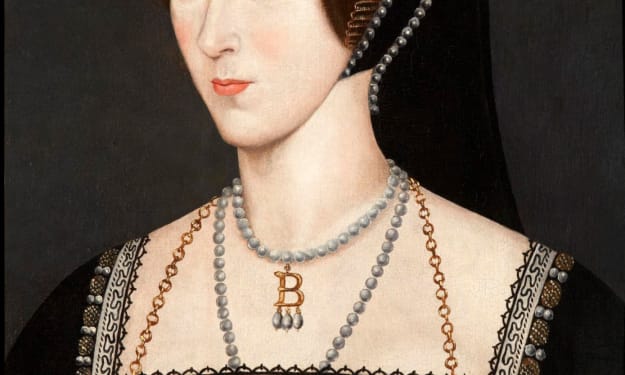
Anne Boleyn: A Tale of Triumph and Tragedy in Tudor England
Anne Boleyn: A Tale of Triumph and Tragedy in Tudor England Anne Boleyn, the second wife of King Henry VIII and mother to Queen Elizabeth I, remains an enigmatic figure in history, with her life marked by an extraordinary rise to power and a swift, tragic fall. This article delves into the captivating narrative of Anne Boleyn, exploring the dynamics of her ascent, characterized by ambition and political maneuvering, and the abrupt descent that unfolded against a backdrop of accusations, betrayal, and the ever-shifting currents of Tudor politics.
By Yaseen Pahad2 years ago in History
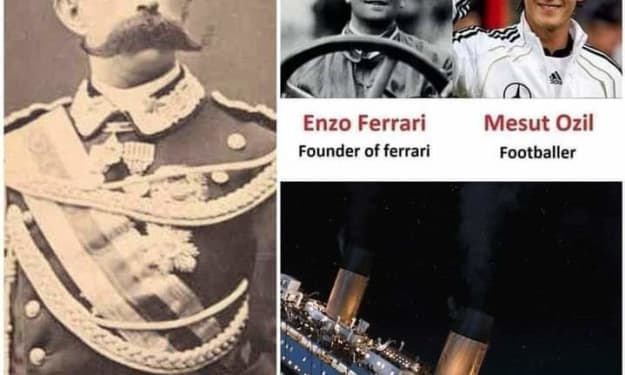
The Unbelievable coincidence
The unbelievable coincidence in History that seemly arose Discussion is the intersection of two seemingly unrelated worlds, German soccer sensation Mesut Ozil and the automotive legacy of Ferrari's founder, Enzo Ferrari, spins an intricate tale of life, death, and the intriguing concept of rebirth. This unique connection hinges on the astonishing alignment of Enzo Ferrari's departure from this world on August 14, 1988, coinciding with the birth of Mesut Ozil on the very same day. This synchronicity has not only raised eyebrows but has ignited spirited discussions about the possibility of rebirth and the mysterious interplay between lives.
By Ronnie Lewis 2 years ago in History