Ancient
The Euphrates River: Running dry for the first time in centuries has revealed hidden cities, ancient artifacts and confirmations related to ancient prophesies.
The Euphrates River, one of most important rivers in the Middle East, has been drying up in what seems to be all of the sudden. This river, runs through countries like Turkey, Syria, and Iraq, and has historically been a lifeline for the people living in these regions of the world, providing essentials such as, water for drinking and farming. Recently, due to a combination of factors including climate change, over-using or misuse of water, and constructions of dams, this historical river’s flow has slowed down significantly.
By ernest womackabout a year ago in History
The Last Dragon of Eldoria
In the twilight of the ancient kingdom of Eldoria, the once mighty land of dragons, a heavy silence lay over the emerald hills and dark forests. The kingdom, once resplendent with the roars of dragons, now whispered only of their legends. The dragons, the keepers of Eldoria’s secrets and the guardians of its skies, had disappeared, leaving behind only myths and an empty sky. Yet, one dragon remained, unknown to all but the oldest and wisest of Eldoria’s inhabitants.
By Nahid Mahmud Shamsuzzamanabout a year ago in History
The Vikings were obsessed with personal hygiene and weekly bathing
The Vikings have often been portrayed as fierce invaders, raiding towns and taking what they wanted, and often depicted as dirty unsophisticated barbarians. While they may have been skilled ferocious warriors, they were not dirty nor unsophisticated.
By sara burdickabout a year ago in History
Archeological history that change our view of history
Intro History is far more complicated that we would like to believe. Even in our schools today, different versions of events are being taught to students, depending on the country they’re in and how those events in history affected that country. “Who controls the past controls the future: who controls the present controls the past,” right? Nevertheless, we also have archaeology, which sometimes helps us to better understand what happened regardless of what was written down in centuries past. And sometimes, some such discoveries turn the way we saw history right on its head. 10. Ancient Fast Food Ancient Fast Food We generally tend to think that fast food came about fairly recently, right? And it does make sense, after all, given the faster pace the world is moving nowadays as opposed to the slower ancient times. In fact, the first such shops, which were serving fish and chips, opened in Britain during the 1860s. Then, in the 1950s in the US, the drive-through restaurants became popular, and… well, you know the rest. But taking a quick snack for lunch and then hurrying on your way is not something new and has been going on since ancient times. This place was the so-called thermopolium, or “place where (something) hot is sold,” and it was a common sight all throughout the Greco-Roman world; particularly in larger towns and cities. These thermopolia are, in fact, the forerunners of all present-day restaurants. They usually consisted of a small room that opened onto the street and specialized in two or three items such as spiced wine, meats, cheese, or lentils. These establishments were quite tiny and almost never had tables for people to sit at. There was only a counter with several embedded earthenware jars called dolia where the food was stored. These places were frequented mostly by slaves or people who did not have the means or facilities to cook for themselves. And as it so happens, these thermopolia were also frequent hangouts for all sorts of shady characters. These places were even abolished on several occasions for this exact reason, since they harbored all sorts of “effeminate Greeks and thieving slaves,” as Plautus, a Roman playwright from the 3rd century BC, once said. There were, however, some fancier establishments too, with some tables inside and even some frescoes painted on the walls. One such ornate restaurant called the “Thermopolium of Asellina” was discovered in Pompeii and is one of the best preserved in the world. 9. War is Older Than We Thought War is Older Than We Thought War was commonly believed to have originated alongside the advent of civilization. This, of course, doesn’t mean that people weren’t killing each other even before that. After all, the reptilian part of the brain, which we all have and which pushes us towards things like hate, envy, aggression, dominance, and territoriality among others, was also found in people more than 10,000 years ago. This means that before the discovery of agriculture and animal husbandry, people were only able to kill each other through the occasional murder or small family skirmishes. But after people began settling down and growing in number, more organized and coordinated forms of battle were invented; things like raids or wars, for instance. The fact that structured hierarchies and slavery also appeared during this time also helped wars along. Nevertheless, an archaeological discovery made in 2012 in Kenya seems to indicate that small scale wars were also taking place even before agriculture appeared there. On the banks of the Lake Turkana, archaeologists came across 27 skeletons dating back to somewhere in between 9,500 to 10,500 years ago. These skeletons once belonged to men, women, and children which archeologists believe were members of a semi-nomadic tribe that settled close to the lake. All of the skeletons showed signs of blunt force trauma or wounds from projectile weapons. One of the women had both of her knees shattered and showed signs that her hands were bound when she died. Who attacked them, or what really happened is not known, but no other massacre on this scale has ever been discovered from so long ago. 8. Europeans and America Europeans and America Christopher Columbus and his men are no longer believed to be the first Europeans to discover the American continent. Today it is fairly common knowledge that Leif Ericsson, an Icelandic Viking explorer, was the first European to come across to North America when he was blown off course on his way to Greenland from Norway almost 500 years before Columbus. In the Saga of the Greenlanders which talks about Leif Ericsson and his travels to Vinland, present-day Newfoundland, there is mention of a Bjarni Herjólfsson, who also made it to a land west of Greenland when he too was blown off course by the wind, even before Leif Ericsson himself. But whatever the case may be here, some newer archaeological evidence points to the fact that the Europeans made it to North America even before Europe had a name, or at least the name of “Europe.” Several dozen stone tools have been found along the East Coast in six distinct locations. One in Pennsylvania, three from the Delmarva Peninsula in Maryland, one in Virginia, and another one was discovered by a scallop trawler some 60 miles off the Virginian coast. All of these tools bear a striking resemblance to the stone tools used by the prehistoric Solutrean tribes from present-day western France and northern Spain. What’s more, all of them were dated somewhere in between 19,000 to 26,000 years ago. Because of this time period, most archaeologists have rejected the idea of being just a simple case of coincidence based on the too-similar design. Furthermore, one of the stone knives discovered in Virginia revealed under chemical analysis that it actually originated in France. The reason for the relatively small number of tools found on the East Coast dating from that period also explains how those Stone Age Europeans got to America in the first place. Back in those times, the planet was going through an Ice Age, and like the Native Americans who crossed into America from Asia over the Bering land bridge, so did these Solutreans cross over what is now the north Atlantic, Iceland, and Greenland. As shown by that knife found by the scallop trawler 60 miles off the coast of Virginia, the sea level was far lower than it is today. And since these people stayed mostly around the coast, many of their tools are also underwater. Another archaeological discovery that places Europeans in North America longer ago than previously believed is an 8,000-year-old skeleton found in Florida. When subjected to a genetic marker test, this man’s remains revealed high levels of European markers, not found in Asians. 7. Australians and America Another archaeological discovery, this time from Brazil, points to the fact that Australians also made it to the Americas long ago. Several human skulls discovered there match the characteristics of those from places like Australia and Melanesia. Similarly, some 33 skulls found on the Baja California peninsula in Mexico also point to this theory. And according to the stone tools and charcoal discovered at the site in Brazil, these people could have inhabited the area for nearly 50,000 years. The theory is that they arrived in the Americas by boat across the Pacific. Though seemingly impossible for people from 50,000 years ago, cave paintings in Australia have shown some boats that were actually built to withstand the ocean. Moreover, in 1947 Norwegian explorer Thor Heyerdahl and a few others made it across on a balsa wood raft. Archaeologists also believe that these people died out with the appearance of the Asian peoples coming in from the north via the Bering land bridge. This is because the shape of the skulls changes from those with an Australian appearance to those with a Mongoloid appearance between 9,000 to 7,000 years ago. The only survivors could be tribes of people who lived in the Terra del Fuego region of South America. This is the southernmost tip of the continent, and the people who still live there show hybrid skull features of both mongoloid and negroid ancestry. If proven true then Native Australians could be the first Americans ever. 6. How Old is Our Friendship with Dogs? How Old is Our Friendship with Dogs? There is no debating that wolves were the first animals ever to be domesticated by humans. Even before animal husbandry became a thing, man and wolves (which then turned into dogs) were hunting together in a sort of synergy that benefited both species. But how old is this interspecies collaboration, really? Common theories place the beginning of this relationship somewhere around 15,000 to 18,000 years ago and it happened separately in both China and the Middle East. This is without a doubt far older than any other domesticated animal in the world. Dogs were well established as part of human society around 10,000 years ago, and in Germany for instance, humans and dogs were sometimes buried together as long as 14,000 years ago. But the discovery of a canine skull in the Altai Mountains in Siberia pushes this timeline by at least another 15,000 years. Radiocarbon dating has placed the skull somewhere around 33,000 years old, and its genetic markers indicate that it more closely resembled modern-day dogs than actual wolves. The similarity between modern dogs and this particular skull was also evident thanks to its shape and size. Another old canine fossil dates back to around 31,000 years ago and was discovered in Goyet Cave in Belgium. And even though its mtDNA (mitochondrial DNA) indicates that it does not share its matriline with any extant wolves or dogs, its skull morphology is more similar to a dog than an actual wolf. 5. The Oldest Writing in the World Three inscribed tablets that were found in what is now present day Romania may contain the oldest writing system in the world. Each of them is about two and a half inches wide, each has markings on it, and all of them are dated back to around 5300 BC. They were found in 1961 in a ritual pit, alongside other clay and stone offerings and the bones of an elderly woman, probably a sort of priestess. The Tartaria Tablets, as they are known, are thought to have belonged to the Turdas-Vinca culture that inhabited the area during that period. But despite the importance of the discovery and what they stand to represent if proven to be the real deal, the tablets are still shrouded in some controversy. For instance, Mesopotamian experts disregard the Tartaria Tablets by saying that the symbols on them are not actually writing, but only decorations. Other experts believe that these tablets actually contain an early form of Sumerian script since some of the symbols found here are identical to pictograms found in Jemdet Nasr in Iraq. A German linguist and Mesopotamian script specialist by the name of Harald Haarmann strongly believes that the symbols on the tablets are an early form of writing. He bases his assumptions on the many other symbols that are part of the so-called Danube script found throughout the region on various other ceramic objects and which number roughly the same as the Egyptian hieroglyphs. A more recent discovery from 2009 has brought to light a Neolithic workshop that was once manufacturing clay tablets. Another 120 similar tablets were found at the site, some containing symbols similar to the ones at Tartaria. If these symbols are ever proven to be authentic and part of an actual ancient script, then the cradle of civilization could be moved from the Middle East to Eastern Europe. 4. The City of the Sun in North America The City of the Sun in North America Native Americans usually lived in tepees, right? Well, yes… at least, some of them did. But in fact, many Native North Americans lived in large cities before the arrival of the Europeans to the continent. One notable example is Cahokia, or the City of the Sun. It is located in in the state of Illinois, close where the Mississippi and Illinois Rivers merge. This area is one of the most fertile on the continent and here one Native American culture, the Mississippians, made it their home. But they didn’t just live in tepees, but rather in grand cities of some 20,000 people strong. Cahokia was at its peak between 1050 and 1200 AD, and during this time, it was bigger than any other European counterpart. And here is where this tepee misconception comes into play. It was so ingrained into white people’s imaginations that when they came across some earthen mounds in the region, they initially attributed them to retreating glaciers. When they did eventually realize that these were actually man-made, they attributed their construction to Phoenicians, Vikings, and even a lost tribe of Israel. Pretty much anyone other than the Native Americans themselves. And Cahokia is big. It spans over an area of about six square miles and had a total of 120 earth mounds. The city was carefully planned and organized, with plazas, residential areas, and elite compounds. The largest of the earth mounds found here is about 100 feet tall and contains more than 25 million cubic feet of earth, carried here in willow baskets 50 pounds at a time. Known as the Monks Mound, this is the largest earthen structure in the Western Hemisphere. Fairly little is known about the civilization that built it, however. We do know that their trade network was vast, reaching from the Rocky Mountains to the Appalachians and from the Great Lakes to Florida. They practiced human sacrifice and relied heavily on corn for nourishment. Today, however, only 70 of the original 120 earth mounds have survived and there is a four lane highway running right through the historic site. Cambodia's Medieval Cities 3. Cambodia’s Medieval Cities The Khmer Empire was one of the most powerful in Southeast Asia, and probably in the world at the time. It existed in between 802 AD to 1431 AD and extended over what are now Cambodia, Laos, Thailand, and Vietnam. They ruled over the region including where the temple complex of Angkor Wat is located. The temple complex itself is one of the most important archaeological sites in Southeast Asia and consists of many architectural marvels besides the obvious temples found there. Back in 2012, a team of archaeologists made use of state of the art laser technology called LiDAR. This technology has the ability to see through dense vegetation and map the topography under the jungle canopy. What they discovered was amazing, to say the least. They used LiDAR again in 2015, in a project that became the most extensive airborne survey used for archaeological purposes ever. Some 734 square miles of terrain was scanned and it revealed an unimaginable network of roads, water ways, and densely populated cities, unrivaled anywhere in the world at the time. Lead archaeologist on the project Damian Evans had this to say about the discovery: “We have entire cities discovered beneath the forest that no one knew were there – at Preah Khan of Kompong Svay and, it turns out, we uncovered only a part of Mahendraparvata on Phnom Kulen [in the 2012 survey] … this time we got the whole deal and it’s big, the size of Phnom Penh big.” Phnom Penh is the current capital city of Cambodia. This survey has shown that the Khmer Empire was able to design and implement an elaborate water system on a grand scale, centuries before archaeologists believed the technology even existed. This new discovery also disproves the theory on how the Khmer Empire eventually collapsed. Up until 2015, it was believed that they were invaded from the north and people fled south. But the lack of any cities in that direction disproves this theory. In any case, Angkor is now, without a shadow of a doubt, the most extensive urban settlement in the world prior to the Industrial Revolution. This is, of course, if LiDAR technology doesn’t discover any others. 2. The Gold Crucifix of Denmark The Gold Crucifix of Denmark One beautiful afternoon in 2016, an amateur metal detector in Denmark came across a gold crucifix in a field near the town of Aunslev, Østfyn. After he posted his discovery on social media, some people advised him to take it to a local museum, which he did. Here, the curator dated the Birka crucifix to somewhere in the first half of the 10th century AD. It is made out of finely articulated goldthreads and small filigree pellets, and has a loop through which a chain once went. What is really interesting about this find is that it’s dated between 900 and 950 AD, leading historians to believe that the Danes were converted to Christianity earlier than previously believed. Prior to this discovery, the earliest representation of Jesus on a cross in Denmark came in the form of the Jelling Stones – two large rune stones dated to 965 AD, and which are located in Jutland. These stones commemorate Harald Blåtand, or Harald Bluetooth, for his role in converting the Danes to Christianity. What this tiny cross does is push back the period when these Vikings became Christians by several decades, at a minimum. The Appearance of Agriculture 1. The Appearance of Agriculture It’s a common belief that agriculture started off in what are now Armenia, eastern Turkey, Syria, Palestine, Israel, Jordan, and Iran around 11,000 years ago. Then it spread to the rest of the Old World. And while this is still true, new archaeological evidence shows that agriculture actually developed in two distinct parts of this particular region, known as the Fertile Crescent, and each then spread to different parts of the world independently. Genetic evidence has proven that there are stark differences between people living in the southern Levant, like Israel and Jordan, and those from across the Zagros Mountains in western Iran. Each of these groups of people developed their own style of agriculture and animal husbandry, favoring different plants and animals for domestication. They lived in complete isolation from each other for centuries or even millennia before they actually met. And it is believed that they only came in contact in eastern Turkey when both groups were in search of obsidian needed for all sorts of tools. It’s also believed that these people met, intermingled, exchanged agricultural techniques and ideas, and then migrated westward into Europe. Those who remained behind, however, went their own separate ways, spreading their distinct forms of agriculture to other parts of the world. Those living in the southern Levant eventually travelled to East Africa, going through present-day Egypt and down the Nile and the Red Sea coast, while those living in western Iran made their way north into the Eurasian steppe and then eastward into present day India and Pakistan. While this discovery doesn’t seem like much given that both of these populations emerged from the Fertile Crescent region, it does change our perspective of how history and the start of civilization actually played out.
By Jariatu Kallonabout a year ago in History
Title: The Last Sunset
The *Horizon Queen* glided across the Pacific, like a piece of a dream, a luxury cruise ship watching the vast horizon with indulgence. In the evening, the sky transformed into a fiery canvas, blazing with red and orange hues as the sun slowly descended toward the sea, leaving behind a trail of gold and fire. On the ship’s deck, passengers meandered slowly, enjoying the serene beauty of the sunset, while soft music played in the background.
By Habachi Habachiabout a year ago in History
Lets Go To China
NOTE!!! China, officially known as the People's Republic of China (PRC), is a vast and complex nation with a history that spans thousands of years, a diverse culture, and a rapidly evolving socio-economic landscape. It is the world's most populous country, with over 1.4 billion people, and the second-largest economy, making it a major global player. Understanding China requires delving into its rich history, political structure, economic development, cultural heritage, and its significant role on the world stage.
By Muhammad Sani Saniabout a year ago in History
The History of the Church
The dissemination of the gospel originated in Jerusalem and extended throughout the globe, commencing with the commissioning of the Eleven Apostles to disciple all nations. This narrative chronicles the journey of the gospel as it spread to regions such as Cyprus, Pamphylia, Galatia, Macedonia, Greece, and beyond. The early Christian apostles preached fervently and faced martyrdom in various locales. Thomas evangelized in Austria, Armenia, and India, ultimately meeting his demise at the hands of Hindu priests. Matthias spread the message in Armenia and around the Black Sea before returning to Jerusalem, where he was stoned to death. The conversion of Justin Martyr and his subsequent travels contributed to the emergence of new movements within the church. After his conversion to Christianity, Justin Martyr traversed Asia, defending the faith and countering opposing teachings. Montanus initiated a new movement that emphasized ecstatic experiences and ongoing revelations from the Holy Spirit, which led to internal conflicts within the church. The early church also grappled with heresies and influential theologians, including Clement of Alexandria, whose writings sparked controversy. The heresy of modalism, associated with Sibelius, resulted in his excommunication by Pope Calixtus I. The Arian controversy arose when a priest named Arius posited that Jesus was a created being, igniting significant disputes within the church. The Council of Nicaea in 325 affirmed the consubstantiality of the Father and the Son, thereby establishing the Nicene Creed. The ongoing struggle between Arianism and the Nicene Creed marked a pivotal chapter in church history, with Pope Liberius facing exile for his refusal to accept the Arian doctrine. Emperor Theodosius later declared Arianism illegal, reinforcing the Nicene faith. Additionally, the Nestorian controversy emerged, with Nestorius opposing the veneration of Mary as Theotokos. Saint Cyril of Alexandria played a crucial role in the deposition of Nestorius, receiving support from Pope Celestine.
By Isaac Ekow Anyidohoabout a year ago in History
10 Most Interesting Facts about The Indian History
1. Indus Valley Civilization (ca. 1300–3300 BC) The Indus Valley Civilization, also known as the Harappan Civilization, was one of the world's first urban cultures. This nation, which flourished along the Indus River and its tributaries, was known for its urban planning, including organized cities such as Harappa and Mohenjo-daro. These cities had complex drainage systems, standard bricks for construction, and trade marks in distant regions. The community was peaceful, there was no sign of military service, and the health and hygiene of the people was very important.
By Vishnu Sharmaabout a year ago in History
The Last Scroll of Alexandria
In the core of old Egypt, the city of Alexandria remained as a signal of information. The Incomparable Library, with its transcending racks and vast parchments, was the pride of the old world. Researchers from each edge of the earth went to its marble corridors to study, learn, and add to the consistently developing store of human insight.
By Nadia Tasnimabout a year ago in History
The Evolution of Domesticated Animals: From Wild Ancestors to Modern Companions
The domestication of animals is one of the most significant achievements in human history. Over thousands of years, various wild species have been transformed into domesticated animals that play essential roles in our lives today. This fascinating journey from wild ancestors to modern companions highlights both the adaptability of these animals and the ingenuity of early humans.
By Adeshola Motunrayoabout a year ago in History
The Egyptian Discovery That Terrified Scientists
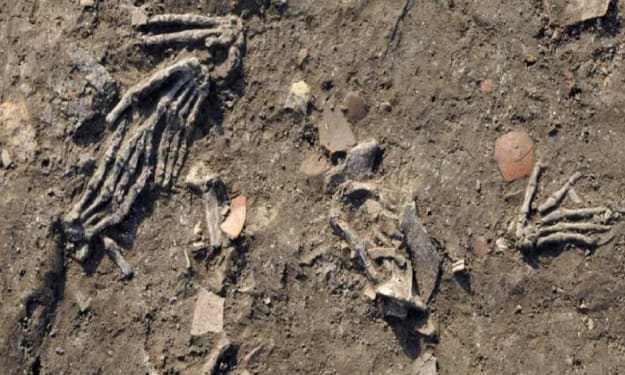
Years ago, a gruesome discovery was made in Egypt that startled scientists. 16 human hands, all right hands, carefully buried in four eerie pits. These hands were abnormally large, making them look less human at first, but they were indeed human hands. Curiously, no left hands were found. This discovery points to an ancient dark ritual, as depicted in old Egyptian art and tales. It was believed that warriors would present the right hand of their defeated adversaries as proof of victory in exchange for gold. The Egyptians believed in the afterlife, so cutting off someone's hand was thought to cut off their power forever, ensuring a complete and eternal defeat for their enemies. This practice is thought to have occurred during battles between the Egyptians and the Hyksos, who lived in what was once known as Canaan.
By Eunice Fasorantiabout a year ago in History
did Indians invent planes 7000 years ago . AI-Generated.
when did mankind first create airplanes and space shuttles recent history tells us that the Wright brothers launched the first successful flight in 1903 and that the first space shuttle was built in 1976 but what if ples and space shuttles existed thousands of years ago not only that but they were much more advanced than what we have [Music] today a controversial paper presented at the prestigious science conference the one 102nd Indian science Congress in Mumbai claims human Aviation and advanced space flight was achieved and Mastered by the ancient Indians thousands of years ago the paper presented by Captain Anand bodas a retired principal of a pilot training facility within a session titled ancient Sciences through Sanskrit details that invida texts from 7,000 years ago a planes are described as being able to fly backwards and side to side they could also shuttle between countries continents and even planets the more than 3,000-year old manuscript also described ancient Pilots diets and clothing according to Buddhas during specific periods Pilots drink the milk of Buffalo cow and sheep and they wore clothes made from vegetation grown underwater bodas indicated that there is official history and unofficial history official history only noted that the Wright brothers flew the first plane in 1903 but the inventor of the airplane was really a sage named barad waja who lived around 7,000 years ago he also said that ancient planes had 40 Small Engines the vas are a large collection of Sanskrit texts originating in Ancient India and constitute the oldest layer of Sanskrit literature and the oldest scriptures of Hinduism some of the collections such as the samhitas are known to date back to at least 1700 BC although it is believed that many go back much further the subject of flying machines has been a popular subject among ancient astronaut theorists who argue that some extracts are evidence of extraterrestrial visitations however Captain bodis said that ancient Indians invented the technology and that it was later forgotten because of the passage of time foreign rulers and things being stolen from the country the times of India reports that the paper presented at the conference which included six Nobel laurates and award-winning academics and scientists in its Ro has been met with skepticism claims of pseudo science and the argument that the theory undermines empirical evidence by citing ancient religious texts the Indian science Congress Association is a premier scientific organization of India with more than 30,000 scientist members their mandate is to publish journals hold conferences and advance and promote the cause of science NASA scientist Dr Ram pad Gandhi Ramen started an online petition before the conference to to oppose certain lectures which were thought to advance a mix of science mythology and the politics of Hindu nationalists however others such as an Indian scientist from the US who attended the conference seem to find the examination of ancient testimony compelling saying knowledge always grows its flow never stops so if all this knowledge was available in the ancient days I need to know where it stopped why did it fail to grow why was there no advancements when did it stop I am not a Ware of the chronology of events but I am definitely willing to learn more and find out the concept of ancient civilizations creating airplanes is not new gold trinkets of what looks like airplanes were found in an area covering Central America this object here which looks like a airplane was found in 1898 in a tomb in Egypt and was later dated as having been created near 200 BCE I've also talked about in videos on this channel that we do think that today's technology is the most advanced it has ever been in the history of the world but is that really true I don't think we can be completely sure there's so much about our history that we do not know and cannot explain but do I believe that advanced civilizations existed before that are capable of creating this technology yes I do these civilizations may not be advanced in today's sense with our iPhones and YouTube but advanced in their own way oh and can you imagine if there was some form of YouTube or Twitter back then what would be the content like a DIY video on how to build the pyramids or a prank Channel all there was was videos on how to mess with people of the future episode one Stonehenge anyway let me know how you guys feel about the story in the comments below again thanks so much for watching everybody see you later
By Jariatu Kallonabout a year ago in History