Analysis
The enchanted Forest
In the heart of a vast kingdom, nestled between towering mountains and winding rivers, lay the Enchanted Forest. Legends whispered of its magical allure, where trees whispered secrets and streams danced with shimmering light. Few dared to venture into its depths, for within its emerald embrace, mysteries and wonders awaited those brave enough to seek them.
By Osman khan2 years ago in History
Unveiling the Charm of Marrakesh, Morocco: A Cultural Gem
Marrakesh, Morocco, often referred to as the "Red City," stands as an epitome of rich cultural heritage, architectural marvels, and vibrant traditions. Nestled at the foothills of the Atlas Mountains, Marrakesh mesmerizes visitors with its bustling souks, intricately designed palaces, and the pulsating rhythm of life that flows through its alleys. Let us delve deeper into the enchanting allure of this historic city.
By quizat karim2 years ago in History
The Ultimate Titanic Conspiracy Theory Iceberg..!!
Despite the sinking of RMS Titanic over a century ago, the story of that fateful day in 1912 is widely known thanks to various forms of media. Titanic, owned by the White Star Line, was built in Belfast, Northern Ireland, for transatlantic travel between Southampton, England, and New York City. Despite being deemed unsinkable, the ship tragically collided with an iceberg and sank, resulting in the loss of over 1,500 lives. The incident has sparked numerous theories, ranging from plausible to outrageous, including some involving aliens. The official narrative states that Titanic sank after sustaining damage to its hull from the iceberg, leading to the flooding of multiple compartments. Efforts to evacuate passengers were hindered by a lack of lifeboats, resulting in many casualties. In his 2003 book "The Sinking of the Titanic: The Mystery Solved," Collins addresses inquiries regarding the events leading to the ship's sinking. According to Collins, the two lookouts on duty that night did not report any haze. However, at 11:30 p.m., they spotted what they believed to be haze on the horizon, extending approximately 20° on either side of the ship's bow. Collins argues that what they actually saw was a strip of pack ice, about 3 to 4 miles ahead of the ship. Other witnesses provided varying descriptions of the iceberg that the Titanic collided with. The lookouts estimated its height to be 60 ft, while quartermaster Row estimated it to be 100 ft, and fourth officer Boxhall described it as being very low in the water. This inconsistency in the iceberg description can be attributed to an optical phenomenon known to ice navigators, where the flat sea and extreme cold cause objects near the waterline to appear distorted and larger than they actually are. After spotting the ice, the Titanic attempted to turn by rotating 1/3 of the way from the bow, causing her rudder to hard over and collide with the ice. This resulted in the ship flooding, capsizing, and sinking within minutes. It is important to note that the theory suggesting the Titanic collided with an ice pack is not widely accepted and is considered implausible by most historians. Another elaborate theory surrounding the Titanic is that it was not the Titanic that sank, but rather her sister ship, the RMS Olympic. Robin Gardner proposed this controversial theory in his book "Titanic: The Ship That Never Sank." Gardner cites several events and coincidences leading up to the sinking to support his theory. The RMS Olympic, launched in October 1910, was nearly identical to the Titanic in terms of exterior profile, with minor differences such as the number of portholes and spacing of windows. On September 20, 1911, the Olympic was involved in a collision with the Royal Navy warship HMS Hawk, causing extensive damage to the liner. Despite numerous inquiries, the true cause of the Titanic's sinking remains a subject of debate and speculation. The 1910 Garden trial alleges that the patched-up Hull of the Olympic was unable to withstand long periods of high speed, which is why the plan was to dispose of the ship, now named Titanic, during its highly anticipated maiden voyage. The intention was to open the seaox and slowly flood the ship, allowing White Star to collect the full insurance value of a supposedly new vessel. The shortage of lifeboats would not have been a concern as the ship was expected to sink slowly, and nearby ships could make multiple trips to rescue the passengers. Survivors' comments after the sinking of the Titanic support this theory, as they mentioned the ship had a noticeable list to Port as it left Southampton, indicating damage. Additionally, Jay Bruce Ismay, the managing director of The White Star Line, inexplicably ordered the floors aboard the Titanic to be carpeted shortly before its departure, possibly to conceal wear and tear. This theory, which has been around for decades, gained renewed attention in 2023 after going viral on TikTok. Since then, numerous other TikToks have been released promoting the conspiracy that the Titanic never sank and was deliberately sunk as part of an elaborate murder plot. Another theory suggests that JP Morgan orchestrated the sinking of the Titanic to establish a centralized banking system in the United States, which eventually became the US Federal Reserve. According to this theory, three influential financial figures who opposed Morgan's plan, John Jacob Astor IV, Isidor Strauss, and Benjamin Guggenheim, lost their lives when the Titanic sank. Theorists believe that Morgan planned for these individuals to be on board the ship and intentionally sank it to eliminate them and proceed with his plans unopposed. Morgan himself attended the ship's voyage. The launching ceremony took place in 1911, but despite having a personal Suite booked on board the Titanic, he decided to cancel his trip at the last minute and stayed at a resort in France. This has led certain conspiracy theorists to speculate that he had prior knowledge of the ship's fate. However, there is limited evidence to support this claim. In reality, Aster Strauss publicly supported Morgan's plan in 1911, while Aster and Guggenheim did not express any opinion on the matter. Furthermore, there is no proof to suggest that Morgan intentionally skipped the voyage of the Titanic. Historians have discussed the reasons behind his decision to cancel his journey, but none of them relate to the Federal Reserve. Even if Morgan had planned for the ship to sink, many factors would have had to align perfectly. There was no guarantee that all three wealthy men would perish in the disaster, and many other innocent people would have also lost their lives. More recently, conspiracy theorist Stu Peters has added an anti-Semitic twist to this theory by claiming that the Rothschilds were the masterminds behind the sinking of the Titanic, as well as the establishment of the Federal Reserve. He alleges that the ship went down as a result of a controlled demolition. Additionally, Peters has suggested that the Ocean Gate submarine was intentionally sabotaged to prevent its passengers from uncovering the truth about the Titanic's sinking. Another theory focuses on the Titanic's watertight doors. The ship, along with its sister ships Olympic and Britannic, had 16 watertight compartments that were meant to provide a subdivision of the ship's hull to retain buoyancy in case of damage. However, some argue that these watertight doors were more harmful than helpful. They claim that if the doors had been opened and allowed the water to flood the ship evenly, passengers would have had more time to evacuate. They also believe that the flooded compartments made the ship sink faster. However, it is important to note that the Expansion Joints were positioned above the strength deck B deck and therefore did not play a significant role in supporting the hull. They merely opened up and separated as the hull flexed or fractured beneath them. It is worth mentioning that there are various theories about why the Titanic sank, and one theory suggests that a fire in the coal bunker could have played a significant role. According to reports, a fire had started in one of the coal bunkers weeks before the ship set sail. However, the crew allegedly covered it up or downplayed its significance to avoid delays. Recently discovered photos of the ship have revealed a 30ft long black streak on the outside of the hull, in the same location where it later collided with the iceberg. Engineers from Imperial College London believe that this visible streak may have resulted from the coal fire burning inside the hull. The fire could have caused significant structural damage to the ship even before it embarked on its journey. It has been suggested that the crew members attempted to control the fire by burning coal at a faster rate, which increased the ship's speed on the night of the collision. Despite warnings of icebergs in the area, the Titanic was known to be traveling close to its maximum speed. The coal fire theory proposes that the reason for this high speed was the burning of smoldering coal. However, while some believe that the fire played a significant role in the sinking of the Titanic, others disagree and argue that the ship would have sunk regardless. David Hill, a former honorary Secretary of the British Titanic Society, stated that a fire could have accelerated the disaster, but it was not the sole cause. In 1912, shortly after the sinking of the Titanic, a conspiracy theory emerged suggesting that the ship was cursed by a mummy. According to one survivor's account, William T. Stead, a British editor who was on board the Titanic, shared a story with his fellow passengers about an ancient Egyptian Priestess whose curse could have affected the ship.
By Nameless writer2 years ago in History
தமிழ். Content Warning.
தமிழ் (Tamil) the oldest language in the world, has a history of over 2,000 years and is primarily spoken in Tamil Nadu, Puducherry, Sri Lanka, Singapore, Malaysia, and other diaspora communities. It holds the status of a classical language due to its antiquity, literary richness, and continuity of tradition. The origins of Tamil can be traced back to the Sangam period, which lasted from around 300 BCE to 300 CE. This era saw the flourishing of Tamil literature, including poetry, epics, and philosophical works.
By Praveen Pk2 years ago in History
Secrets of Success
In the bustling city of New York, amidst the sea of aspiring entrepreneurs and dreamers, was Eliana Rowe, a woman whose path to success was as unconventional as it was inspiring. Her journey began in a small, cluttered apartment, doubling as her makeshift office. Here, she laid down the foundation of what would become one of the most innovative tech companies of the decade.
By lahsen ezahouani2 years ago in History
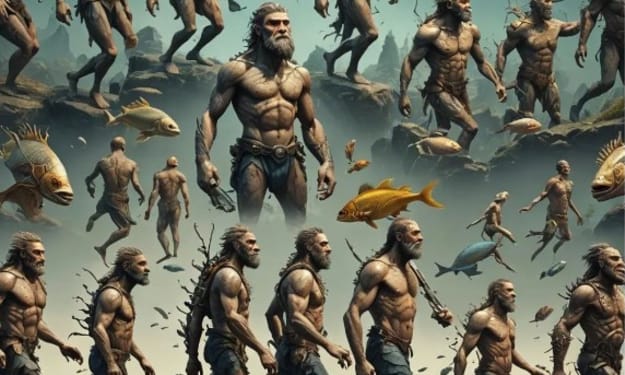
Evolution Is A Lie. Content Warning.
Introduction Yes, the title is clickbait, but so many people see that as a truth, too many in fact. The fact is that people who think that way will probably not evolve themselves, but evolution is with us every day in so many forms.
By Mike Singleton 💜 Mikeydred 2 years ago in History