
Surviving Two Atomic Bombs: The Incredible True Story of Tsutomu Yamaguchi
A Japanese Engineer Who Endured Hiroshima and Nagasaki Bombings and Lived to Tell the Tale

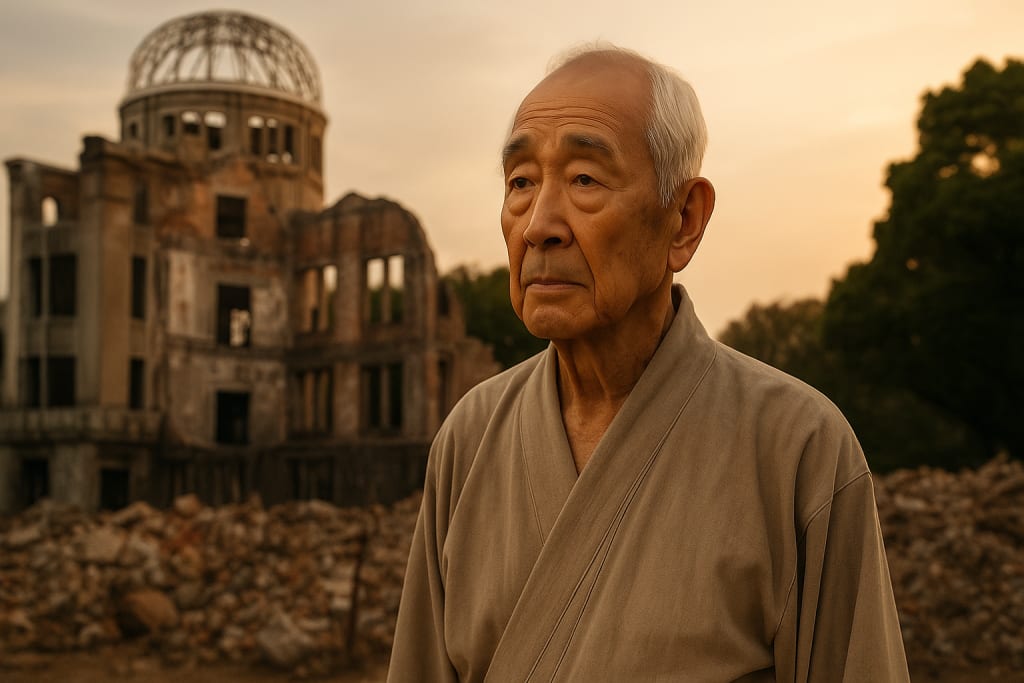
✦ Life Before the Bombs ✦
Tsutomu Yamaguchi worked as a shipbuilding engineer for Mitsubishi Heavy Industries. In late July 1945, he traveled from his home city of Nagasaki to Hiroshima on business. He planned to return after completing work that lasted only a day or two. At that time, many Japanese cities were facing shortages and hardship, but Yamaguchi’s work continued amid wartime pressures.
✦ The First Blast: Hiroshima ✦
On the morning of August 6, 1945, Yamaguchi was in Hiroshima, standing near the city center. Around 8:15 a.m., a sudden, blinding flash lit the sky. The world shook with a deafening roar. The atomic bomb “Little Boy” exploded overhead. Yamaguchi, approximately two miles from ground zero, was thrown by the blast, knocked unconscious, and seriously burned.
When he regained consciousness, he found himself bleeding, scorched, and disoriented. He managed to return to his lodging, applied makeshift first aid, and—despite his injuries—boarded a train to Nagasaki that evening to return home and warn others.
✦ Return to Nagasaki and Second Blast ✦
Just three days later, on August 9, 1945, Yamaguchi was back at work in Nagasaki. At around 11:02 a.m., another atomic bomb—“Fat Man”—was dropped. He was once again engulfed in a blinding flash and massive blast wave. The explosion devastated the city and wounded Yamaguchi again.
He survived the second bombing with further burns and trauma, experiencing the rare and unimaginable: surviving two nuclear blasts in one week.
✦ Physical and Emotional Recovery ✦
In the aftermath, Yamaguchi faced severe radiation sickness, chronic pain, and lasting health problems like cataracts and liver damage. Emotionally, he was haunted by memories of two shattered cities and the deaths of many friends and co-workers.
Still, he continued to work, support his family, and help others. His quiet strength was reflected in small acts of resilience and kindness.
✦ Speaking Out for Peace ✦
In later years, Yamaguchi began publicly sharing his experience. As one of the very few officially recognized survivors of both bombings (a nijū hibakusha), he used his voice to campaign for nuclear disarmament.
He described the horrors: sudden silence, shadows burned into walls, skin melted from heat, and the cries of the injured. His message was clear—no one should experience what he had lived through.
✦ Legacy and Lessons ✦
Tsutomu Yamaguchi passed away in 2010 at the age of 93. His story remains a testimony to survival, courage, and the importance of peace. He transformed personal trauma into public advocacy, calling on the world to remember the human cost of war.
Key Lessons:
Nuclear destruction is instant, but its trauma lasts forever.
Resilience is real—but scars remain.
Peace must be pursued actively to prevent future tragedies.
✦ Reflection ✦
Yamaguchi’s extraordinary journey is not just a historical curiosity—it is a moral lesson. In a time of global tension, his voice reminds us that hope can emerge from horror, and healing is possible through remembrance and responsibility.
This remarkable journey continues to resonate in today’s world, reminding us that individual stories carry immense power to shape collective action. By honoring Yamaguchi’s legacy, communities can foster dialogue about the lasting impact of conflict and the importance of empathy across generations. His willingness to share pain and hope offers a template for addressing contemporary challenges—whether in advocating for nuclear disarmament, supporting survivors of trauma, or nurturing resilience in times of crisis. Remembering his voice encourages each person to reflect on personal responsibility: how can one contribute to a culture of peace, understanding, and solidarity? As we face new global uncertainties, Yamaguchi’s example teaches that bearing witness to history demands both remembrance and proactive engagement. In embracing his message, readers are invited to transform empathy into action, ensuring that lessons from the past guide efforts toward a more compassionate, harmonious future.
> How can remembering real stories of past tragedies guide us toward a safer, more compassionate world?
About the Creator
Echoes by Imad
Start writing...I write suspenseful stories inspired by hidden secrets, unexpected twists, and real emotions. If you love mystery, drama, and endings you won’t forget—stick around. New stories coming soon.
Keep reading
More stories from Echoes by Imad and writers in History and other communities.
Frozen in Fear: The 12-Year-Old Boy Who Survived a Blizzard Alone for 3 Days ❄️🧒🏻🏔️
On December 8, 2017, 12-year-old Artem Kuznetsov set out before dawn to cross a narrow mountain pass and deliver fresh bread 🍞 to his grandmother’s cabin. The frost sparkled ❄️ on every surface, and the snow was piled high from a storm earlier that week. He pulled his woolen cap over his ears, zipped up his jacket tight, and stepped out into what looked like a peaceful winter morning.
By Echoes by Imad6 months ago in History
Why August Wilson’s Joe Turner’s Come and Gone Feels Urgent on Today’s Broadway Stage by NWO Sparrow
Why August Wilson’s vision of identity and movement resonates in today’s political climate by NWO Sparrow Joe Turner’s Come and Gone returns with urgency, reflection, and cultural weight
By NWO SPARROW4 days ago in History
The Koh-i-Noor Diamond
The Koh-i-Noor, meaning “Mountain of Light” in Persian, is one of the most famous and controversial diamonds in the world. More than just a gemstone, it is a symbol of power, conquest, imperial ambition, and historical dispute. For centuries, the Koh-i-Noor passed from one ruler to another, almost always through war, betrayal, or political domination. Its story is deeply intertwined with the history of South Asia, Persia, Afghanistan, and the British Empire. Origins in Ancient India The exact origins of the Koh-i-Noor are surrounded by legend and uncertainty. Most historians agree that the diamond was discovered in India, likely in the Golconda region (modern-day Telangana), which was once the world’s richest source of diamonds. Golconda diamonds were renowned for their exceptional clarity and brilliance, and many legendary gems came from this area. Ancient Indian texts and folklore suggest that the Koh-i-Noor may have been known thousands of years ago. Some legends associate it with the Syamantaka Mani, a mythical jewel mentioned in Hindu scriptures. While this link cannot be proven, it reflects how deeply the diamond is embedded in Indian cultural imagination. What is more certain is that for centuries, India was the only known source of diamonds in the world, making gems like the Koh-i-Noor extraordinarily rare and valuable. The Delhi Sultanate and Early Rulers By the medieval period, the Koh-i-Noor had become part of royal treasuries in northern India. It is believed to have been owned by rulers of the Delhi Sultanate, a series of Muslim dynasties that ruled large parts of India from the 13th to the 16th centuries. During this time, the diamond was not merely an ornament. It symbolized divine favor, royal authority, and military dominance. Possessing such a gem enhanced a ruler’s prestige and legitimacy. However, the diamond’s history already showed a pattern: it rarely stayed with one dynasty for long. The Mughal Empire and the Peacock Throne The Koh-i-Noor reached new heights of fame under the Mughal Empire, one of the greatest empires in South Asian history. In 1526, Babur, the founder of the Mughal dynasty, defeated Ibrahim Lodi at the Battle of Panipat. The diamond came into Mughal possession shortly after. Babur himself mentioned a famous diamond in his memoirs, the Baburnama, describing its immense value. Later Mughal emperors treasured the Koh-i-Noor, but it was under Shah Jahan—the builder of the Taj Mahal—that the diamond achieved legendary status. Shah Jahan placed the Koh-i-Noor in the magnificent Peacock Throne, a jewel-encrusted seat symbolizing Mughal wealth and glory. At this point, the diamond was not just a treasure; it was the heart of imperial power. Nadir Shah and the Name “Koh-i-Noor” In 1739, disaster struck the Mughal Empire. Nadir Shah, the ruler of Persia (modern Iran), invaded India and sacked Delhi. The Mughal capital was looted, and unimaginable wealth was carried away. According to legend, when Nadir Shah first saw the diamond, he exclaimed “Koh-i-Noor!”—Mountain of Light. From that moment, the diamond became known by this name. Nadir Shah took the Koh-i-Noor back to Persia, but his reign was short-lived. He was assassinated in 1747, and once again, the diamond changed hands amid chaos. Afghanistan and the Durrani Empire After Nadir Shah’s death, the Koh-i-Noor came into the possession of Ahmad Shah Durrani, the founder of the Durrani Empire in Afghanistan. For a time, the diamond remained in Afghan royal custody. However, internal conflicts weakened Afghan rulers. One of Ahmad Shah’s descendants, Shah Shuja Durrani, was eventually overthrown and imprisoned. Desperate to regain his throne, Shah Shuja sought help from the Sikh Empire in India—and brought the Koh-i-Noor with him as a bargaining tool. Maharaja Ranjit Singh and the Sikh Empire In the early 19th century, the Koh-i-Noor entered the treasury of Maharaja Ranjit Singh, the powerful founder of the Sikh Empire. Shah Shuja gave the diamond to Ranjit Singh in exchange for military assistance. Ranjit Singh valued the Koh-i-Noor deeply, but unlike many rulers before him, he reportedly wished for the diamond to be donated to a Hindu temple after his death. However, this wish was never fulfilled. After Ranjit Singh’s death in 1839, the Sikh Empire rapidly declined due to internal struggles and British interference. This set the stage for the final and most controversial chapter of the Koh-i-Noor’s journey. British Conquest and Transfer to Britain Following the Anglo-Sikh Wars, the British East India Company annexed Punjab in 1849. As part of the Treaty of Lahore, the Koh-i-Noor was handed over to the British. The diamond was presented to Queen Victoria and transported to Britain. This transfer remains one of the most disputed moments in the diamond’s history, as it occurred under colonial domination, not free consent. In 1851, the Koh-i-Noor was displayed at the Great Exhibition in London. However, many viewers found it disappointing, as its original cut did not reflect light well by European standards. Recutting and the British Crown Jewels To enhance its brilliance, Prince Albert ordered the diamond to be re-cut in 1852. While this made the Koh-i-Noor smaller, it significantly increased its sparkle. The diamond was later set into various pieces of British royal jewelry. Today, it is mounted in the crown of Queen Elizabeth The Queen Mother, part of the British Crown Jewels, and kept in the Tower of London. Traditionally, the Koh-i-Noor is worn only by female members of the royal family, due to a long-standing belief that the diamond brings misfortune to men who possess it. Modern Controversies and Claims In the modern era, the Koh-i-Noor has become a symbol of colonial injustice. India, Pakistan, Iran, and Afghanistan have all, at different times, claimed rightful ownership of the diamond. India argues that the Koh-i-Noor was taken during British colonial rule and should be returned. Pakistan claims it as part of the Sikh Empire’s legacy, which was based in Lahore. Afghanistan cites its period under Durrani rulers, while Iran references Nadir Shah. Britain, however, maintains that the diamond was acquired legally under the Treaty of Lahore. Conclusion: A Symbol Beyond a Gem The Koh-i-Noor is far more than a diamond. It represents centuries of empire-building, conquest, ambition, and loss. Its journey mirrors the violent and complex history of South Asia and imperial expansion. Whether it will ever be returned remains uncertain. But one thing is clear: the Koh-i-Noor is not just a Mountain of Light—it is a mountain of history, carrying within it the stories of rulers, empires, and nations.
By The best writer about 15 hours ago in History
How to Succeed at the Benson Directory®
Congratulations and welcome to the Benson Directory® employee #22391! As our newest call handler, you will have the privilege of speaking with dozens of unique and interesting people on a daily basis as well as the opportunity to earn bonuses for high performance. Contained within this handbook you will find a set of ease to follow instructions designed to help you settle in to your new role and begin paving the way to success.
By S. A. Crawford4 days ago in Fiction




Comments
There are no comments for this story
Be the first to respond and start the conversation.