
Story behind: Juan Luna's spoliarium painting
it was first exhibited at the Exposición Nacional de Bellas Artes in Madrid in 1884

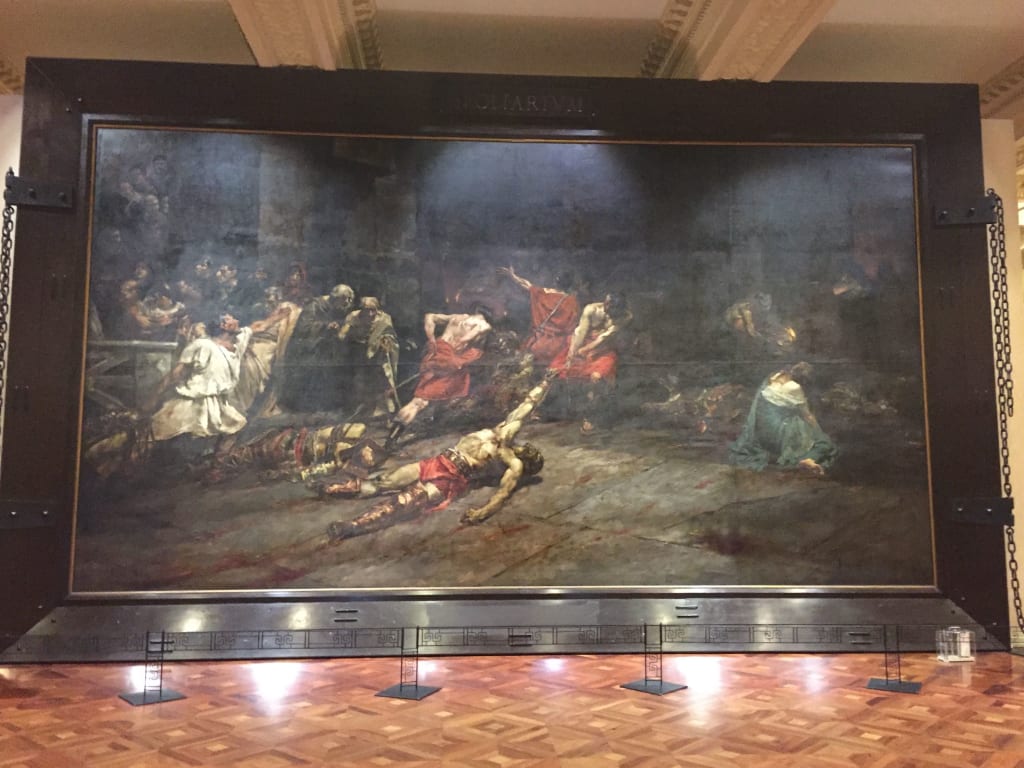
Juan Luna's "Spoliarium" is a renowned artwork that holds significant historical and cultural importance in the Philippines. Painted in 1884, it depicts a scene in the Roman Colosseum where fallen gladiators are being stripped of their armor and belongings. The painting is known for its grand scale, dramatic lighting, and meticulous attention to detail.
The story behind the creation of the "Spoliarium" is quite fascinating. Juan Luna, a Filipino artist, was studying in Europe at the time and was deeply affected by the social and political situation in the Philippines. He was particularly disturbed by the injustices and abuses under Spanish colonial rule.
Luna's decision to paint the "Spoliarium" was a direct response to the oppressive regime and the suffering of his fellow countrymen. He wanted to highlight the dark realities of the Filipino people and shed light on the brutalities of colonialism.
The painting was first exhibited at the Exposición Nacional de Bellas Artes in Madrid in 1884, where it garnered significant attention and acclaim. It won the first gold medal in the exhibition and brought international recognition to Luna and his talent.
The "Spoliarium" eventually found its way back to the Philippines and is now housed in the National Museum of Fine Arts in Manila. It is considered a national treasure and a symbol of Filipino resilience and resistance against oppression.
Overall, the story behind Juan Luna's "Spoliarium" is one of artistic expression, social commentary, and national pride. It stands as a powerful testament to the artist's passion for justice and his desire to bring attention to the struggles of his people.
Juan Luna's "Spoliarium" is a renowned artwork that holds significant historical and cultural importance in the Philippines. Painted in 1884, it depicts a scene in the Roman Colosseum where fallen gladiators are being stripped of their armor and belongings. The painting is known for its grand scale, dramatic lighting, and meticulous attention to detail.
The story behind the creation of the "Spoliarium" is quite fascinating. Juan Luna, a Filipino artist, was studying in Europe at the time and was deeply affected by the social and political situation in the Philippines. He was particularly disturbed by the injustices and abuses under Spanish colonial rule.
Luna's decision to paint the "Spoliarium" was a direct response to the oppressive regime and the suffering of his fellow countrymen. He wanted to highlight the dark realities of the Filipino people and shed light on the brutalities of colonialism.
The painting was first exhibited at the Exposición Nacional de Bellas Artes in Madrid in 1884, where it garnered significant attention and acclaim. It won the first gold medal in the exhibition and brought international recognition to Luna and his talent.
The "Spoliarium" eventually found its way back to the Philippines and is now housed in the National Museum of Fine Arts in Manila. It is considered a national treasure and a symbol of Filipino resilience and resistance against oppression.
Overall, the story behind Juan Luna's "Spoliarium" is one of artistic expression, social commentary, and national pride. It stands as a powerful testament to the artist's passion for justice and his desire to bring attention to the struggles of his people.
what is he inspired to make one
Juan Luna was inspired to create the "Spoliarium" based on his observations and experiences in Europe, as well as his deep concern for the social and political situation in the Philippines. While studying in Spain, Luna witnessed the injustices and abuses suffered by his fellow countrymen under Spanish colonial rule. He was deeply affected by the suffering and wanted to shed light on the dark realities of the Filipino people.
Additionally, Luna drew inspiration from his visits to the Roman Colosseum, where he observed the ruins and imagined the scenes that once took place there. The grandeur and historical significance of the Colosseum, combined with Luna's desire to portray the harsh realities of his own society, led him to create the "Spoliarium" as a powerful statement against oppression.
Luna's personal experiences, observations, and his desire to bring attention to the struggles of his people all played a role in inspiring him to create the monumental and impactful artwork that is the "Spoliarium."
About the Creator
ynawrites
As a ghostwriter, my purpose is to transform your ideas, visions, and stories into captivating written works. Talented | Imaginative | Versatile | Collaborative | Detail-Oriented.
Can the United States Leave NATO?
Can the United States Leave NATO? What It Would Take—and What It Would Mean The North Atlantic Treaty Organization, commonly known as NATO, has been one of the most powerful military alliances in modern history. Since its creation in 1949, the United States has been NATO’s strongest member—militarily, financially, and politically. But in recent years, debates have grown louder about whether the U.S. should remain in the alliance. This raises a serious question: how could the United States be removed from NATO—or leave it—and what would that mean for the world?
By Wings of Time 6 days ago in History



Comments
There are no comments for this story
Be the first to respond and start the conversation.