
Stories of Coincidences and Miraculous Survivals
Extraordinary True Events From Atomic Bomb Survivors to Titanic Predictions

Stories of Coincidences and Miraculous Survivals
# The Man Who Survived Two Atomic Bomb Attacks
In a historic act of war, the United States dropped the first atomic bomb on August 6, 1945, decimating the Japanese city of Hiroshima. Just three days later, another bomb was dropped on Nagasaki, killing nearly 990,000 people due to the explosions and subsequent radiation. However, it wasn’t until 2009 that the Japanese government revealed an extraordinary story: Tsutomu Yamaguchi, a Japanese citizen, had survived both attacks.
Yamaguchi, a resident of Nagasaki, had been in Hiroshima on August 6th for a business trip. While walking through the city, the detonation threw him into the sidewalk. Miraculously, despite his injuries and the chaos around him, Yamaguchi survived and returned to Nagasaki. Just three days later, on August 9th, he witnessed yet another atomic explosion—this time in his hometown. Astonishingly, Yamaguchi survived once more and lived until 2010, passing away at the age of 93.
# The Remarkable Story of the Jim Twins
The Jim twins’ story is one of the most extraordinary tales of coincidence. Born in 1940 and separated at birth, these twins were both adopted by families who, without any prior communication, named them James. For 37 years, neither twin knew the other existed until they reunited at the age of 39. What followed was a cascade of astonishing revelations.
Both men pursued careers in law enforcement and shared an interest in woodworking and mathematics. But the coincidences didn’t stop there. As reported by *People* magazine, both twins had married and divorced women named Linda and then remarried women named Betty. Even more surprisingly, each had a son named James Allen.
# The Prediction of the Titanic's Tragic End
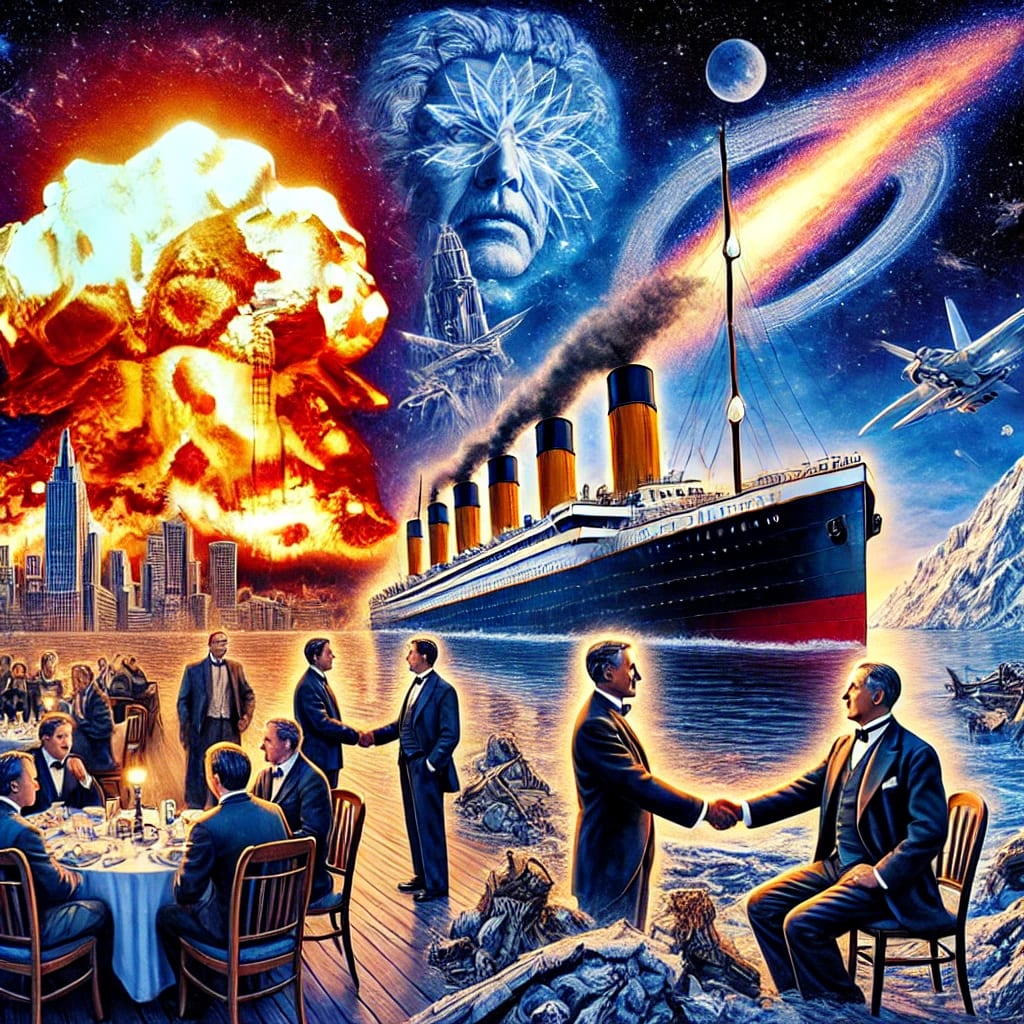
Morgan Robertson, a former U.S. Merchant Marine officer, penned a novel titled *Futility, or the Wreck of the Titan* in 1898. The story eerily predicted the sinking of a massive ocean liner, the SS Titan, during its maiden voyage after it collided with an iceberg. While the novel was fictional, the striking similarities between Robertson’s Titan and the real-life RMS Titanic, which sank 14 years later, are astonishing.
Both ships were deemed unsinkable, featured luxurious accommodations for wealthy passengers, and tragically lacked an adequate number of lifeboats. Some theorists suggest that Robertson's work was simply a reflection of the knowledge and assumptions of the time. However, the magnitude of these parallels remains difficult to ignore.
# The Doppelgänger of King Humbert I
King Humbert I of Italy encountered an eerie doppelgänger in 1900. While dining at a local restaurant in Monza, the King was struck by the remarkable resemblance between himself and the restaurant’s owner. As they conversed, the coincidences multiplied. Both men were born on March 14, 1844, in Turin, and both had married women named Margherita. Even more strangely, the restaurant's opening day coincided with King Humbert's coronation.
Unfortunately, the day after their meeting, on July 29, 1900, both men met tragic ends. King Humbert was assassinated by an Italian anarchist, and the restaurant owner also died in a separate incident. The story of these two men, bound by fate and coincidence, continues to intrigue historians and mystery lovers alike.
# Abraham Lincoln's Assassination: A Fateful Connection
In late 1863 or early 1864, Robert Lincoln, the eldest son of President Abraham Lincoln, faced a life-threatening situation at a train station in Jersey City, New Jersey. A moving train nearly trapped him between cars, but a compassionate bystander saved him from certain death. To Robert’s amazement, his rescuer turned out to be the famous actor Edwin Booth.
This encounter took on an even more dramatic significance when, just 16 months later, Booth's brother, John Wilkes Booth, assassinated Robert’s father, President Abraham Lincoln. The fateful connection between the two brothers and the Lincolns remains one of the most striking ironies of American history.
# The Extraordinary Life of Violet Jessop
Violet Jessop led a life that can only be described as remarkable. Born in 1887 in Bahia Blanca, she worked as a stewardess and nurse aboard three of the most famous ships of her time: the RMS Olympic, the RMS Titanic, and the hospital ship HMS Britannic. All three vessels suffered catastrophic incidents, yet Jessop managed to survive each one.
When the Titanic sank in 1912, Jessop escaped in Lifeboat 16. In 1916, she also survived the sinking of the Britannic after it struck a mine in the Aegean Sea. Additionally, Jessop was aboard the Olympic when it collided with the HMS Hawke in 1911, though no fatalities occurred. Her life remains a testament to survival against seemingly impossible odds.
# A Father and Son's Tragic Fate at the Hoover Dam
During the construction of the Hoover Dam on the Colorado River, 96 workers tragically lost their lives. One story, in particular, stands out as extraordinary. On December 20, 1921, a flood claimed the life of John Gregory Tierney, just as work on the dam was beginning. Fourteen years later, on December 20, 1935, Tierney’s son, Patrick William Tierney, died during a tragic accident at the dam’s construction site. The father and son, both lost on the same date, are forever linked to the construction of one of the world’s most iconic structures.
# Mark Twain's Connection to Halley's Comet
Halley's Comet, a celestial body that appears in Earth’s sky every 76 years, is connected to one of America’s most famous authors—Mark Twain. Born in 1835, just after the comet's appearance, Twain predicted he would die when it returned. In 1910, the comet reappeared, and Twain passed away on April 21, just one day after its closest approach to Earth. This eerie coincidence remains one of the many fascinating aspects of Twain's remarkable life.
# A Sandwich Break That Sparked World War I
In one of the most serendipitous moments in history, a sandwich break became the catalyst for World War I. After a failed assassination attempt on Archduke Franz Ferdinand, the would-be assassin, Gavrilo Princip, stopped at a Sarajevo café for a quick bite. Fate intervened when the Archduke’s car mistakenly drove down the street where Princip was eating. Seizing the opportunity, Princip fired the fatal shots that killed Ferdinand and his wife, Sophie, setting off the chain of events that ignited World War I.
About the Creator
Hottest in the Office
Dear Rafi, You’re very distracting to work around. For the first second I saw you the other day, I thought you were some type of executive. It took a moment to realize no, you were just the new guy, dressed up for the job he wants. Be still, my heart.
By Gabriel Shames4 days ago in Pride



Comments
There are no comments for this story
Be the first to respond and start the conversation.