
Stories from the Arabian Peninsula
Oman and the Early Bronze Age
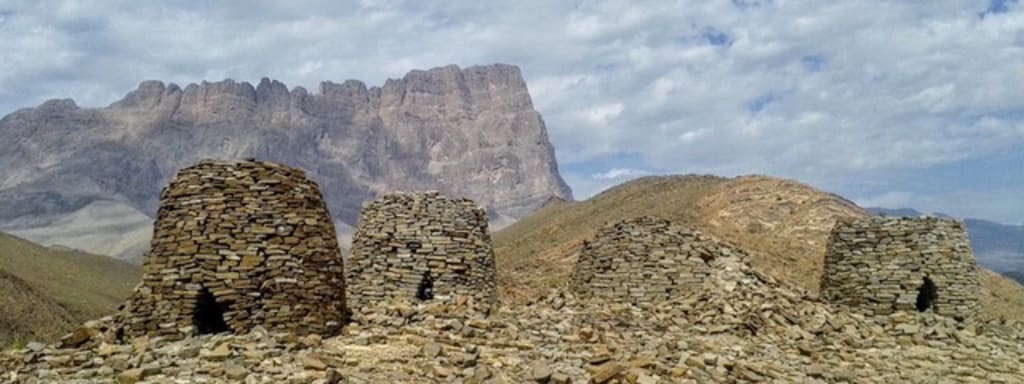
The archaeological UNESCO World Cultural Heritage Sites of Bat, al-Khutm and al-Ayn provide a unique insight into Early Bronze Age life and culture, offering evidence for the emergence and development of complex, hierarchical societies in the Arabian Peninsula. These sites showcase an incredibly well-preserved range of monuments, including a number of monumental towers, rural settlements, irrigation systems, and burial sites, all of which are testaments to the creativity and networks of the people who lived here during this time.
By bringing to light cultural relics in this state of preservation, these sites have become a key resource in understanding the past of southeastern Arabia, providing valuable insight into its diverse range of cultural contacts with other parts of the ancient world.
As more archaeological research is undertaken, knowledge about prehistoric and historic societies in this region has greatly expanded. Archaeologists in this region study sites ranging from large settlements to specialized ritual contexts, providing a more nuanced understanding of the region’s past. Also, local ministries of heritage are now more actively involved in the practice of archaeology, with many sites being brought to light through joint projects with foreign universities. This involvement has served to stimulate research in the region, allowing archaeologists to better understand the structure and development of human activity in this part of the Arabian Peninsula.
Surveys conducted in both the UAE and Oman have revealed evidence of human activity stretching from the early, Middle, and Late Stone Age (Mesolithic, Neolithic, and Chalcolithic periods) to the Iron Age, Islamic period (ca. 600-1600 onwards), and recent past. Notably, the region is an important link between other areas of the Arabian Peninsula and South Asia, with early settlements having appeared in the region from as early as the 1st millennium BC. Evidence of exchanges between these regions – including the spread of Iron Age technology, the migration of populations, and the migration of goods and ideas – allows archaeologists to reconstruct how people in the past conceptualized life beyond the local landscape. The rich array of material remains from areas such as Jebel Hafit in the UAE, Shabwa, Bat in Oman, and other sites provide insights into the daily life of early inhabitants in this region, as well as the supernatural world they constructed. Ceramic finds and other artefacts allow archaeologists to map out patterns of social behaviour, technological innovations, and interregional interactions. In addition, ongoing research aimed to investigate climate changes and their impacts on human activity in the region is strongly underway and has allowed archaeologists to track the evolution and transformation of past societies in southeastern Arabia. Overall, the rich cultural heritage of southeastern Arabia combined with its archaeological potential has made it an attractive destination for researchers seeking to uncover the history and culture of this intriguing region. By studying sites throughout the region, archaeologists are better able to understand the complexity of past human societies and their relationships to each other and the environment in which they lived.
The Early Bronze Age (3000-2000 BCE) was an important period of transition and transformation in many historically significant areas across the Near East, including southern Oman. This period saw the rise of early cities and villages in the form of the cities of Bat and Al Ayn in modern-day Oman. The earliest traces of human settlement during this period have been found at Bat and Al Ayn, suggesting these sites were long-standing cultural centres. At Bat, the earliest evidence of human habitation dates to c. 3500 BCE.
Bee Hive Tombs are a type of ancient burial monument, most commonly found in the Arabian Peninsula. They take the form of a beehive-like structure made of blocks of stone, with a small entrance at the base. It is thought that they were built around 5,000 years ago as a way to honour the dead. They often contain multiple burials and may have been associated with religious or social structures. Excavations here uncovered several important finds, including large fortifications and complex dwellings. Seven monumental stone towers have been discovered at Bat, one in al-Khutm, 2 km west of Bat. The towers feature a circular outer wall about 20-25 m in diameter, and two rows of parallel compartments on either side of a central well. The earliest known tower at Bat is the mud-brick Hafit-period structure underneath the Early Umm an-Nar stone tower at Matariya. The latest known tower is probably Kasr al-Rojoom, which can be ceramically dated to the Late Umm an-Nar period (ca. 2200-2000). All of the stone-built towers show dressed blocks of local limestone laid carefully with simple mud mortar. While conclusive evidence of their function is still missing, they seem to be platforms on which superstructures (now missing) were built – either houses, temples, or something else entirely.
The vast necropolis at Bat includes different clusters of monumental tombs that can be divided into two distinct groups. The first group is Hafit-period “beehive” tombs located on the top of the rocky slopes surrounding Bat, while the second group extends over a river terrace and includes more than a hundred dry-stone cairn tombs. Another important group of beehive tombs is located at Qubur Juhhal at al-Ayn, 22 km east-southeast of Bat. Most of these tombs are small, single-chambered, round tombs with dry masonry walls dating to the beginning of the 3rd millennium BCE. Others are more elaborate, bigger, multi-chambered tombs from the second half of the 3rdrd millennium BCE.
As in many other ancient civilizations, monuments in ancient Oman were usually built with regularly cut stones. Unique to Bat and al-Ayn are the remains of the ancient quarries from which the building materials were mined, and the many workshops that attest to the complete operational procedure, from the quarries to the stone masonry to the buildings' construction techniques.
The inhabitants of Bat were thought to be farmers and herders who lived in a highly regulated and structured society. Meanwhile, at Al Ayn, buildings date back to the Early Bronze Age and some suggest an urban form of society at the site. The earliest publicly dated pottery is attributable to the 3rd millennium BCE, but there are indications that some form of organized communities may have existed prior to that time. It is possible that inhabitants of this site were engaged in external trade and were also linked to other groups in the region.
Overall, the Early Bronze Age was an important period of cultural and economic connections between various sites and settlements in the region. The connections between Bat and Al Ayn suggest an ancient relationship between the two sites that may have provided each other with resources, facilitated trade and exchanged cultural ideas.
About the Creator
Elisabeth
For more than 25 years I have called home one of the most amazing places on Earth - The Sultanate of Oman. I have travelled all the corners, the mountains, the green valleys, the sand dunes and sea.
Time to share my experience and stories!
Savoy Hotel – Mussoorie: The Colonial Luxury Hotel Where an Unsolved Murder Still Walks the Corridors
The First Night: Beauty Wrapped in Silence Mussoorie looks peaceful from a distance. Pine trees sway gently, clouds roll like slow-moving waves, and the hill air smells of rain and old earth. But as evening falls, the silence becomes heavier—almost watchful.
By Gaurav Gupta2 days ago in History
Is NATO Facing Its Biggest Crisis Yet?
Is NATO Facing Its Biggest Crisis Yet? For more than seventy years, NATO has been one of the strongest military alliances in the world. Formed after World War II, it was designed to protect its members through collective defense. An attack on one was considered an attack on all. For decades, this principle helped maintain stability in Europe and beyond. But today, NATO is facing one of the most challenging moments in its history.
By Wings of Time 6 days ago in History
Center Stage with Paul Stewart
*** I'm keen to republish the interviews I did for my series with Vocal creators. It's been a few years and I thought it might be nice to revisit these wonderful conversations. I'll be releasing them one at a time for a few weeks/months.
By Heather Hubler3 days ago in Interview




Comments
There are no comments for this story
Be the first to respond and start the conversation.