
Spectral Sails: MV Derbyshire
Terrible Weather can be a Serious Problem!


I hope you guys are enjoying the Spectral Sails series as much as I'm enjoying writing it. Now, while the previous two stories in the series were ghost ships, this one is going to be very different.
This is the story of the MV Derbyshire.
Typhoon Orchid

Our story begins on September 1, 1980, with the formation of Typhoon Orchid. This was a tropical depression that moved Northwest for a while before dissipating four days later on September 5. It didn't dissipate all the way. Instead, it escalated until it reached the status of a tropical storm on the 6th of September.
Now, there's a difference between a tropical storm and a typhoon - a typhoon is stronger. Unfortunately, it wasn't long before that would change. The storm looped on itself with each loop making it stronger, how many times did the storm loop? How's about three times?
Yep, you read that right, the storm looped on itself three times - getting stronger each time. The status of the storm was upgraded to a typhoon on September 9, 1980 - reaching windspeeds of 95 miles per hour (152 km).
It travelled across the Pacific Ocean and into the Sea of Japan before making landfall on the Southwest of Japan on the 11th of September.
The Derbyshire's Final Voyage
The Derbyshire was a bulk carrier that carried cargos of oil and ore - this is going to be important in a bit.
Unfortunately, the Derbyshire had a very short service record. She went into service in 1976 as Liverpool Bridge - but was laid up for two years. It eventually launched in 1978 as the Derbyshire.
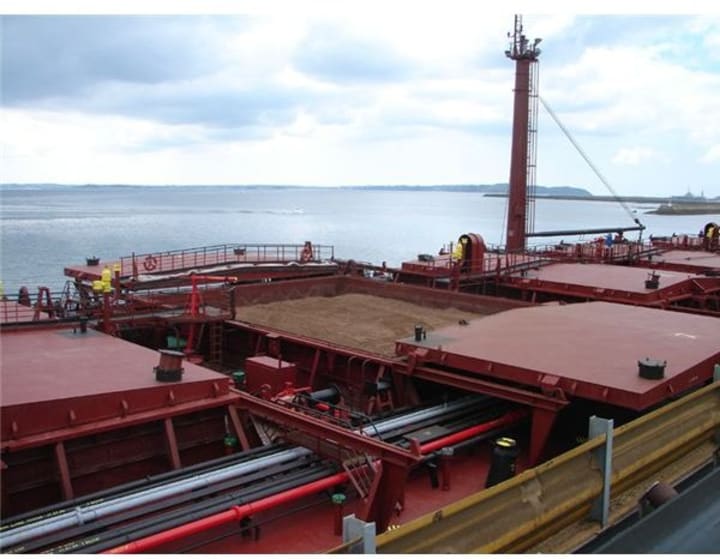
The Derbyshire left Quebec, Canada on July 11, 1980, headed for Kawasaki, Japan with crew of 44 people (42 crew, and 2 wives) and a cargo of 157 tonnes of iron ore - this is also going to be important shortly.
On September 9, 1980, the ship was overwhelmed by the storm, sinking 230 miles (370 km) from the coast of Okinawa. There were no survivors, and the ship never managed to get out a distress signal.
The search for the ship started on the 15th, but there was no sign of the ship, until six weeks later when a Japanese tanker spotted one of the ship's lifeboats. When the ship couldn't be found, it was declared lost at sea.
So...What Happened to the MV Derbyshire?
So...what exactly happened to the MV Derbyshire?
Well, it sank - obviously - but how did it sink, and why? To answer that question, we need to look at Typhoon Orchid again. Here's how I understand it, the ship was getting different readings. There were 3 different weather reports from Guam, the Philippines, and Japan/Okinawa, and each one was different. This led to some confusion as to which report was the right one.
The ship's captain, therefore, had to make an educated guess about what route to take to get out of the storm's path. Sadly, the ship ended up in the very jaws of Typhoon Orchid, with the winds driving waves over the bow of the vessel.
At one point, the ship quite literally broke apart.
Difficulty Getting to the Evidence
The investigation into the sinking of the MV Derbyshire only started in 1994 - 14 years after the initial sinking. The wreckage was found in June of 1994, 4 kilometres down and scattered over a distance of 1.3 kilometres on the sea floor.
The depth and condition of the ship's remnants made the investigation...difficult. Like I said, the ship had broken apart, so there wasn't much in terms of physical evidence. The bigger challenge was getting to it. The wreckage was 2.5 miles down. Why was that a problem? Well, it was too far for scuba divers to go down.
Divers have a very specific safe depth to which they can go; this is determined by certification and the equipment they're using. The deepest scuba dive on record that I could find is from 2014. A dude named Ahmed Gabr went into the Red Sea off the Egyptian coast and dove a whopping 332.35 meters - around 1100 feet.

Before Gabr, the record for deepest scuba dive was held by one Nuno Gomes, who made it down 318.3 meters or 1044 feet back in 2005.
The Derbyshire was 132oo ft. down, it was way too far. Gabr's dive took 14 hours and 15 minutes. 15 minutes to descend and 14 hours to return to the surface. Let me repeat that last bit: it took 14 hours, not minutes, HOURS to return to the surface. The reason it took that long is that he had to stop several times to avoid decompression sickness.
How did they get it? Well, the investigators used an ROV (Remote Operated Vehicle) to get hundreds of photos of the wreckage. The only part of the ship that was intact was the bow.
The Investigation
The investigation involved building a puzzle - literally. The team used a series of photographs to build a picture of the ship. Initial findings led investigators to conclude bad seamanship - one of the forward hatches (specifically the bosun’s hatch) was open, and it seemed that it hadn’t been secured properly, allowing the bosun’s hatch to fill with water and…well, sink the ship.
Obviously, that didn’t go over well with the families of the ship’s crew, but one crewman who hadn’t been on the Derbyshire’s last voyage, basically shot that idea down. He had taught the crew a specific methodology to secure the hatches, and there was just enough of the securing lines left to showcase that the hatch had indeed been properly secured. Of course, that meant the investigation was back at square one.
So, if it wasn’t bad seamanship, what was it? Well, remember how I mentioned that the only bit of the ship that was intact was the bow - specifically the spot where the bosun’s hatch was? Well, the investigators now had to come up with a new idea. They went off to the Maritime Research Institute Netherlands (MARIN).

The team at MARIN had a particularly useful wave tank that could be used to simulate the conditions of the Derbyshire’s final voyage. Basically, the team would take specific data, including wind speeds and temperatures and load that into a computer. The computer takes this info and uses it to replicate those conditions in the wave tank with a small model of the ship, allowing researchers to see what happened.
Initial results weren’t exactly promising. The team couldn’t get a result that would actually sink the ship. According to the simulation, the waves going across the deck would’ve been bad, but not catastrophic. So, they’re stumped, and then one of the guys is looking at the model and starts to wonder:
“What about the vents?”
It was a crazy theory, but if all hatches had been battened down, how did the water get into the hold? Well, the vents were an option - albeit an unlikely one. So, they put the same data into the computer and found that the water from the waves went into the hold via damaged vent caps.
Ordinarily, this wouldn’t have been an issue, but the Derbyshire had spent two days being hammered by Typhoon Orchid - this was more than enough time for the ship to fill with water and fall apart - courtesy of a serious structural problem.
Positive Changes as a Result of the Sinking

The Derbyshire's sinking, as tragic as it was, did have some positive changes to the maritime world, increased safety laws, and that sort of thing.
Watching the documentaries and reading the different articles about the Derbyshire was just painful. The maintenance issues that caused the lethal structural flaw were addressed, sure, but it wasn't before the sinkings of two ships - one of the Derbyshire's sister ships sank in 1986 - and the Derbyshire itself took 44 lives (42 crewmen and 2 of their wives).
*sigh* The MV Derbyshire's sinking NEVER should've happened. If the maintenance work had been done correctly, the ship's vent covers and hold doors may not have failed - that's not a guarantee, but it's a possibility. While I'm no expert, the MARIN investigation tells me that the ship might have also survived being in the storm - probably with some damage.
About the Creator
Greg Seebregts
I'm a South African writer, blogger and English tutor; I've published 1 novel and am working on publishing a 2nd. I also write reviews on whatever interests me. I have a YouTube Channel as well where I review books, and manga and so on.
Keep reading
More stories from Greg Seebregts and writers in History and other communities.
60 Seconds and Over the Top
Captain Montgomery was cold. It seemed to him that he was always cold. His boots were coated in a thick, cold mud. The air was cold on his face. The only time he wasn’t cold was when he was in the officer’s mess, sharing a bit of brandy with the other commanders. But the last drink they shared was weeks ago. Now half of those officers were over the top – lying in the muck and craters of no-man’s land, dead and left behind.
By Jonas Kraft7 days ago in History


Comments
There are no comments for this story
Be the first to respond and start the conversation.